Kyrgyzstan-China (XUAR) Business Forum and its takeaways
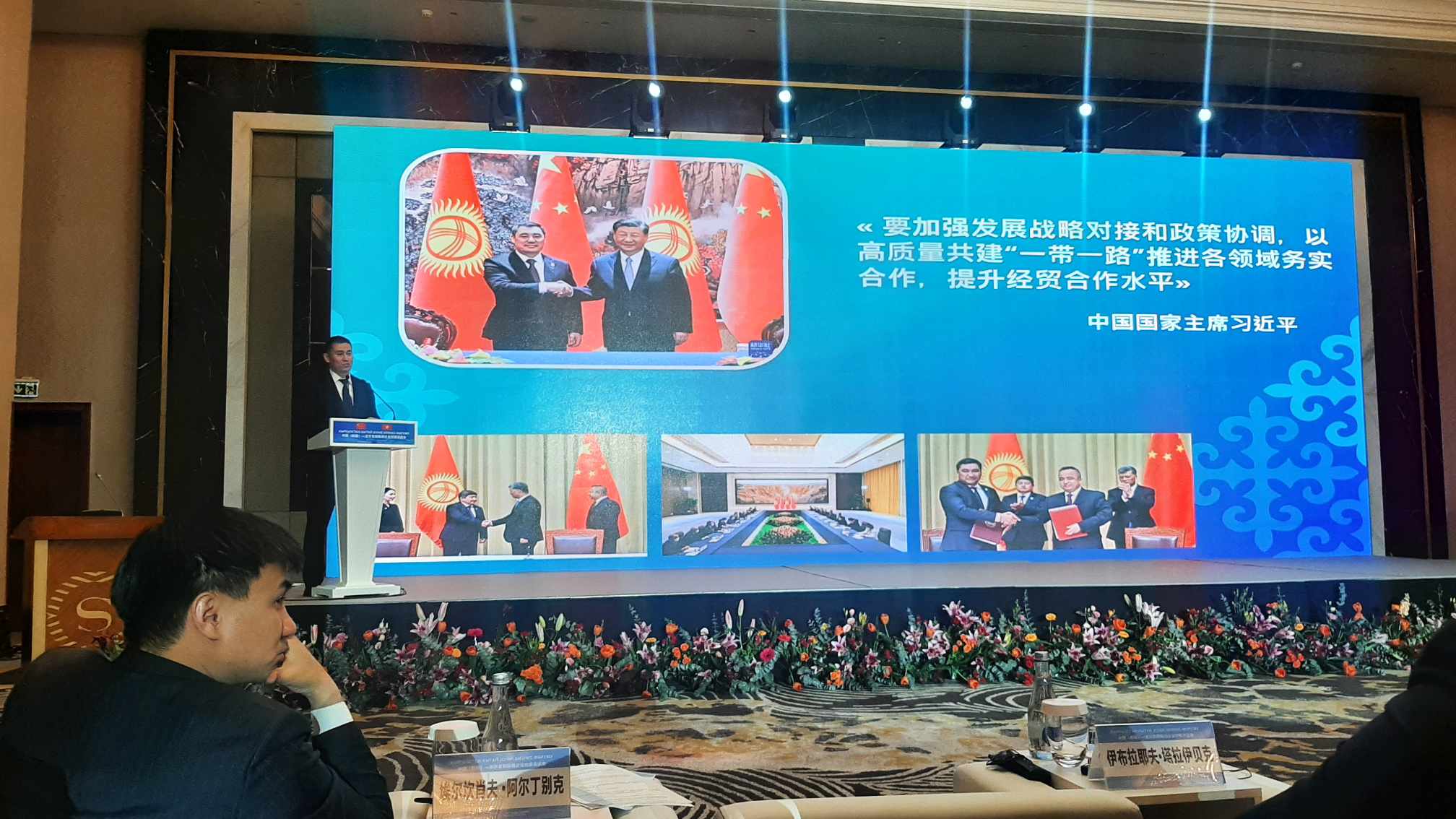
On April 2nd, the Kyrgyzstan-China (XUAR - Xinjiang-Uygur Autonomous Region) business forum was held in Bishkek, and with its results, agreements on the implementation of useful projects with a total amount of more than 1 billion US dollars were signed. With this, it became clear that Chinese companies are interested in small- medium projects when it comes to alternative energy resources.
At the beginning of the Forum, a short video about the investment opportunities in Kyrgyzstan was shown in Chinese language. During the Forum, Bakyt Turobaev, Deputy Chairman of the Cabinet of Ministers of the Kyrgyz Republic and he is also Minister of Water Management, Agriculture, and Processing Industry, spoke about attractive deposits for investment and opportunities for Kyrgyz-Chinese cooperation. Trade between Kyrgyzstan and China increased by 30% compared to last year. Foreign direct investment (FDI) from China increased by 27% in 2023. There are hectares of arable land for investment in agriculture in Kyrgyzstan. Currently, Kyrgyz-Chinese relations have risen to the highest strategic level, and this event (Forum) is proof of such relations. In his speech, he invited Chinese investors to pay more attention to the potential of green energy in Kyrgyzstan considering its nature and create more joint ventures between the two countries in this field. So far, only 10% of hydropower potential has been implemented. To support his views, he emphasized, that there are huge investment opportunities for solar, wind, and geothermal. For investment in small and medium-sized hydroelectric power plants, Kyrgyzstan has liberal laws to protect businesses and further develop its investment. Investors are protected by their earned capital and the operation of a liberal banking system within Kyrgyzstan and transactions with other countries. The Kyrgyz side said that it is ready for negotiations to switch to conducting mutual settlements partially in the Chinese currency – RMB (yuan) and that this step would lead to diversification of the financial system of the Kyrgyz economy as well. He also spoke about GSP+ in the frame of which Kyrgyzstan is entitled to export great varieties of goods to the EU without special tax, in favorable conditions.
After that, the Chairman of the People's Government of XUAR, Erkin Tuniyaz, briefly touched on the historical ties between Xinjiang and Central Asia within the framework of the Great Silk Road and the geographically convenient connection, made a brief presentation about the economic achievements of the Chinese government, as well as the global community of common destiny, and urged Kyrgyzstan to build a future society together and He invited to contribute to the development of Sino-Kyrgyz relations along with the wide use of business opportunities in the XUAR region.
According to the information of the main organizers of the forum - the National Investment Agency under the President of the Kyrgyz Republic and the China Council for the Development of International Trade: the following agreements and memorandums were signed in the total amount of 1 billion 151 million US dollars.
An investment agreement was signed between the Ministry of Energy of the Kyrgyz Republic and "Dachenglongyuan Energy Technology" LLC in the city of Xinjiang near the "Erkechtam-autodorozhny" checkpoint on the Kyrgyz-Chinese border of the Alai district (Osh region);
A memorandum was signed between the Ministry of Energy of the Kyrgyz Republic and "Dachenglongyuan Energy Technology" LLC in Xinjiang on the construction of a wind power plant in Erkestam region of Alai district (Osh region);
A memorandum on cooperation between the Ministry of Energy of the Kyrgyz Republic and the Chinese Tebian Electric Apparatus electric and photoelectric company on the capital repair of blocks #3 and #4 of the CHP was signed (Bishkek city);
An agreement was signed between the state enterprise "Kyrgyzkomur" and the company "Huasing Coal Industry Company" in the Shuichen district of the People's Republic of China and the subsidiary company "Umar Too Ken" LLC in the Kyrgyz Republic on the joint operation of the Tulek section of Kok-suusu - Kok - Yangak coal mine (Jalal-Abad region)
An agreement was signed between the state enterprise "Kyrgyzkomur" and the company Huaxing Coal Industrial Company in the Shuichen district of the People's Republic of China on joint activities on conducting joint geological exploration works in the "Tulek" section of the Kok-Yangak coal mine (Jalal-Abad region);
An agreement was signed between the state enterprise "Kyrgyzkomur" and the coal industry company "Huasing" in the Shuichen district of the People's Republic of China on the joint development of the Markai section of the Kok-Yangak coal mine (Jalal-Abad region);
Office of the Authorized Representative of the President of the Kyrgyz Republic (for Naryn region) and "Zhongtian Zhicontrol Technology Holding Co., Ltd. - (Zhongtian Zhicontrol Technology Holding. Co. Ltd.) signed a memorandum on the implementation of the drone assembly plant construction project.
Conclusions
Chinese state-backed corporations are expanding their operations in Central Asian countries, especially, Kyrgyzstan since it plays the role of gateway to the Central Asian market. At the same time Chinese side has been avoiding being a reason for tension between CA countries for instance, the Tajik government initiative to build Rogun, a hydroelectric power plant (HPP) in Tajikistan or Kambar-Ata HPP in Kyrgyzstan, which requires a long-term and very large investment, and secondly, there is a risk of causing problems in the future due to water shortage in the BA region. Therefore, relatively cheaper and less time-consuming projects are attractive to the current Chinese economy. Moreover, 15-25 years ago, China was mainly interested in gold extractive industry projects in Kyrgyzstan, but last few years, it seems that it has shown a great interest in investing in medium and small alternative (green) energy production projects that do not require large and long term financial investments and commitments. Also, the increase in the number of joint Kyrgyz-Chinese enterprises in the production of energy resources and the hiring of local people for middle-high ranking jobs is a relatively new trend in Kyrgyz-Chinese business relations. Basically, in China, many companies that are operating in a strategic field for the Chinese economy have always been under the control or support of the state apparatus. This ‘preferential treatment’ in turn, often provides considerable advantage in competition with foreign corporations during the global crisis.
Erkinbek Kamalov