Nowadays online scam and its varieties are becoming frequent headaches for not only state authorities and banks but also ordinary citizens of Central Asia and beyond. In today’s globalized realities, Central Asian scam criminal groups have been replicating from Southeast Asian scam industry. There are cases when Central Asians fall into traps of Southeast Asian scam compounds through human trafficking. On Global level, according to the UN authorities estimate more than 300000 people from 80 different countries have been affected and caught in Southeast Asia region. Amy Pope, IOM director general “They’re recruiting people who often speak English very well, who often have graduate degrees, some level of education,” FBI Chief also has named SEA as one of the places from where scammers are targeting citizens of developed nations There are cases when Central Asians become victims of online scams in Southeast Asia. For instance, an IT specialist from Kazakhstan fall into trap of online scammers in Myanmar.
Frequency and varieties of online scams in Central Asia countries
More than 6.5 billion Kazakh tenge has been returned to victims of online fraud in Kazakhstan since the beginning of the year, Minister of Internal Affairs Yerzhan Sadenov reported during a meeting with President Kassym-Jomart Tokayev, according to Akorda. According to the Ministry of Internal Affairs of the Republic of Tajikistan, more than 7,000 cases of fraud were recorded in 2023 alone—an increase of 20% compared to the previous year. Since the beginning of 2026, more than 69,000 cybercrimes have been registered in Uzbekistan. As a result of various fraudulent schemes, citizens have lost over 1 trillion Uzbek sum—a staggering sum that people have been deprived of due to the actions of cybercriminals.
Citizens of Kyrgyzstan lost 826 million soms as a result of internet fraud in 2025. Deputy Interior Minister Nurbek Abdiev said at a meeting of the Kyrgyz Parliament.
Online scammers are targeting every field by being ‘relevant’ and ‘creative’ in their activities
With acceleration of Digitalization process, especially after Covid-19, in online state services, online banking services as well as online shopping platforms had provided comfort for and created convenience in people’s live. In Kazakhstan, Kaspi system and in Kyrgyzstan Mbank system and other services provided platforms where people could use not only use online banking services but also pay their utilities expenses and do online shopping without visiting shopping malls physically. These and other online services significantly catalyzed the process of transitioning of majority from cash to cashless society. Additionally, on parallel level, people in Kyrgyzstan enjoyed using Tunduk State online service for receiving their certificates of marriage or housing ownership and other services digitally. As a result, number of Kyrgyz citizens using mobile internet has increased enormously However, all above-mentioned created a vast area for risks of cybersecurity including online scams. Furthermore, with introduction of generative AI, now local online scammers actively applying it in their criminal activities as well.
Online scammers in Central Asia have been persuasive by constant reinventing and innovating themselves. For instance, recent online scam type is sending video files with tricky and attractive comments “Is it you on this video? I am chocked…” (in local Central Asian languages, Kyrgyz, Uzbek Kazakh, Russian etc.,) via Telegram and Whats app channel by using this approach they are tapping intro users’ human psychological curiosity. Accordingly, there are many people who are falling into trap by opening that type of files since that files spread like viruses and/or provide access for outside (in this case, scammers) users to mobile phones, laptops, desktops of users where they have digital wallets, bank accounts which also jeopardize personal identity details. Moreover, local scammers are using every opportunity to make them relevant. For instance, if there is scheduled celebration of Teachers’ or Students’ Day or Doctors Day on calendar, they adjust their online scam tricks on that events accordingly. Subsequently, teachers or students or doctors are at risk becoming scammed by receiving or clicking dangerous online links.
What can be learned from SEA region?
The experience of Southeast Asian countries, particularly Cambodia, Myanmar, Laos and Thailand, demonstrates that online scams have evolved far beyond conventional cybercrime. They have become a complex transnational security challenge involving human trafficking, forced labour, financial fraud, money laundering, corruption and organized criminal networks. SEA region provides a unique case study for Central Asia to learn: how criminal organizations recruit individuals through fraudulent employment advertisements, transport them across borders, confiscate their identity documents and force them to participate in online fraud operations.
One particularly concerning aspect is that individuals recruited into these criminal operations are not necessarily professional criminals. Many are ordinary job seekers, migrant workers and young people looking for better economic opportunities. After arriving at scam compounds, they may experience confinement, threats, physical violence, psychological pressure and forced criminality. This distinction is important: people working inside scam compounds can simultaneously be victims of human trafficking and individuals forced to commit crimes against others. For Central Asian countries, including Kyrgyzstan, Kazakhstan, Uzbekistan, Tajikistan and Turkmenistan, the Southeast Asian experience offers important lessons. Although the geographical, political and economic circumstances differ, both regions face vulnerabilities associated with labour migration, unemployment, digital recruitment, cross-border criminal networks and insufficient public awareness. The central lesson is that online scams should not be treated exclusively as a cybersecurity issue. They require a comprehensive response involving law enforcement, migration authorities, financial institutions, civil society, international organizations and regional cooperation.
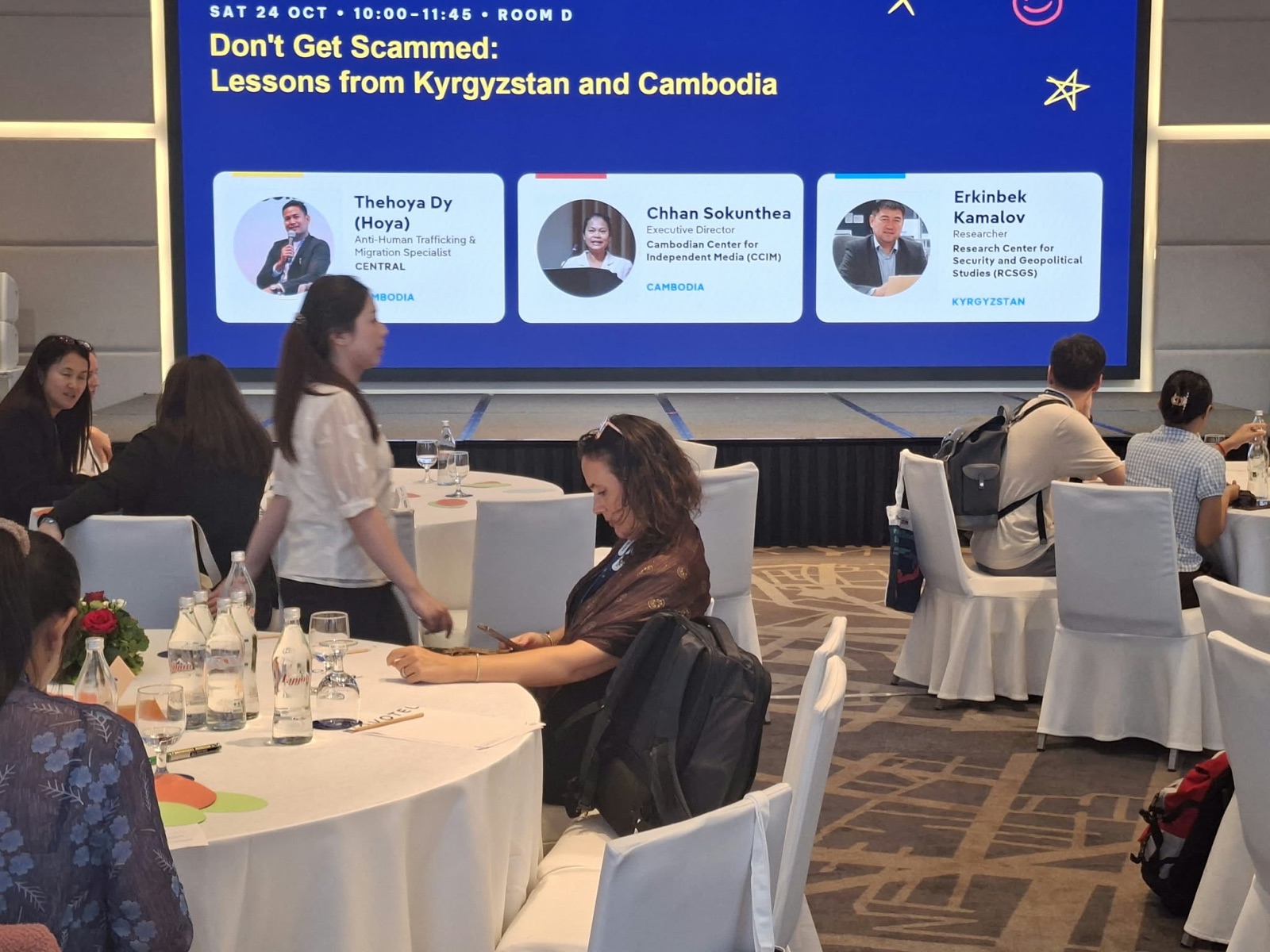
During International Conference of DW Academy Asia on Youth Meets Media held in Cambodia. Dy Thehoya, Head of the Anti-Human Trafficking and Migration Unit at the Center for Alliance of Labor and Human Rights identified the development of organized scam operations across the Mekong region, particularly Cambodia, Myanmar and Laos, with connections to Thailand and other neighboring nations. Dy highlights several important developments:
- Geographical expansion: Criminal networks have moved between countries and regions in response to law enforcement pressure, political instability and changing regulatory environments.
- Sophisticated recruitment: Criminal groups increasingly use Facebook, Telegram, TikTok, WhatsApp and other digital platforms to attract potential victims.
- Diversification of targets: Recruitment extends beyond traditional migrant workers to include young people, women, unemployed individuals and returning migrants.
- Forced criminality: Individuals recruited through fraudulent job advertisements may subsequently be forced to conduct romance scams, investment fraud, cryptocurrency fraud and other forms of online deception.
- Transnational financial operations: Criminal proceeds can move through bank accounts, money mules, cryptocurrency and informal financial networks.
Chhan Sokunthea, Media Development Director of the Cambodia Center for Independent Media also emphasized on importance of application a three-pillar approach:
- Prevention: Safe migration awareness, community training, public campaigns and information-sharing.
- Protection: Rescue, repatriation, reintegration and legal assistance for victims.
- Promotion of migrant workers' rights: Empowering migrant workers through leadership development, community networks and collective advocacy.
This approach illustrates that combating organized online scams requires not only criminal investigations but also preventive work and long-term victim rights and dignity protection.
Why the Southeast Asian Experience Matters for Central Asia
Central Asian countries are increasingly connected to international labour markets and digital economies. Millions of people from the region seek employment abroad, particularly in Russia, Kazakhstan, Turkey, South Korea, the Middle East and other destinations. This mobility creates economic opportunities but also exposes vulnerable individuals to fraudulent recruitment agencies, fake employment contracts, identity theft and trafficking networks.
There are several potential areas of concern.
First, fraudulent overseas employment. Job seekers may encounter social media advertisements promising high salaries, free accommodation, transportation and easy employment abroad. These offers can conceal recruitment into exploitative or criminal activities.
Second, the vulnerability of returning migrants. Migrants returning home because of unemployment, economic difficulties or changes in immigration policies may become attractive targets for fraudulent recruiters. The Cambodian presentation specifically identifies returning migrants as an increasingly important recruitment target.
Third, digital recruitment and social media. Criminal networks can use local languages, fabricated company profiles and targeted advertising to establish trust with potential victims.
Fourth, cross-border criminal cooperation. Criminal organizations can exploit differences in national legislation, limited information-sharing and weak coordination between law enforcement agencies.
Finally, the financial dimension. Online scams can undermine public confidence in banking systems, digital payments and emerging financial technologies.
For these reasons, Central Asian governments should examine Southeast Asia's experience not simply as a distant regional problem but as an early warning of how organized cyber-enabled trafficking networks can develop and expand.
What Can Central Asian Countries Learn from Southeast Asia?
The Cambodian experience offers at least seven important lessons for Central Asian policymakers.
Lesson 1. Treat online scams as a human trafficking and national security issue
One of the most important lessons is the need to connect cybersecurity policy with anti-human trafficking and migration policy. Traditional approaches to online fraud tend to focus on financial losses, digital security and the prosecution of perpetrators. However, the Cambodian experience demonstrates that organized scam operations can depend on trafficking victims who are forced to conduct fraudulent activities.
Central Asian governments should therefore:
- Integrate technology-facilitated human trafficking into national security strategies.
- Strengthen cooperation between cybercrime departments and specialized anti-trafficking units.
- Train police officers, prosecutors and judges to identify victims of forced criminality.
- Ensure that trafficked individuals are not automatically treated as criminal suspects.
- Establish mechanisms to identify victims in cooperation with embassies and international organizations.
Application to Central Asia: Kyrgyzstan, Uzbekistan and Tajikistan should strengthen the connection between their migration authorities, law enforcement agencies and cybercrime investigation units.
Lesson 2. Strengthen safe migration and recruitment monitoring
The Cambodian presentation demonstrates that fake employment advertisements are among the principal entry points into organized scam networks. Criminal recruiters exploit economic vulnerability and people's desire to obtain higher salaries abroad. They often use professional-looking social media accounts, attractive employment packages and fabricated company information. Central Asian countries can learn from Cambodia's community-based prevention model.
Recommended measures include:
- Establishing accessible databases of licensed recruitment agencies.
- Introducing effective monitoring of overseas employment advertisements.
- Strengthening legal responsibility for fraudulent recruitment.
- Providing pre-departure training for migrant workers.
- Creating public platforms where people can verify foreign employers and employment contracts.
- Conducting targeted awareness campaigns for young people and returning migrants.
For example, Kyrgyzstan could expand cooperation between its migration authorities, employment services, civil society organizations and local administrations to identify suspicious recruitment activities before individuals leave the country.
Lesson 3. Build stronger regional cooperation and intelligence-sharing mechanisms
The Southeast Asian experience illustrates how criminal networks move their operations between jurisdictions when authorities increase enforcement pressure. A crackdown in one country may displace criminal operations to neighbouring territories rather than eliminate them. This creates a serious policy challenge: national enforcement measures are insufficient when criminal networks operate transnationally. Central Asian countries should consider establishing a regional cooperation framework involving Kazakhstan, Kyrgyzstan, Tajikistan, Turkmenistan and Uzbekistan. Such cooperation could include:
- Regular information exchange on trafficking networks and fraudulent recruitment agencies.
- Joint investigations into transnational cybercrime.
- Cross-border mechanisms for identifying and rescuing trafficking victims.
- Cooperation between embassies and consular services.
- Shared databases of reported scam operations and suspicious recruiters.
- Regional training programmes for law enforcement and migration officials.
Existing regional mechanisms, including the Shanghai Cooperation Organisation (SCO), the Commonwealth of Independent States (CIS) and other international partnerships, could provide platforms for cooperation. However, regional cooperation should also involve practical coordination between national police agencies, financial intelligence units, prosecutors and civil society organizations.
Lesson 4. Strengthen the role of civil society organizations
One of the strongest aspects of the Cambodian presentation is its emphasis on civil society participation. CENTRAL's experience demonstrates that NGOs can perform important functions that government agencies may not always be able to deliver effectively, particularly in identifying vulnerable individuals, building trust with communities, supporting victims and documenting human rights violations. Central Asian governments should recognize NGOs as strategic partners rather than simply organizations responsible for implementing awareness campaigns. Their contribution could include:
- Community-based monitoring of fraudulent recruitment.
- Safe migration education.
- Legal and psychological assistance for victims.
- Support for families of missing or trafficked individuals.
- Independent documentation of trafficking cases.
- Advocacy for stronger victim-protection policies.
- Reintegration support for returning victims.
A particularly important lesson is the need to avoid victim-blaming. People who have been deceived into participating in online fraud should have access to protection and legal assessment.
Lesson 5. Address the economic and social roots of vulnerability
The Cambodian case shows that organized scam networks exploit economic insecurity, unemployment, debt and insufficient employment opportunities. The presentation identifies the economic difficulties of returning migrants as one of the factors contributing to recruitment vulnerability. This is particularly relevant to Central Asia, where labour migration remains an important source of household income. Preventive measures should therefore extend beyond law enforcement. Governments should:
- Develop employment programmes for returning migrants.
- Improve access to vocational training and professional retraining.
- Support entrepreneurship and small businesses.
- Expand employment opportunities in economically vulnerable regions.
- Provide financial literacy and digital literacy education.
- Develop accessible employment information services.
The objective should be to reduce the economic vulnerability that makes fraudulent job advertisements attractive in the first place.
Lesson 6. Strengthen financial intelligence and anti-money laundering measures
Online scam operations are not sustainable without mechanisms for transferring, concealing and laundering criminal proceeds. The Cambodian presentation highlights the involvement of bank accounts, money mules, cryptocurrency and informal financial networks.
Central Asian governments should strengthen cooperation between:
- Central banks and financial regulators.
- Financial intelligence units.
- Commercial banks and payment providers.
- Cybercrime investigators.
- International financial monitoring organizations.
Particular attention should be paid to suspicious transactions, fraudulent investment platforms, identity theft and the misuse of personal bank accounts. Public awareness campaigns should also explain the risks of allowing strangers to use personal bank accounts or digital wallets to receive and transfer money.
Lesson 7. Develop a victim-centred approach to rescue and reintegration
The Cambodian experience illustrates that rescuing victims is only the beginning of the protection process. People escaping scam compounds may face immigration penalties, documentation problems, limited embassy support, psychological trauma and the risk of being recruited again. Central Asian countries should establish comprehensive mechanisms for supporting citizens who become victims of trafficking abroad. These mechanisms should include:
- Emergency consular assistance.
- Legal support and interpretation.
- Cooperation with local shelters and international NGOs.
- Assistance with travel documents and repatriation.
- Psychological and medical support.
- Legal assessment of potential criminal liability.
- Employment and social reintegration programmes.
A victim-centred approach is essential to ensure that people feel safe reporting exploitation and cooperating with investigations.
The experience of Southeast Asian countries demonstrates that organized online scams are not simply a technological problem. They represent a convergence of cybercrime, human trafficking, forced labour, financial crime, corruption and transnational organized crime. The most important lesson for Central Asia is that governments should not wait until large-scale scam compounds emerge within their territories before developing comprehensive preventive policies. Central Asian countries have an opportunity to learn from Southeast Asia's experience and strengthen their institutional capacity before the problem becomes more deeply entrenched. This requires a shift from reactive law enforcement towards a comprehensive approach that combines prevention, protection, prosecution and regional cooperation. Equally important is recognizing the role of civil society organizations and local communities. Government institutions cannot address the problem independently, particularly when recruitment networks operate through social media and exploit people's economic vulnerabilities. Central Asia should learn from Southeast Asia not only how to combat organized online scams, but also how to prevent the emergence of criminal ecosystems that exploit vulnerable people and undermine regional security.