Summary
The war has changed shape. Neither side can move the front line in any way that decides the outcome, so both have shifted their main effort to destroying the other’s economy from the air and at sea. Russia is closing Ukraine’s sea exports by attacking merchant ships rather than ports. Ukraine is burning Russian refineries and airbases at ranges that now reach the Gulf of Finland.
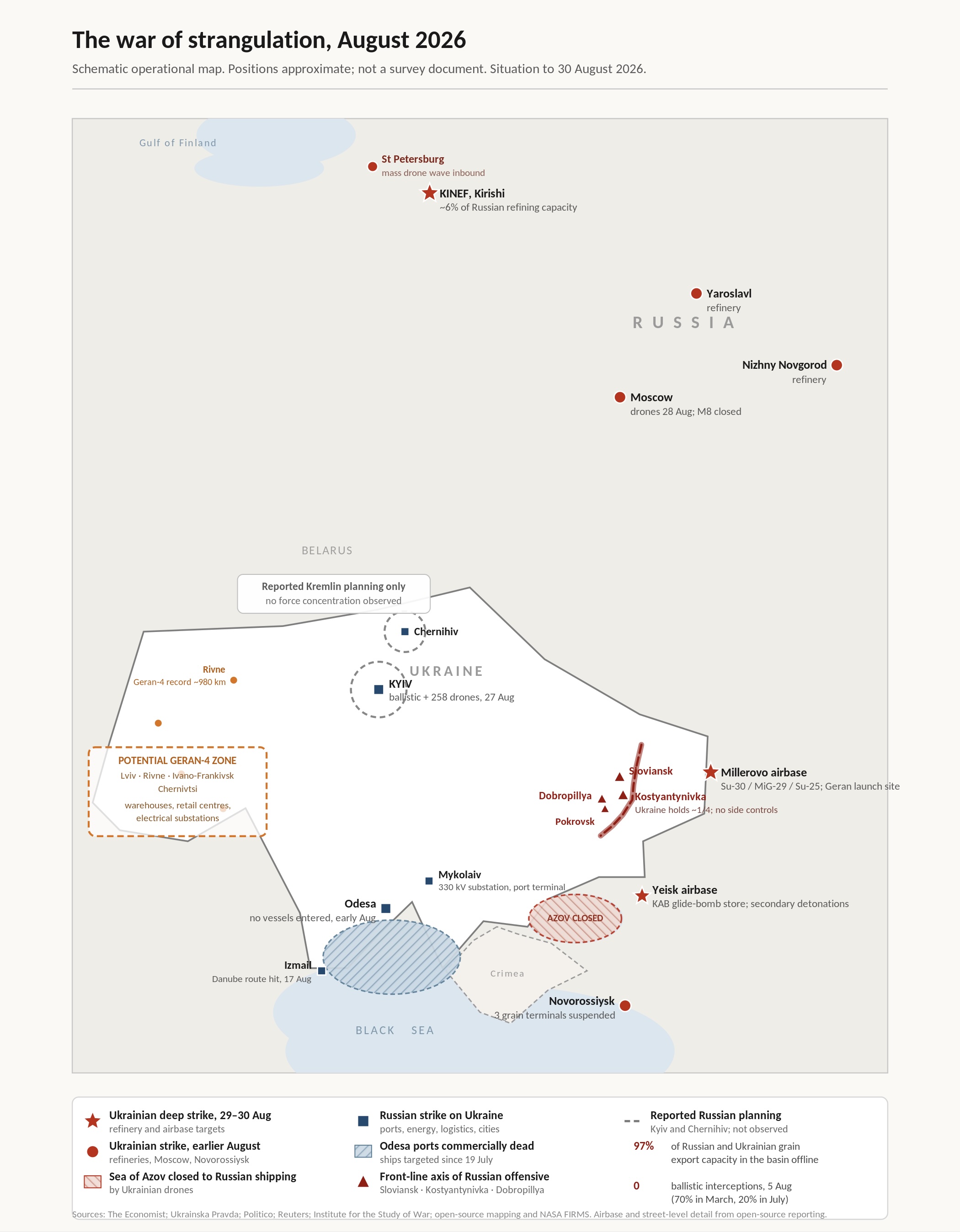
Two developments in the last forty-eight hours matter more than anything else in this report. Ukraine struck the KINEF refinery at Kirishi in Leningrad Oblast, which is one of the largest refineries in Russia, and it did so as part of a mass attack reaching towards St Petersburg. At the same time Ukraine disclosed intelligence that the Kremlin has ordered its military to prepare ground offensives against Kyiv and Chernihiv.
The two facts point in opposite directions, and holding both is the analytical problem of the moment. Ukraine is inflicting deeper damage on Russia than at any previous point in the war, while simultaneously warning that Russia is preparing to widen it.
A note on sources appears at the end, because the material for this period comes in three very different tiers and they should not be read alike.
The deep strike campaign
Overnight on 29 and 30 August Ukrainian long-range drones attacked the KINEF refinery at Kirishi in Leningrad Oblast and started a large fire. The plant processes around 20 million tonnes of crude a year, which is roughly 6 per cent of Russia’s total refining capacity, making it the most significant single refining target struck so far. Hundreds of drones were reported moving towards Leningrad Oblast and St Petersburg in the same wave, with Russian air defence engaging both there and in the regions the drones crossed.
Two airbases were hit in the same period. Satellite fire-detection data indicated a large fire at Millerovo in Rostov Oblast, which hosts Su-30, MiG-29 and Su-25 aircraft and serves as a launch point for Geran-2 and Gerbera drones. At Yeisk in Krasnodar Krai, home to Su-30SM and Su-34 aircraft, the strike appears to have hit a storage facility holding KAB glide bombs, with secondary detonations continuing for over an hour and multiple fires still growing.
Striking glide-bomb stocks is significant beyond the immediate damage, because KABs are the weapon doing most of the work against Ukrainian positions in Donetsk oblast, and they are cheap, plentiful and difficult to counter in flight.
This campaign has produced cumulative results. Strikes on refineries have taken out upwards of 30 per cent of Russia’s operating refining capacity. Petrol rationing at its peak affected 80 regions and continues in 18. Reuters has reported that Russian petrol output fell to about 70 per cent of domestic demand in late August after attacks forced the Perm, Nizhny Novgorod and Yaroslavl refineries offline. President Zelensky has said that Russia is importing petrol for the first time in its history while spending budget funds to support its oil companies.
These figures need care. Ukraine’s general staff claims 13.5 billion dollars of losses to Russian refining since August 2025, while an analyst at the Carnegie Endowment assesses the real immediate business losses at perhaps a tenth of that and says state revenue has barely been touched. Both sides inflate.
The volume of the air war has reversed
Figures for the twelve hours to 30 August illustrate a change that has happened quietly. The Ukrainian Air Force reported 130 Russian drones of the Geran and Gerbera families. The Russian Ministry of Defence claimed Ukraine had launched at least 494 mid to long-range drones.
Each figure comes from the opposing side and both should be treated as claims, but the direction is consistent with other reporting. Ukraine is now launching more drones than Russia on some nights. What Russia retains is the ballistic and hypersonic missile force, which is the category Ukraine can no longer intercept.
The Ukrainian Air Force has also stopped publishing its interception rates, which is consistent with the collapse described below.
The interceptor problem
The most consequential military fact of the summer is that Ukraine has almost exhausted its Patriot interceptors, the only weapons it holds that can engage Russian ballistic and hypersonic missiles.
The intercept rate against ballistic missiles was around 70 per cent in March, fell to 20 per cent in July, and on the night of 5 August there were no interceptions at all. Russia has responded by increasing missile production. In July it fired a record 198 ballistic and hypersonic missiles, most at the Kyiv region, and on 27 August it conducted an hours-long attack on Kyiv and other cities using ballistic missiles together with 258 drones, aimed at ports, industrial sites and the distribution centres of retail chains.
Ukraine has asked for at least 300 Patriot interceptors. Its allies do not have them either. The Pentagon fired close to two thirds of its pre-war Patriot stock during this year’s war with Iran, and rebuilding to pre-war levels is estimated to take until 2029. A PAC-3 MSE interceptor costs four to five million dollars while the drones it is used against can cost as little as a used car, and defenders normally fire two interceptors at each incoming missile.
President Zelensky acknowledged in a video address on Friday 28 August that Ukraine needs to significantly accelerate its own production of interceptors capable of downing Shahed-type drones. That is an admission that the Patriot supply problem will not be solved externally in the timeframe that matters.
The Black Sea and the grain trade
The turning point came in July, when Russia stopped attacking port infrastructure and began attacking ships. On 19 July cruise missiles sank a Turkish-owned cargo vessel leaving Chornomorsk and killed ten people. Since then every vessel entering or leaving Odesa has been targeted, and no vessels entered Odesa at all during the first weeks of August.
Russia has extended the campaign to the Danube. On 17 August it struck the Izmail district and damaged a Togo-flagged civilian ship, injuring four people. The Danube was Ukraine’s fallback route in 2022, so closing it removes the alternative as well as the main channel.
Ukraine has done the same in reverse. Its drones have effectively closed the Sea of Azov to Russian shipping, and in mid-August all three grain terminals at Novorossiysk, the largest wheat-exporting port in the world, suspended operations. More than 90 per cent of Russia’s grain export capacity in the basin is offline in the busiest weeks of the season.
Taken together, roughly 97 per cent of the combined Russian and Ukrainian grain export capacity in the Azov and Black Sea basin is now out of action.
The scale is global. In August 2025 the two countries exported 6.3 million tonnes of wheat between them, out of about 16 million tonnes traded worldwide that month. This August their combined exports may reach only about 2.5 million tonnes. Ukrainian grain exports fell around 75 per cent in the first two weeks of August year on year, and Kyiv has said port closures may halve its farm exports for the year, with 50 million tonnes of harvest still to move. Estimates in the trade press put the potential global supply gap at 30 to 40 million tonnes, though these are projections rather than observed outcomes.
The damage runs both ways. Fourth-class Russian wheat has fallen to about 12,000 roubles a tonne from 15,000 a year earlier, precisely because Russia cannot export it while world prices rise.
The battlefield
The Russian summer offensive is running on three axes, which are Sloviansk, Kostyantynivka and Dobropillya.
Kostyantynivka is the most advanced. Russian forces hold significant positions throughout all parts of the town. Ukrainian forces retain significant positions in only about a quarter of it, concentrated around Lomonosova Street and the adjacent residential blocks in the west, where the two sides overlap. The accurate description is that neither side controls the town, since most of it is a large contested zone, but the trend is against Ukraine. Fresh geolocations at the end of August led one detailed mapping analyst to adjust the western grey zone slightly in Ukraine’s favour, so the position there is not yet settled.
Sloviansk is being approached from the east and south-east after Russian attempts to take it from the north-east through Lyman failed earlier in the offensive. No confirmed advances were recorded in the last week of August.
Dobropillya is under increased artillery and glide-bomb attack, with large fires burning around Dobropillya and Bilozerske in the last twenty-four hours. Druzhkivka, in the same belt, is described by observers as reduced to a ghost town.
Elsewhere, Russian forces continued offensive operations in the Pokrovsk, Novopavlivka and Oleksandrivka directions in the last week of August without advancing. Ukrainian forces retook the small town of Novoselivka in the Lyman direction after a battle lasting about six months.
The wider picture is of Russia creeping forward at heavy cost while Ukraine gains ground locally, with neither achieving anything decisive. That is why both have moved their main effort into the air and the sea.
The warning about Kyiv and Chernihiv
On 29 August Pavlo Palisa, deputy head of the President’s Office, told reporters that Russian military chiefs have been tasked by the Kremlin’s political leadership with planning and preparing attacks on Kyiv and Chernihiv, based on intelligence Ukraine says it has received and verified.
The caveat he attached matters as much as the claim. Palisa said there is not yet evidence that Russian troops are gathering to carry out such attacks, and that Ukraine’s priority is to prevent the conditions in which any offensive becomes possible. This is therefore a report about planning, not about observed force concentration.
It should also be read against Russia’s manpower position. Western assessments reported in late August indicate that Russia is losing around 6,000 more troops each month than it recruits. The Wall Street Journal has reported that Russia is testing its capacity to mobilise further troops, and there is a growing exodus of Russians who expect a new mobilisation to be announced. Ukrainian and foreign intelligence have reported a Russian General Staff plan for an additional 600,000 mobilised across 2026 and 2027.
An offensive against Kyiv would require forces Russia does not currently have available, which is consistent with Palisa’s own caveat. The planning is credible; the capability is not yet demonstrated.
Ukraine’s exposure this winter
Russia has been striking civilian logistics deliberately. A warehouse supplying a Kyiv food retailer was hit on 19 July, two distribution hubs of a larger chain were struck two weeks later with six workers killed, and the private postal service much of the country depends on has been hit repeatedly. One businessman estimated three weeks of strikes cost Ukrainian companies around 500 million dollars.
The pattern continues. Recent Geran-4 jet-drone strikes in Mykolaiv oblast targeted the Trykhaty 330 kilovolt electrical substation, a marine transhipment terminal and a logistics warehouse, coordinated with Geran-2 drones, glide bombs, Banderol cruise missiles and Iskander-M ballistic missiles. Kyiv was struck again on 30 August, including a target in the Holosiivskyi district that caused a large fire.
Two capability points follow. The Geran-4 jet-drone has demonstrated a flight of approximately 980 kilometres to Rivne oblast, which is a new record and places western Ukraine within reach. Analysts expect attacks on Lviv, Chernivtsi, Rivne and Ivano-Frankivsk oblasts in the coming days, with logistics warehouses, large retail centres and electrical substations as likely targets. Western Ukraine has until now been the country’s rear area.
The economic exposure is concentrated in agriculture. A Ukrainian investment firm estimates the sea blockade will cost about 0.6 per cent of GDP this year. If the harvest cannot be sold, farmers are likely to skip winter sowing, and the head of the Ukrainian Agribusiness Club puts the resulting losses at 10 to 12 billion dollars, or around 5 per cent of GDP. President Zelensky disclosed on 22 August a 27 billion dollar shortfall in the defence budget. Ukraine says it holds sufficient gas reserves for the winter.
Ukraine’s political crisis
The military position is complicated by a political one. On 18 August Mykhailo Fedorov, dismissed as defence minister in July after a clash with senior generals, released a video challenging Zelensky to hold elections. Wartime elections are prohibited under martial law and Zelensky has described the idea as a tsunami for the country, with polling showing Ukrainians strongly opposed.
The following morning parliament confirmed his successor, General Yevhenii Khmara, by 312 votes to two. On the same day the anti-corruption agencies released material from two linked investigations into a scheme to launder bail money for a former justice minister facing charges. Iryna Mudra, a deputy head of the President’s Office, was charged and dismissed. An unpublished poll taken before these events put Zelensky at 21 per cent, former commander-in-chief Valery Zaluzhny at 18, Fedorov at 16 and Kyrylo Budanov at 8.
A debate has opened about the anti-corruption bodies themselves, with supporters describing them as a necessary check on a centralised presidency and critics, including some inside government, calling them a parallel government.
What the participants are saying
Kyrylo Budanov, now head of the President’s Office, said on 28 August that Russia categorically does not want to stop the war along the line of contact, that talks are limited mainly to prisoner exchanges, and that another large exchange will follow shortly. Asked whether Ukraine would still be fighting in winter, he said he was afraid so, adding that the war cannot be stopped now not because Ukraine does not want to but because it is unrealistic. He also said Ukraine must mobilise at least 30,000 people a month simply to hold what it has, that the new minister will not change that figure, and that the number of dissatisfied people will therefore not fall either.
President Zelensky said on 29 August that Russia is bombarding Kyiv with virtually nonstop attacks from jet-powered drones.
Donald Tusk, the Polish prime minister, said on 29 August after a briefing from the NATO Secretary General that escalation from Russia’s side is progressing, that Ukraine needs more air support, and that the next six months will be decisive and Poland and NATO must be prepared for various scenarios.
President Trump told Axios that he is not concerned at all about Russia attacking NATO members, and denied that the recent Ratcliffe visit to Moscow carried any warning, describing the meeting as routine.
The Russian Foreign Ministry said on 27 August that the United Kingdom and France are playing with fire by supplying Ukraine with technology capable of striking deep inside Russia, and threatened British military facilities both in Ukraine and abroad. Pyotr Tolstoy, a deputy chairman of the State Duma, argued on state television that Russia should bomb Ukrainian cities openly, after twenty-four hours notice, until the population is demoralised enough to surrender.
The diplomatic track, and a contradiction worth noting
John Ratcliffe, the CIA director, travelled to Moscow around 25 August and met the heads of the FSB and the foreign intelligence service. Three accounts of that meeting are now in circulation and they do not agree.
The New York Times, citing American officials, reported that he gave a pessimistic assessment of Russia’s position and urged genuine negotiations, but issued no threats about the consequences of continuing the war. Politico reported that he warned Russian officials not to escalate the conflict with America’s NATO allies. President Trump denied that any message was carried at all and called the visit routine.
These cannot all be correct, and the divergence is itself informative about how the administration is managing the file. Subsequent reporting indicates Ratcliffe raised the idea of a trilateral summit between Trump, Putin and Zelensky, and judged the FSB director a potentially constructive participant in restarting talks. Zelensky has been briefed and is reported willing. Putin has rejected the format before.
This channel runs in parallel with those maintained by the special envoys Steve Witkoff and Jared Kushner, who may travel to Kyiv and Moscow. Ukrainian officials remain sceptical and point to the intelligence on northern offensive planning as evidence that Moscow is not preparing to negotiate.
Separately, the European Union is expected to resume preparations from 1 September for opening negotiating clusters with Ukraine and Moldova.
Assessment
Four judgements follow from the material above.
The sea is the decisive theatre. Russia can close Ukraine’s exports and Ukraine cannot fully reciprocate, because Russia retains Baltic and Caspian alternatives while Ukraine has only the Danube, which is constrained by low water and is now itself under attack. Russia is therefore likely to continue regardless of what happens in diplomacy.
The interceptor shortage converts every other Ukrainian problem into a worse one. Without air defence, strikes on logistics, energy and ports cannot be prevented, only absorbed. The extension of Geran-4 range to nearly a thousand kilometres removes the western rear area as a place of relative safety, which affects both civilian morale and the storage of incoming Western supplies.
Ukraine’s deep-strike campaign is working, but on a slower clock than Russia’s. Burning 6 per cent of Russian refining capacity in a night is a real achievement and the airbase strikes reduce the glide-bomb and drone effort at source. The question is whether that accumulates faster than the damage to Ukraine’s exports and grid, and on the present evidence it does not.
The warning about Kyiv and Chernihiv should be treated seriously but read precisely. Ukraine reports Kremlin-directed planning, not force concentration, and Russia is currently losing more men each month than it recruits. The most likely reading is that Moscow is preparing options rather than executing a decision, and that disclosing the intelligence serves Kyiv’s argument for more air defence, which Tusk made explicitly the same weekend.
The scenario discussed quietly in Kyiv is that strikes on energy, water and sewage could force mass emigration. One businessman described a company meeting originally titled Autumn Actions being renamed Survive Till April.