1. What is happening in Yemen
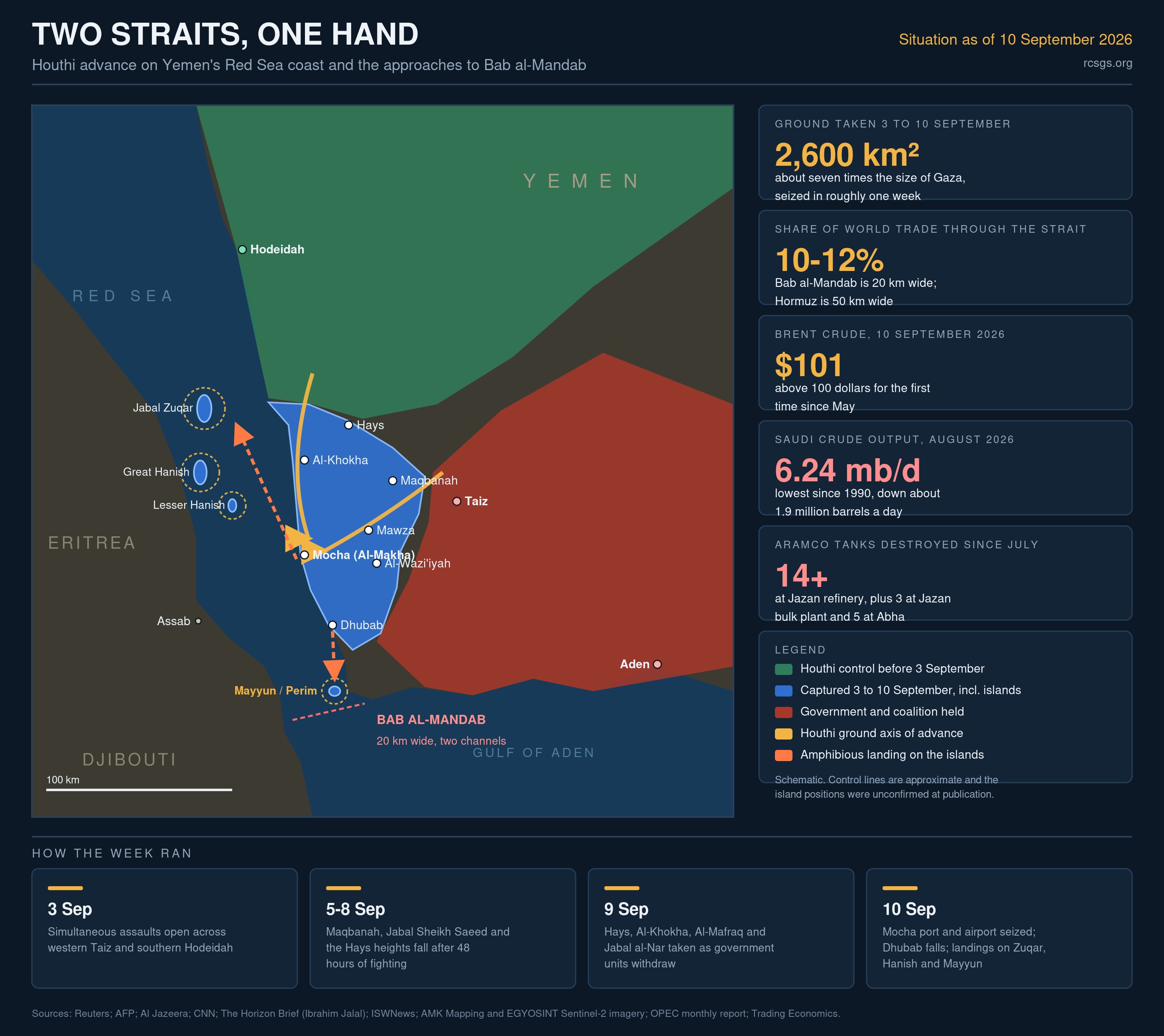
On the morning of 10 September 2026 the Houthi forces, who call themselves Ansar Allah, entered the port city of Mocha on Yemen’s Red Sea coast and took the port and the airport without a serious fight, because the Saudi backed government forces holding the city had already withdrawn during the night. Three Yemeni government sources confirmed the loss to Reuters, and the government itself said nothing for most of the day, which in this war is usually the clearest confirmation of all.
Mocha was not an ordinary town. It had been in the hands of the anti Houthi coalition since early 2017, it was the main military and logistical base of Tariq Saleh’s National Resistance Forces on the western coast, and before that it had served as a base for the United Arab Emirates. Losing it removes the last significant government anchor on the Red Sea, and it sits between sixty and seventy five kilometres north of the Bab al-Mandab strait.
The fall of Mocha was the end of a campaign that had run for a week rather than an isolated event. Since 3 September the Houthis have attacked along several connected fronts at once in western Taiz and southern Hodeidah, and within roughly twenty four hours at the end of that week they took a coastal belt of about 2,600 square kilometres, which is around seven times the size of the Gaza Strip. The towns that fell in sequence were Hays, Al-Khokha, Al-Mafraq, Jabal al-Nar, Mawza, Al-Wazi’iyah and finally Mocha itself, together with the Khalid ibn al-Walid military camp, and by the end of the day the coastal town of Dhubab had gone as well, which is the last settlement on the Yemeni shore before the strait.
Then the campaign went to sea. Houthi units carried out missile and rocket strikes followed by boat borne landings and took Jabal Zuqar island, and reports through the day placed further landings on the Hanish islands, both Greater and Lesser, and on Mayyun, which is better known as Perim and which sits inside the strait itself. Iranian state linked outlets claimed outright that Ansar Allah now controls Bab al-Mandab. That claim runs ahead of what has been confirmed, and the situation on the islands was still unsettled at the time of writing, but the direction is not in doubt.
At the same time the Houthis have been striking Saudi Arabia directly. Satellite imagery from Sentinel-2 confirms that four oil storage tanks were destroyed at Aramco’s Jazan refinery, with three more at the Jazan bulk plant and five at the Abha bulk plant, and at least fourteen tanks of various sizes have been destroyed at the Jazan refinery alone since July. Missile and drone attacks have reached Abha, Jazan, Khamis Mushait and Najran, wounding dozens of people and forcing the temporary shutdown of several energy facilities.
2. The battlefield, and how it moved so quickly
The campaign has a clear geographic logic and it was fought in a sequence rather than as a scattering of separate attacks.
The first move was inland, against the mountain belt west of Taiz, where Houthi forces attacked Maqbanah, Al-Kadaha and Jabal Habashi with heavy preparatory fire and drone support, and captured Jabal Sheikh Saeed and the remaining Qahban positions. The purpose of taking those heights was not the ground itself but the road, because whoever holds that belt controls the route between Taiz and the sea. The second move ran down the coast from the north, where Hays and Jabal Dubas were fought over for about forty eight hours before the defence broke, and once Hays fell the coastal road to Al-Khokha and then to Mocha lay open. The third move joined the two, running from Mawza and Al-Wazi’iyah in the interior down to the coast, which cut Mocha off from the inland positions that were supposed to support it.
What turned steady pressure into a collapse was not firepower alone. Government units withdrew from Al-Khokha, from Al-Mafraq and from Jabal al-Nar before the fighting was decided, and the same happened at Mocha in the early hours of 10 September, with footage showing government forces leaving before Houthi fighters arrived. In several places the line did not break under assault, it simply moved.
Two further points deserve recording because they explain the speed. The first is that the anti Houthi camp was already divided before the offensive began, since the Emirati policy of backing the Southern Transitional Council against Saudi aligned forces has left the coalition politically fragmented and operationally uncoordinated, so there was no single commander able to hold a line that ran across several different forces. The second is information warfare. During the offensive an audio recording appeared that was made to sound like Lieutenant General Tariq Saleh announcing a withdrawal, and it was amplified to an audience of around half a million people before the National Resistance denied it and said the recording had been fabricated. Whether or not that single recording changed any decision, its existence tells us that the Houthis are now fighting for the morale of the opposing side as deliberately as they fight for ground.
The government response has been real but late. The Giants Brigades and the Nation’s Shield forces have been sent into Taiz and southern Hodeidah, Major General Hamdi Shukri of the Fourth Military Region and Major General Abdulrahman al-Lahji of the Nation’s Shield have been moved to Mocha to run coastal operations, and government aircraft have struck Houthi targets from Hays down to Al-Kadaha. Saudi aircraft flew about forty strikes on Taiz, Hodeidah, Al-Jawf and Marib on 10 September according to Houthi sources, and the government has tried to relieve the pressure by opening new fronts of its own in Al-Jawf, Marib and Al-Bayda. None of this has yet stopped the movement on the coast. At least 917 families have been displaced from Maqbanah and Jabal Habashi alone.
3. How the Houthis fight, and what this success actually means
The Houthis do not fight the war their opponents keep preparing for. They combine four things, and the combination rather than any single element is what makes them difficult.
They use tempo. The offensive did not pause between objectives, and each captured position was used immediately as the starting line for the next attack, which never gave the defence the day or two it needed to organise a new line. They use layered fire, meaning artillery, rockets, drones and missiles used together against the same position, so that a defender who can handle one of these has to handle all of them at once. They use small boats, and the island landings show that a force with no navy at all can take islands from a coalition that has warships, provided it moves at night, moves quickly and picks targets that nobody has bothered to garrison properly. And they use politics as a weapon, through fabricated recordings, through announcements timed to arrive before the fighting is settled, and through offers such as the statement from Sanaa that navigation in the Red Sea is safe for everyone except Saudi shipping.
That last statement is worth reading closely, because it is the whole strategy in a single sentence. It tells the shipping industry that the Houthis are a reasonable authority that can be dealt with. It tells Riyadh that it alone will pay. And it quietly assumes something that no government has yet conceded, which is that the Houthis are now the party that decides who may pass.
The wider meaning of the past week is therefore not really about Mocha. It is that a movement which began as a highland insurgency in the far north of Yemen has become a coastal power with a hand on one of the world’s most important shipping routes, and it has done this while the state that has been fighting it for eleven years watches from the air. The Houthis have also shown that they can raise support well outside their own Zaydi Shia base, because the coastal population of Tihama is largely Sunni and the advance did not stall in hostile country. Some of that is coercion and some of it is the ordinary tribal arithmetic of a place where alliances follow whoever is winning, but the effect is the same.
4. How the pro-Saudi side is reacting
The response so far has three parts, and each of them has a visible weakness.
The first part is air power, and here the striking fact of the past week is how little of it there has been. Saudi Arabia holds one of the largest and most modern combat air fleets in the region, and yet government forces on the ground appear to have been fighting without reliable Saudi air cover and without American air cover, which does more damage to morale than to the order of battle. The wider problem is that air power did not defeat the Houthis between 2015 and 2022 either, and the reason was never the quality of the aircraft. What decides an air campaign is the joining together of intelligence, target selection, strike, damage assessment and coordination with the troops on the ground, and that has been the weak point of the Saudi effort from the beginning. The Houthis of 2026 are also a harder target than the Houthis of 2015, because they have far more combat experience and considerably better air defences, so sustained air operations against them now carry a real cost in aircraft and crews.
The second part is reinforcement, and the Giants Brigades and Nation’s Shield are genuine formations with real fighting records. The difficulty is that the anti Houthi camp is a coalition of forces that answer to different masters, since the National Resistance answers to Tariq Saleh, the southern forces answer to the Southern Transitional Council and through it to Abu Dhabi, and the Presidential Leadership Council has never truly commanded any of them. Reinforcement only produces recovery if these units can be made to operate as one force in one theatre, and that has not been demonstrated.
The third part is alliance building, and this is the newest element. Saudi Arabia, Pakistan and Türkiye finalised a mutual defence pact in August 2026, known as the Mecca Defence Alliance, and Pakistan has now warned Iran that continued Houthi attacks on Saudi territory could bring that pact into operation. This is a serious development on paper. In practice it is hard to see Islamabad or Ankara sending ground forces into Yemen, and the one power that did successfully mount an amphibious operation in this war, the United Arab Emirates when it retook Aden in 2015, is now estranged from Riyadh and is very unlikely to repeat it.
There is also a timing problem that has no good answer. Saudi Arabia will be tempted to launch a ground offensive to reverse the losses, but rebuilding Yemeni government forces into a force capable of that would take months, and during those months the Houthis in the south and the Iran aligned armed groups in Iraq to the north could do very serious damage to Saudi energy infrastructure. Saudi crude production last month fell to 6.238 million barrels a day, which is the lowest figure since 1990 and about 1.9 million barrels a day below recent levels. A country that is already producing less than it has at any point in thirty six years is not in a strong position to invite more strikes on its refineries.
5. What this means for the regional balance
The honest way to describe the past week is that the map of pressure in the Middle East has changed more than the map of Yemen.
Since the closure of the Strait of Hormuz to normal traffic earlier this year, Saudi Arabia has moved a large part of its crude exports to the Red Sea through the East-West pipeline to Yanbu, precisely in order to avoid the Gulf. That decision made commercial and military sense at the time. It also meant that the Red Sea route stopped being an alternative and became the main road, and the Houthi campaign of the past week has been aimed at exactly that road. If Bab al-Mandab comes under reliable Houthi control, then both of the exits from the Gulf region are subject to the same coalition, and the alternative that was created to escape the first chokepoint runs through the second.
The geography makes this worse than it sounds. The Strait of Hormuz is about fifty kilometres wide at its narrowest point, while Bab al-Mandab is about twenty kilometres wide and is divided into two channels by Perim island. A force holding the Yemeni shore and the islands does not need anti ship missiles to interfere with traffic, because ordinary artillery reaches across that distance. That is a fundamentally different kind of threat from missile and drone attacks, which can be intercepted, deterred and insured against. Artillery on a headland is a permanent condition rather than an incident.
For Iran the value of this is obvious and does not depend on any single ship being hit. Tehran is under severe economic pressure and is fighting a war it did not choose the timing of, and its ability to raise the cost of that war for others is now its main currency. Holding leverage over two chokepoints at once gives it something to trade in any negotiation with Washington, and it gives it that leverage without needing to use it. As Yemen’s ambassador to Qatar put it this week, a grip over these two points would be worth more to Iran than any nuclear arsenal, and while that is a partisan statement it is not a foolish one.
It would be wrong, however, to treat the Houthis as simply an Iranian instrument. They receive weapons, training and targeting help from the Islamic Revolutionary Guard Corps, and their leaders speak openly about the relationship, but they are also fighting their own war for control of Yemen and they have their own reasons for wanting the coast. The useful way to think about it is that Iranian and Houthi interests overlap almost completely at the moment, which makes the question of who is directing whom less important than it looks. What should worry planners is a further point, which is that the Houthis are a working model of what an armed movement can achieve without a state behind it, so even a serious weakening of Iran would not necessarily remove the pressure on the Red Sea.
6. What the Houthis actually want
Their immediate aim has been achieved, which was to take the whole Yemeni Red Sea coast and the approaches to the strait, and to cut Taiz off from the sea. Taiz is now supplied by a single remaining route.
The larger aim is recognition. Everything in the Houthi public position points in the same direction, from the foreign ministry statement in Sanaa saying that Yemen poses no threat and seeks relations based on mutual respect, to the offer to join a regional security arrangement and help protect maritime navigation alongside the other coastal states, to the notice that shipping is safe for everyone except Saudi vessels. These are the statements of a movement that wants to be treated as the government of Yemen and is using the shipping lane as the argument. Control of Bab al-Mandab is the strongest bargaining position any Yemeni actor has ever held, and it is not being collected in order to be given away.
The immediate question is whether they will now push further south towards Aden, which is the temporary seat of the internationally recognised government. Their own messaging has suggested they will stop at the old border between North and South Yemen and negotiate with the southern forces from a position of strength, and most experienced observers expect that, since taking Aden would unite the southern factions against them and turn a fast campaign into a long occupation. That expectation may hold. It is worth remembering, though, that a week ago the same reasoning said that Mocha would be defended.
7. Energy, shipping and the wider consequences
Between ten and twelve per cent of global trade passes through Bab al-Mandab in normal times, and the strait is the only sea route between the Mediterranean and the Indian Ocean that does not require the long passage around the Cape of Good Hope. The consequences of losing confidence in it fall into several layers.
The first is price. Brent was trading around 101 dollars a barrel on 10 September, having risen above 100 for the first time since May, and the market is already pricing in disruption at both chokepoints rather than one. Analysts at Goldman Sachs have identified more intense attacks in Hormuz and the Red Sea as the most likely cause of further increases and expect the disruption to run into 2027. The important point for European governments is that this is not a spike caused by a single incident, it is a structural change in the cost of moving energy, and structural changes do not reverse when the news cycle moves on.
The second is insurance and routing. War risk premiums for the southern Red Sea will rise again, and some owners will simply stop using the route, which adds roughly ten to fourteen days and a great deal of fuel to every voyage between Asia and Europe. That cost lands on European consumers through goods prices rather than through the oil price, and it lands on Egypt directly, since Suez Canal revenues have already been badly damaged by the attacks that began in 2023 and a further collapse would hit an economy that can afford it least.
The third is the exposure of Saudi Arabia itself. The whole point of the East-West pipeline and the Yanbu terminal was to give the kingdom an exit that did not depend on the Gulf. That exit now runs down a sea whose southern gate is held by the movement currently bombing its refineries, and the refineries themselves are being destroyed tank by tank. This is the reason Saudi production has fallen to a thirty six year low, and it is why Riyadh has no good options: acting decisively invites more strikes on energy infrastructure it cannot fully protect, while not acting concedes the coast.
The fourth is the effect on the countries that are usually forgotten in this discussion. Yemen imports the overwhelming majority of its food and fuel, and a war fought along its ports will produce a humanitarian emergency well beyond the 917 families already displaced this week. The Horn of Africa depends on the same lane. Djibouti, Eritrea and Somalia sit on the western side of a strait that is about to become a military frontier.
For the South Caucasus and for the wider region that this centre studies, there is a further consequence that is easy to miss. Every month that both maritime routes out of the Gulf remain unreliable strengthens the argument for overland corridors between Asia and Europe, which is the argument on which the Middle Corridor through Azerbaijan, Georgia and Türkiye rests. Trade does not move to a new route because the new route is cheaper, it moves because the old route stops being dependable, and that is precisely what is happening now.
8. What to watch next
The clearest indicator will be Perim, or Mayyun, because holding the island is what turns influence over the strait into control of it. Watch also for the appearance of radar sets, surveillance equipment and missile or drone launchers on the newly captured coast and on the islands, since that is the step that converts territory into the ability to strike shipping.
On the government side, the question is whether the Giants Brigades, the Nation’s Shield, the National Resistance and the Taiz Axis can be made to work as a single force under one command, and whether Saudi air power will be used properly or held back. Newly captured ground is at its weakest before it is entrenched and mined, so there is a window for a counterattack, and that window is measured in days rather than weeks.
Politically, the question is whether the Mecca Defence Alliance turns out to mean anything, and whether Washington chooses to act. And the question that matters most for the rest of the world is a simple one, which is whether the first ship is fired on from the shore rather than from the air, because that would be the moment when the southern Red Sea stops being a dangerous route and becomes a closed one.
Half measures have failed in Yemen for eleven years. The Houthis have understood that better than anyone else in this war, and last week they acted on it.