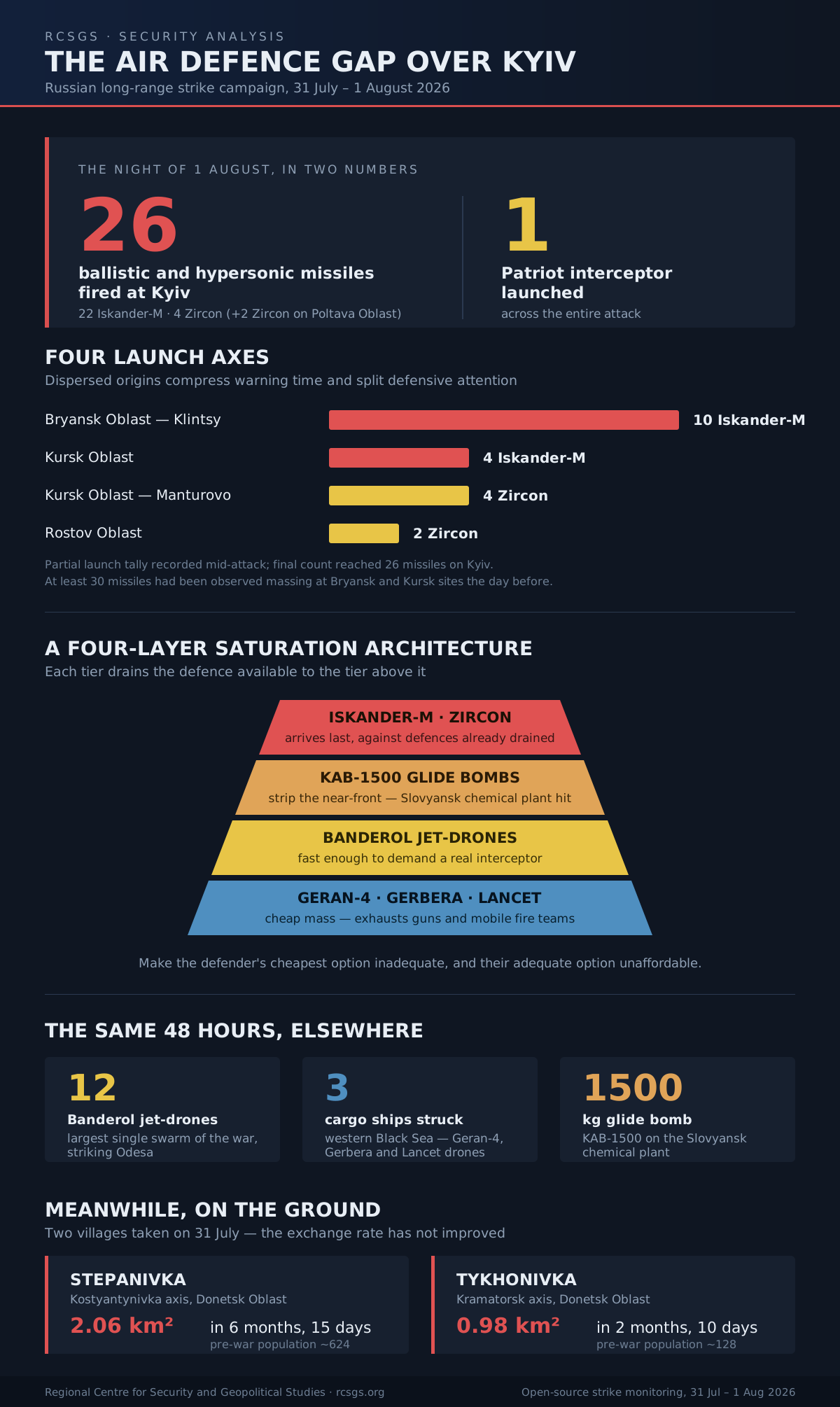
On the night of 1 August, Russia fired twenty-two Iskander-M ballistic missiles and four Zircon hypersonic cruise missiles at Kyiv. A further two Zircons struck targets in Poltava Oblast. Fires burned across several districts of the capital by morning.
The number that matters most, however, is not twenty-six. It is one. Across the entire attack — the full duration of the barrage, every inbound track, every district under threat — Ukrainian forces launched a single Patriot interceptor.
That figure, more than any battlefield map, describes the state of the war entering the second half of 2026.
A Telegraphed Strike That Could Not Be Stopped
The attack was not a surprise. A day earlier, open-source monitors tracking Russian launch infrastructure flagged an unusual accumulation: at least thirty Iskander-M ballistic missiles and Zircon hypersonic cruise missiles massing at launch sites in Bryansk and Kursk Oblasts. The warning was explicit, and it was correct.
When the strike came, it came from four separate axes. Ten Iskander-Ms launched from Klintsy in Bryansk Oblast. Four more from Kursk Oblast. Four Zircons from Manturovo, also in Kursk. Two Zircons from Rostov Oblast. The dispersal is deliberate: multiple launch points across a wide arc compress warning time, complicate track correlation, and force defenders to divide attention across simultaneous threat vectors rather than concentrating on a single corridor.
Footage from Kyiv showed impacts near the CHP-5 combined heat and power plant. The plant itself does not appear to have been the target; the strikes fell on an adjacent industrial zone. Whether that reflects targeting intent or targeting error, the effect on a city heading toward another winter is much the same — the message lands even when the missile does not.
The Interceptor Arithmetic
Ukraine’s Patriot batteries remain the only system in its inventory capable of engaging Iskander-M ballistic missiles with any consistency. Zircons, flying a depressed hypersonic profile, are harder still. Against twenty-six such weapons, a functioning layered defence would expect to expend dozens of interceptors — often two per inbound track, given single-shot kill probabilities against manoeuvring ballistic targets.
One was fired.
There are only a few explanations, and none of them are good. Either the batteries covering Kyiv were out of position or off-line; or the engagement was declined because interceptor stocks are being rationed for a narrower set of protected assets; or there were simply too few missiles in the tubes to attempt a meaningful defence. The rationing explanation is the most likely, and the most consequential. It implies that Ukrainian air defence planners have moved from defending a capital city to defending a shortlist within it.
This is the predictable end state of a supply problem that has been visible for two years. PAC-3 MSE production has expanded, but not at the rate Russia has expanded ballistic missile output, and certainly not at the rate required to absorb salvos of this size on a recurring basis. Every interceptor spent is one that must be replaced from a queue measured in months. Every interceptor withheld is a decision about which parts of a city are defended and which are not.
Saturation Across Every Layer
The Kyiv barrage did not occur in isolation. In the twenty-four hours preceding it, Russia executed what appears to be its largest single Banderol jet-drone attack of the war: at least twelve Banderol jet-drones striking Odesa in a coordinated swarm, starting large fires. Odesa Oblast absorbed dozens of additional drone strikes across the same day.
In the western Black Sea, Geran-4, Gerbera and Lancet drones struck three cargo vessels — an extension of the campaign against Ukraine’s maritime export corridor, and a reminder that the grain route survives on tolerance rather than protection.
At Slovyansk, a KAB-1500 glide bomb hit the city’s chemical plant. Slovyansk has come under progressively heavier glide-bomb attack in recent days, consistent with the pattern that has preceded Russian ground pushes elsewhere in Donetsk Oblast.
Read together, these are not four separate events. They are four layers of the same architecture. Cheap Gerbera decoys and Geran-4 loitering munitions saturate the low tier and exhaust gun and mobile-fire-team capacity. Banderol jet-drones occupy the middle, fast enough to demand a real interceptor. Glide bombs strip the near-front. Iskanders and Zircons finish at the top, arriving against defences that have already been drained by everything below them.
The design logic is straightforward: make the defender’s cheapest option inadequate and their adequate option unaffordable.
The Ground War Has Not Changed
None of this has produced a breakthrough. On 31 July, Russian forces captured Tykhonivka on the Kramatorsk axis — a village of roughly 128 pre-war residents covering 0.98 square kilometres. The fighting for it lasted two months and ten days. The same day brought the capture of Stepanivka on the Kostyantynivka axis: 624 pre-war residents, 2.06 square kilometres, six months and fifteen days of combat.
Six and a half months for two square kilometres. That is the exchange rate of the ground war, and it has not meaningfully improved for Russia despite the air campaign above it.
The asymmetry is the point. Russia is not converting deep strikes into territory. It is converting them into cumulative degradation — of the grid, of industry, of ports, and above all of Ukraine’s capacity to defend anything at all. That campaign does not need a front line to advance.
The Assessment
The single-interceptor response over Kyiv should be treated as a threshold event rather than an anomaly. It indicates that Ukraine’s ballistic missile defence has passed from constrained to selective, and that Russia can now assume a high leakage rate against the capital when it commits a salvo of two dozen or more.
If that assumption holds through the autumn, the operational consequences are predictable: larger salvos, more frequent hypersonic employment, and a targeting shift toward energy and industrial infrastructure ahead of winter. The corresponding requirement for Ukraine and its partners is equally clear, and it is not a new capability. It is interceptor volume, delivered faster than it is being expended.
That is a manufacturing problem before it is a military one — and manufacturing problems are not solved on the timeline of a barrage.