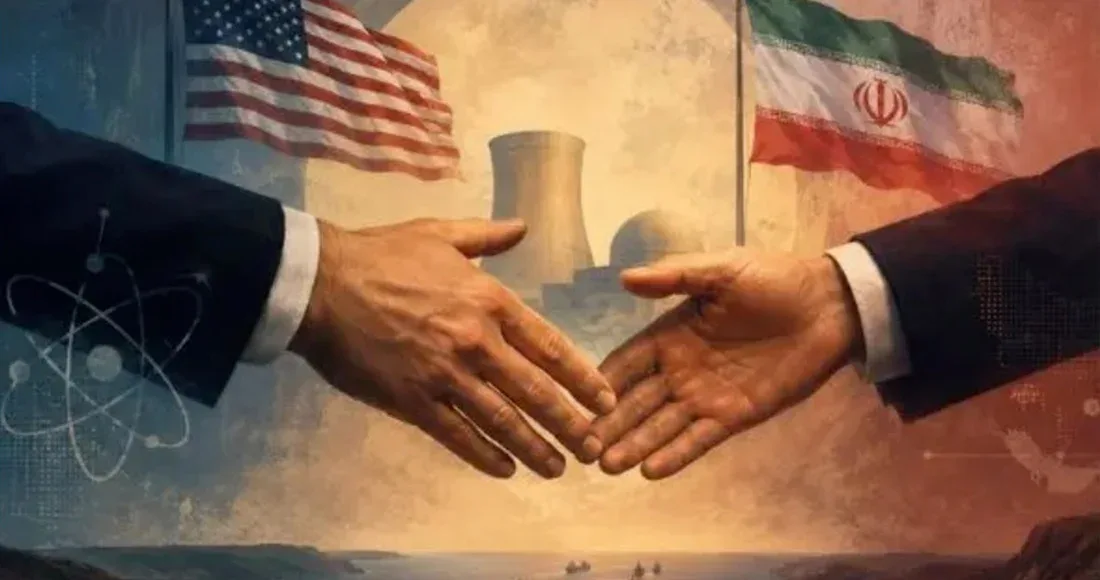
The final week of November 2026 produced neither a battle nor a breakthrough between the United States and Iran, yet it may prove more revealing than many weeks of open fighting. It showed the confrontation in its current form: a contest over endurance, conducted through ports, oil revenues, currency markets and household budgets rather than through air strikes. Washington, which announced in mid-November that it no longer needed a deal with Tehran, spent the week describing its blockade as a success and its adversary as close to collapse. Tehran insisted that its conditions had not changed, while its own president told the nation that the state had run out of money. The central question this raises is not whether the pressure is hurting Iran, which it plainly is, but whether hurting Iran is the same as moving it. This assessment argues that, for now, it is not. The blockade is succeeding as an instrument of damage, but it is not yet succeeding as an instrument of persuasion, because the way it is reshaping Iranian politics makes compromise harder rather than easier.
The American theory of victory
The United States now has a clearly stated theory of how this confrontation ends. Its core is that economic strangulation can deliver what military force could not: an Iranian commitment, on American terms, never to acquire a nuclear weapon. President Trump set out the mood on Thanksgiving, 26 November, telling troops that "we have victory at hand. It will happen whenever I want it to happen." Treasury Secretary Scott Bessent supplied the evidence, announcing new sanctions and claiming that Iran had "exhausted its floating oil stocks", the crude held at sea that had softened the first months of the blockade. "Iran's economy is underwater," he said, "and its leaders are panicking." Central Command reported that it had turned back 158 commercial vessels and disabled six blockade runners, one of them in the Gulf of Oman on the day Trump spoke.
The theory has real foundations. The blockade has removed the margin that sanctions alone never did. Earlier sanctions regimes leaked through ship-to-ship transfers, shadow fleets and discounted sales to Chinese refiners; a physical blockade closes most of those routes at once. CENTCOM's estimate that at least $25 billion of crude exports have been stopped, and Iranian economists' own calculation that land routes can carry only a fifth of what Iran once shipped to China by sea, describe a state that has lost most of its main source of foreign currency.
Yet the American position contains a revealing contradiction. A government confident that victory will come "whenever I want" does not usually reinforce its military posture at the same moment. Trump also said that "we sent an extra aircraft carrier there", accused Iran of "big mistakes", and named a target, the underground site known as Pickaxe Mountain near Natanz, that would be struck if fighting resumed. He added that he did not personally expect Iran to agree to a deal. These are the signals of a strategy that is unsure its economic instrument will be sufficient and is preparing a military fallback. There is also a timetable. Trump has said that war funding will last until roughly the end of January. Economic coercion is, by nature, slow; this one now operates against a political deadline about two months away.
Tehran's position: rigid in public, strained in private
Iran's public diplomacy during the week was strikingly consistent. Foreign ministry spokesman Esmaeil Baqaei described the blockade as "an act of military aggression", invoked the right of self-defence under Article 51 of the UN Charter, and promised to use "all available means" against it. In the same briefing he offered a conditional exit: Hormuz could reopen within two days if Washington ended hostilities, lifted the blockade and waived sanctions. Foreign Minister Abbas Araghchi, speaking on 26 November, kept the door ajar, saying that Qatari and Pakistani mediators were still exchanging ideas and that "paths can be opened", but insisting that "our main position has not changed". He has also described keeping Iran's highly enriched uranium inside the country as a red line.
This rigidity is not simply stubbornness. It reflects a calculation about how concessions are read. For the Iranian leadership, conceding while blockaded would confirm the American theory that pressure works, and would invite further demands on missiles, regional allies and the nuclear programme. The leadership's instinct, shaped by decades of sanctions, is that the price of an agreement rises the more visibly Iran needs one. It therefore has every incentive to conceal weakness at precisely the moment weakness is growing.
The military signals of the week fit that logic. Army chief Amir Hatami ordered tighter restrictions on passage through Hormuz on 23 November, and an MP on parliament's national security committee claimed that 14 tankers were being prepared to challenge the blockade. When Trump warned that such ships would be sunk, the story vanished from state media. The episode is a small but telling illustration of Iran's position: it can still threaten, but it is increasingly reluctant to test those threats against American firepower.
The sequencing trap
The most important feature of the current deadlock is that it is a dispute about order, not about content. Washington wants nuclear commitments first and will consider easing the blockade afterwards. Tehran wants the blockade lifted, frozen assets released and hostilities ended before it discusses the nuclear file. Both sides appear, in principle, to accept a final package that would include a reopened strait, an end to the blockade and some limits on enrichment. Neither will take the first step.
This is a classic commitment problem. Each side fears that whatever it concedes first will be pocketed while the other side's promised concession never arrives. The history of the past year deepens that fear. The draft understanding that briefly lifted the blockade in June collapsed within weeks, and the blockade was reimposed on 14 July. Trump has since dismissed the Islamabad memorandum as worthless. For Tehran, these episodes suggest that American concessions are reversible by a single post; for Washington, Iran's continued attacks on shipping suggest that Iranian restraint is equally reversible. Where trust is this low, the usual solution is simultaneity: concessions made in parallel, verified by a third party. That is precisely the role mediators exist to play, and it explains why the condition of Qatar's mediation matters so much.
Inside Iran: an economy turned into a front line
The most candid statement of the week came from Iran's president. In remarks on national television, widely reported on 28 November, Masoud Pezeshkian said: "We have no money," and described a "silent war that is far more difficult than one in which missiles are launched." It is rare for an Iranian head of government to speak so plainly, and the candour has a purpose. Pezeshkian is preparing the public for austerity, and he is staking a claim that the elected government, and not only the armed forces, is fighting the war.
Iran's economy under blockade
Prices are rising faster than the state can pay
Sources: Statistical Centre of Iran via Iran International (inflation, year on year); Iranian economists cited by Iran International (land routes 250–300k bpd vs. ~1.5m bpd formerly shipped to China). Bars scaled to the largest value.
The figures behind his words are severe. Consumer prices rose 88.7 per cent in the year to October and food prices 112.6 per cent. The rial fell to around 2.99 million to the dollar. The economist Saeed Leilaz called the blockade "the greatest economic shock in Iran's history" on state television. The government has cut subsidies on food, fuel and electricity, introduced rolling blackouts, reduced supplies of subsidised flour and bread in seven provinces, and delayed wages across the energy, manufacturing and construction sectors, and reportedly in parts of the security forces. Parliament's economic commission has warned of fuel and heating shortages in winter.
What matters analytically is not only the scale of the hardship but its distribution. Rationing, unpaid wages and inflation fall hardest on wage earners, pensioners and public employees, the groups whose acquiescence the state has long purchased with subsidies. Protests this month, by bakers in Zanjan, by retirees on 22 November and by oil workers after a fatal accident, have been about living costs rather than regime change, and the authorities have chosen to tolerate them. They remain far smaller than the January uprising, which was crushed with great loss of life. The immediate risk to the state is therefore not revolt but attrition: a slow loss of loyalty among the people it pays, including members of the security apparatus whose salaries are now being withheld. That is the vulnerability American strategists are counting on. It is also the one Iranian leaders have spent decades learning to manage.
Who governs in Tehran, and why it matters for a deal
The more consequential effect of the blockade may be on how Iran is governed. Mohsen Rezaei, the former IRGC commander who heads the secretariat of the Supreme National Security Council and whose standing has grown since Mojtaba Khamenei became Supreme Leader, has appointed conservative figures, many from the late President Raisi's administration, to oversee economic, energy and infrastructure affairs. These are not cabinet appointments and do not carry new constitutional authority. But their direction is unmistakable. As the economy becomes a theatre of war, the security establishment is extending its reach into areas that belong to the elected government.
This has direct consequences for diplomacy. Coercive strategies assume that pain will be felt by decision-makers and will push them toward concessions. In practice, pressure on authoritarian systems often does the reverse: it shifts power toward the institutions that control force and scarce resources, and those institutions tend to see compromise as a threat to their own position. Iran's internal debate already follows this line. Pezeshkian's government argues for adaptation and diplomacy. The hardline daily Kayhan has called the negotiations an "operation of deception" and urged attacks on oil facilities and US companies in the region. Parliament Speaker Mohammad Bagher Qalibaf, who leads the negotiating team, warned earlier this month that Iran "will not remain in a state of 'neither war nor peace'". When Bessent says that Iran's leaders are "panicking", he strengthens the faction in Tehran that argues restraint is being read as weakness.
The paradox is therefore sharp. The more successfully the blockade weakens the Iranian state, the more it empowers the actors inside that state who are least likely to sign the agreement the blockade is meant to produce. Economic pressure can create the need for a deal; it cannot, on its own, create a government willing and able to make one.
Qatar's mediation: a channel under strain
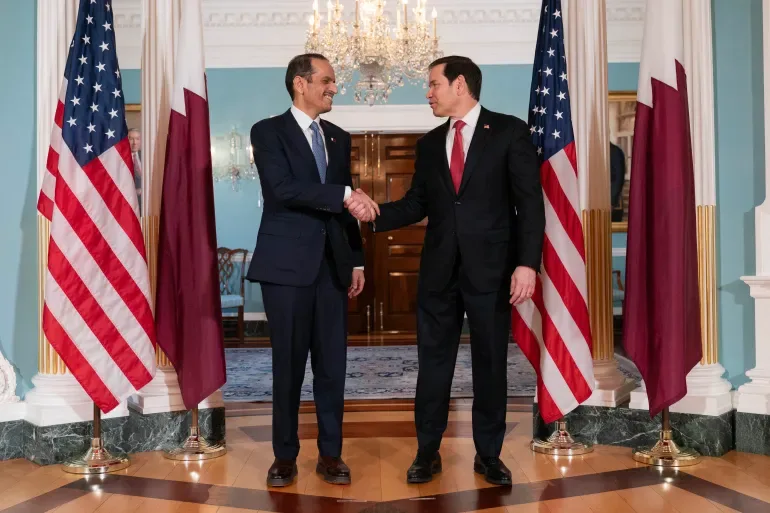
If the solution to a sequencing trap is a trusted intermediary, the events of the week show how fragile that intermediary has become. On 23 November Qatar's Prime Minister, Sheikh Mohammed bin Abdulrahman Al Thani, held talks in Washington with Secretary of State Marco Rubio and Vice President JD Vance during the annual US–Qatar Strategic Dialogue. The State Department thanked Doha for its mediation and reaffirmed its commitment to Qatar's security. The prime minister warned that "the situation cannot bear another escalation between America and Iran."
On the same day Tehran summoned Qatar's chargé d'affaires over a joint declaration that Emir Tamim bin Hamad Al Thani had signed in Berlin two days earlier. The text condemned Iranian attacks on Qatar and its neighbours as a "flagrant violation" of sovereignty, called on Iran to cooperate with the IAEA and end support for armed groups, and rejected any closure of Hormuz. Iran called the accusations "completely baseless and unacceptable". Qatar's spokesman, Majed Al Ansari, replied that Doha "will not accept any attacks on our country, whatever form they take", while confirming that both sides were still engaged in the mediation.
The exchange exposes a structural limit of Gulf mediation in this war. Qatar is not a neutral party in the way Oman or Switzerland can be. It hosts the largest American air base in the region and has itself been struck. It cannot remain silent about attacks on its own territory without losing credibility at home and with its Western partners, yet each public criticism of Iran costs it trust in Tehran. The drone attack in Kuwait on 26 November, which killed two Italian technicians, made the balance harder still. Iran denied involvement and offered a joint investigation, but Saudi Arabia blamed Tehran and Qatar warned that repeated attacks could undermine diplomacy. Araghchi's reference to Pakistan as a second channel is significant in this light. Tehran is preserving an alternative route in case Doha's usefulness declines, which suggests it expects the Qatari channel to come under further pressure.
Outlook: two clocks running
The confrontation is now governed by two clocks. The first measures Iran's capacity to endure: foreign currency reserves, the patience of unpaid workers, the loyalty of the security forces through a cold winter with fuel shortages. The second measures Washington's capacity to wait: war funding that runs to about the end of January, the tolerance of Gulf hosts whose territory keeps being struck, and oil markets that have so far absorbed the disruption because Iran's neighbours export under American protection. Each side believes the other's clock will run out first.
In our assessment, the most likely course over the next two months is a continuation of the siege, with mediators keeping the channel open but unable to solve the problem of who moves first. The most dangerous course is an Iranian attempt to break the blockade by force, which the strengthening of the security establishment makes more plausible than it was a month ago and which Trump has already said would be answered with strikes. An interim agreement remains possible, but only if mediators can design concessions that happen simultaneously, a partial reopening of Hormuz matched by a partial easing of the blockade, with the nuclear file deferred. A domestic rupture inside Iran is the least likely outcome in this period; the state has shown it can contain cost-of-living protests, even if it is losing the means to address their causes.
The lesson of this week is that economic coercion has two distinct tasks. The first is to impose costs, and the blockade is doing that with great efficiency. The second is to convert those costs into political decisions in the target state, and here the record is weaker. The pressure is falling on Iranian households while power flows toward the institutions most hostile to compromise. Unless Washington pairs pressure with a credible and simultaneous path out of it, the end of January may arrive with Iran poorer, its hardliners stronger, and both sides closer to the renewed war that each says it wants to avoid.