Executive summary
After eleven months of grinding attrition, the Russian Armed Forces have broken into Kostiantynivka, the southern anchor of Ukraine’s “fortress belt” in Donetsk Oblast, and are steadily overrunning the urban area. The breach is strategically significant for one reason above all: it is the first of the four fortress-belt cities to be seriously penetrated, and it opens the southern approach to the Sloviansk–Kramatorsk agglomeration — the last major bloc of Ukrainian-held urban terrain in the east and the backbone of Ukraine’s defence since 2014.
This assessment examines (i) how the battle developed and where it stands, (ii) the operational and strategic meaning of the city for each side, (iii) the wider campaign for the fortress belt and the two-pincer envelopment Russia is attempting, (iv) the structural vulnerabilities the battle has exposed in Ukraine’s drone-centric defence, (v) the interaction between the battlefield and the parallel diplomatic track, and (vi) four scenarios for the coming six to twelve months. The central judgment of this assessment is that the fall of Kostiantynivka would be tactically decisive but strategically incremental: it materially advances Russia’s Donbas campaign and strengthens Moscow’s negotiating claim over the whole of Donetsk, but it does not by itself collapse Ukraine’s front, and on present rates of advance the complete reduction of the fortress belt remains a multi-year undertaking rather than an imminent one.
Strategic context: how the battle developed
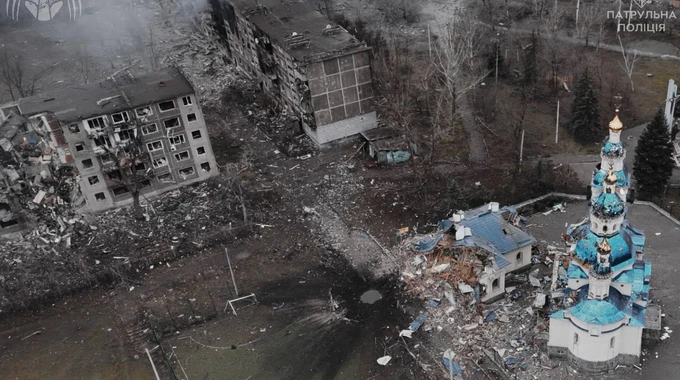
Russia designated the full seizure of Donetsk Oblast its principal war priority for 2026. Following the capture of Toretsk in August 2025, Kostiantynivka became the immediate operational objective on the southern axis. By 23 August Russian forces had taken the intermediate village of Kleban-Byk, and the first infiltration attempts into the city itself followed at the end of October 2025, with assault groups probing from the southeast. An estimated 4,800 residents remained by early November; that figure had fallen to roughly 2,500 by April 2026 as humanitarian teams evacuated civilians under constant drone presence.
Through the winter the Russian command prioritised the strangulation of the garrison’s logistics over frontal assault. In December 2025 its forces reached the T-0504 Bakhmut–Pokrovsk highway and began advancing toward the railway station; by February 2026 they had secured full control of the Kleban-Byk reservoir and struck the dam near Osykove, flooding low ground and rendering the Oleksiievo-Druzhkivka–Kostiantynivka road impassable. This methodical degradation of supply routes — roads, bridges and the canal line east of the city — rather than mass mechanised assault, has been the defining feature of the operation, supported throughout by small infiltrating assault groups, drone reconnaissance and a sustained battlefield air interdiction campaign.
The decisive shift came in spring. ISW assessed that Russia had likely begun its anticipated spring–summer 2026 offensive against the fortress belt in late March, developing from the north through the Lyman direction and from the south through the Kostiantynivka direction. By May the fortress had, in the words of Ukrainian field reporting, already been breached: exploiting weaker and recently formed Ukrainian units such as the 156th Mechanized Brigade, Russian infiltrating groups turned from a manageable set of fires into a tide that proved difficult to stop, streaming through the western half of the city toward the northern entrance. By mid-to-late June, Ukrainian commanders described their forces as being in semi-encirclement, factories had begun evacuating from Kramatorsk to the rear, and fighting had reached the central districts, the industrial zone and the zinc plant.
I.The contested city: value, control, and the limits of the claim
What Kostiantynivka is worth
The value of Kostiantynivka is positional rather than intrinsic. The city itself is destroyed and very nearly depopulated; its worth lies entirely in the door it opens. It forms the southern tip of the fortress belt — a roughly fifty-kilometre chain of four fortified cities (Sloviansk, Kramatorsk, Druzhkivka and Kostiantynivka) reinforced continuously since 2014 and connected by the H-20 highway that has served for years as the backbone of Ukraine’s defence in Donetsk. Its capture would furnish Russia with a forward bridgehead and staging area against the Sloviansk–Kramatorsk agglomeration, the principal remaining urban objective in the oblast. As one Ukrainian commander on the ground put it, the city is the gateway to the agglomeration, and its fall removes the southern keystone of the entire defensive arch.
The gap between claim and control
How much of the city Russia actually holds is genuinely uncertain, and the uncertainty is instructive. Russian milbloggers describe a near-complete capture — control of some eighty per cent of the city and a collapse of organised Ukrainian defence — with assault units already orienting toward Druzhkovka and Kramatorsk. The most cautious credible assessment, that of ISW, has consistently described a more granular picture: Russian infantry infiltrating individually at intervals of several hours, with an estimated one hundred to two hundred and fifty servicemembers operating inside the built-up area at the point of breakthrough. Critically, ISW noted that geolocated combat footage was dispersed across a wider area than such a force could physically hold, indicating that the footage was filmed over a period of time and warning explicitly against the maximalist “control” figures circulating in Russian outlets. Earlier in the battle, geolocations showed Russian and Ukrainian positions interspersed to the point where the front line could not be cleanly drawn; Ukrainian troops at one stage captured a Russian soldier near the central railway station, indicating continued Ukrainian presence in the centre even as Russian infiltration deepened.
The accurate characterisation as of late June is therefore a deep and consolidating penetration rather than a completed encirclement. The city is being lost; but the “cauldron” rhetoric runs ahead of the verified evidence, and the distinction matters for any judgment about what comes next.
II.Significance for Russia: the envelopment design
For Moscow the deeper operational logic is envelopment rather than frontal reduction. The stated intention, articulated openly by Russian analysts, is to repeat the approach used at Pokrovsk (Krasnoarmeysk) by attempting a deep envelopment of the entire Sloviansk–Kramatorsk agglomeration. That manoeuvre takes shape only once both anchors are secured — the southern anchor at Kostiantynivka and the northern anchor near Lyman (Krasny Liman). Kostiantynivka is thus one of two pincer arms, and a necessary but far from sufficient condition for the maximal Russian aim of controlling the whole of Donetsk Oblast.
The constraint on this design is force geometry. Independent assessments of the Russian order of battle suggest that of the formations engaged across the belt — elements of the 20th and 25th Combined Arms Armies in the Lyman direction and the 8th Combined Arms Army and 3rd Army Corps in the Kostiantynivka direction — only the 3rd Combined Arms Army has been positioned to drive directly on the agglomeration, and that force stalled after a month of tactically significant advances east of Sloviansk. ISW has assessed that attempting such an operation without mutually supportive flanking advances would likely inflict critically high casualties for disproportionately minimal gains. In other words, the capture of Kostiantynivka is a precondition the Russian command must satisfy precisely because a direct lunge at Sloviansk–Kramatorsk without secured flanks is not militarily viable. Beyond Kostiantynivka, Russian forces will almost certainly turn next to Druzhkivka, which sits in the same valley with an almost continuous residential corridor linking the two cities and which — being closer to the former front line — has been fortified less thoroughly than the cities deeper in the rear.
III.Significance for Ukraine: an anticipated loss with a structural warning
For Kyiv the loss is serious but was largely anticipated. Kostiantynivka functioned for nearly twelve years as a fortified logistics hub deliberately prepared for prolonged defence, and its role in the campaign has been one of planned attrition — trading time and Russian casualties for ground. The genuinely concerning feature for the Ukrainian command is not that the city is falling but the speed at which interior positions were lost, which by several accounts exceeded expectations and was enabled in part by the commitment of weaker, recently raised brigades to a sector that demanded experienced infantry.
The mechanism of the loss exposes a structural vulnerability likely to recur across the theatre. Ukrainian defence increasingly depends on drone strike capability to offset shortages of infantry and artillery ammunition. Yet the effectiveness of drone units is materially degraded in dense urban terrain, precisely where Russian infantry can shelter inside buildings to negate aerial observation, and where Russia has deliberately switched to dispersed single-soldier infiltration designed to overwhelm and distract a drone-based defence. The fortress-belt cities behind Kostiantynivka are larger and, in the cases of Sloviansk and Kramatorsk, better fortified; but the Druzhkivka–Kostiantynivka corridor offers exactly the kind of continuous urban terrain in which the Ukrainian drone advantage is least effective. Where Ukraine has retained the initiative is in deep strikes against the Russian rear — the Crimea and Kerch Strait ferry attacks, the refinery campaign, and a parallel battlefield air interdiction effort of its own against Russian artillery and logistics in the Sloviansk and Kostiantynivka directions — the asymmetric lever through which it imposes costs it cannot impose at the line of contact.
IV.The wider campaign: rates of advance and the multi-year problem
Placed against the arithmetic of the wider front, the fall of one fortress-belt city looks less like a breakthrough and more like the opening move of a campaign measured in years. Roughly nineteen per cent of Donetsk Oblast remained under Ukrainian control in spring 2026, and that sliver — anchored on the fortress belt — is the foundation of the eastern defence. The pace at which Russia is reducing it has slowed markedly. Where Russian forces captured an average of around fifteen square kilometres per day across 2025, in the first quarter of 2026 they advanced an average of roughly 5.5 square kilometres per day. On the basis of late-2025 rates, ISW assessed that Russia would finalise the seizure of the remainder of Donetsk Oblast only around August 2027 — and only on the assumption that it could sustain its rate of advance, which is itself in question given the strain on Russian manpower, the defence-industrial base and the recruitment system.
Two readings follow, and the honest analyst holds both. The fall of Kostiantynivka demonstrates that Russia can still penetrate even heavily fortified urban defences given sufficient time and casualties, bucking the broader trend of offensive stagnation along the rest of the line. But it does so slowly, at a cost, and against a belt whose remaining cities are individually larger and more defensible than anything Russia has taken since 2022. The capture of the southern anchor advances the timeline; it does not compress it into the weeks that maximalist commentary implies.
V.The battlefield as leverage: the parallel diplomatic track
The fate of the war is not being settled at Kostiantynivka so much as by the interaction of attrition rates with a parallel diplomatic process. Even as the battle peaked, European capitals and Kyiv were reported to be exploring the conditions for negotiations, while Moscow’s stated position holds that controlling the whole of Donbas and reaching a settlement with Ukraine are not mutually exclusive. Territorial facts such as Kostiantynivka therefore function principally as leverage: Russia is converting battlefield momentum into a maximalist negotiating claim over the entirety of Donetsk Oblast, and in particular into the demand that Ukraine cede the fortress belt without a fight — a demand whose attraction for Moscow lies precisely in the years of costly urban warfare it would otherwise require.
This frames the stakes of the city’s fall in their proper terms. The argument advanced by Ukrainian officials and a number of Western analysts is that surrendering the belt by negotiation would hand Russia, at the conference table, the operational prize it cannot reliably seize by force — and would open routes westward toward Kharkiv, Dnipro and Zaporizhzhia that the belt currently blocks. The counter-argument, implicit in Moscow’s diplomacy, is that the trajectory is now set and that formalising it would spare both sides further attrition. Which of these prevails is a political question that the battlefield informs but does not decide.
VI.Scenarios for the next six to twelve months
Drawing the strands together, four scenarios appear plausible. Probabilities are this analysis’s assessment and reflect the situation as of late June 2026; they are intended as structured judgment, not precision.
Scenario A — Sequential reduction continues (probability ~45%). Kostiantynivka falls fully over the summer; Russian forces consolidate and turn to Druzhkivka along the continuous urban corridor, making slow, costly creeping gains while the northern pincer grinds forward from Lyman. The fortress belt is progressively reduced but not collapsed within the year, consistent with the slowing rate of advance and ISW’s multi-year projection. This is the most likely near-term trajectory: it extrapolates the observed pattern without assuming either a Ukrainian breakdown or a Russian culmination.
Scenario B — Negotiated cession of the belt (probability ~20%). The parallel diplomatic track produces a settlement or freeze in which Ukraine cedes all or part of Donetsk, including the fortress belt, in exchange for broader guarantees. Russia secures by negotiation the prize it cannot cheaply take by force. The probability is conditional on factors external to the battlefield — the durability of Western support, domestic politics in Kyiv and Washington, and the credibility of any guarantee — and the city’s fall strengthens Moscow’s hand in exactly this scenario.
Scenario C — Ukrainian stabilisation behind the belt (probability ~20%). Having traded Kostiantynivka for time and Russian casualties, Ukraine stabilises on the stronger defences of Druzhkivka, Kramatorsk and Sloviansk, where fortification is deeper and the urban mass larger. Russia’s southern pincer culminates short of the agglomeration, its 3rd Combined Arms Army unable to drive directly on Sloviansk without secured flanks. The front in eastern Donetsk hardens into a slow-moving stalemate.
Scenario D — Accelerated collapse of the belt (probability ~15%). The loss of the southern anchor cascades: Druzhkivka’s thinner fortifications give way quickly, the drone-centric defence proves unable to hold the continuous urban corridor, and the agglomeration is placed under direct threat within the year. This is the maximalist Russian case. It cannot be excluded — the speed of the Kostiantynivka breach is a genuine warning — but it runs against the prevailing rate of advance, the demonstrated difficulty of taking large cities, and the strain on Russian capacity, and is therefore the least likely of the four.
Summary assessment
For Russia, the immediate outcome is the near-capture of the fortress belt’s southern anchor after eleven months of attrition; for Ukraine, it is the anticipated loss of a planned attrition position, though faster than expected. Strategically, the city gives Russia a bridgehead and the southern arm of a pincer against Sloviansk–Kramatorsk, while for Ukraine it represents time and Russian casualties traded for ground, with the belt still largely intact behind it. The principal constraint on Russia is force geometry — only the stalled 3rd Combined Arms Army is positioned to drive on the agglomeration, and gains come at high cost — while Ukraine’s principal constraint is the degradation of its drone advantage in continuous urban terrain, compounded by manpower and unit-quality strain. In wider terms, the battle furnishes Moscow with leverage for a maximalist claim over all of Donetsk and a possible negotiated cession of the belt, while Ukraine increasingly relies on deep strikes to impose asymmetric costs in the Russian rear.
Conclusion: a hinge, not yet a turning point
The breach of Kostiantynivka is the most significant development on the eastern front since the fall of Toretsk, and it would be a mistake to minimise it: for the first time, one of the four fortress-belt cities has been seriously penetrated, and the southern approach to the heart of free Donetsk is now open. It conforms to the established pattern of Bakhmut and Pokrovsk — a protracted, costly Russian effort yielding a destroyed city whose principal value is access to the next defended position.
Yet whether this proves a genuine turning point depends on variables not visible in the battle itself: whether Ukrainian manpower and the deeper fortifications of Druzhkivka, Kramatorsk and Sloviansk hold through the summer; whether Western materiel and political support are sustained; and whether the diplomatic track converts battlefield momentum into a negotiated cession. If the belt holds, Kostiantynivka is one more expensive Russian gain in a war of diminishing marginal returns, consistent with a timeline that ISW measures in years rather than months. If it cracks, this will be remembered as the hinge that opened Donetsk. Both readings are presently defensible; confident assertion in either direction reflects the maximalism of the sources rather than the weight of the evidence. The accurate judgment, for now, is that Russia has won the southern keystone of the fortress belt — and that the belt itself, and the war it anchors, remains to be decided.