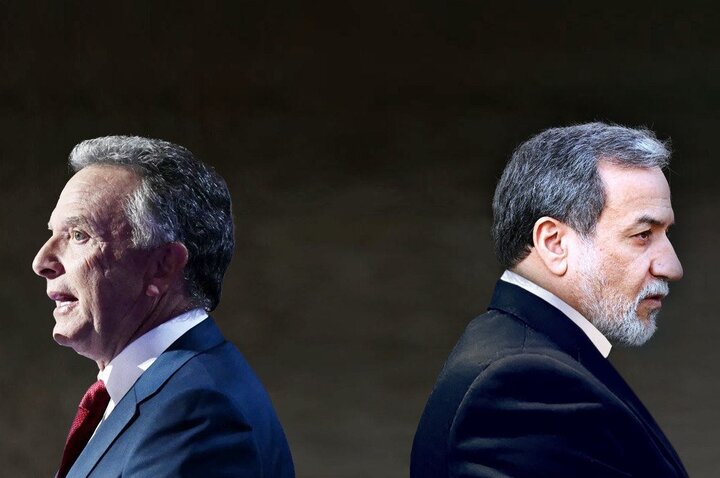
The week of 2 to 9 August was the quietest of the war and, for that reason, the most consequential. no American strike inside Iran was confirmed on any night of it, the first sustained pause since the June truce collapsed, and into that silence stepped something the conflict has not produced in five and a half months: an actual text. Iran and Oman agreed on the coordinates of shipping lanes through the Strait of Hormuz, a draft arrangement moved from the two foreign ministries into Iran's parliament, and by Thursday President Trump was telling reporters in the Oval Office that "the war's got to end pretty soon" and that he did not think Iran "can go much longer." Yet by Saturday the secretary of Iran's Supreme National Security Council had published a list of conditions for reopening the strait so expansive that it reads less like the price of a shipping agreement than the price of the war itself, and on Sunday Foreign Minister Abbas Araghchi ruled out direct talks with Washington for the time being.
The gap between those two facts — a technical arrangement all but finished, and a political precondition list that has grown rather than shrunk — is the story of the week. What follows sets out what is actually in the Hormuz arrangement, who has to approve it, why Washington cannot accept it as reported, and what the markets made of the whole thing.
What the arrangement actually contains
Strip away the rhetoric and the emerging Iran–Oman text is a piece of maritime traffic engineering. Inbound vessels would enter the strait through a northern lane running inside Iranian territorial waters; outbound vessels would leave through a southern lane in Omani waters, coordinated with Tehran. Both sides announced on Thursday that they had agreed the coordinates of those lanes, which is a more meaningful step than it sounds, because the previous arrangement foundered on precisely this point: the memorandum of understanding signed by Iran and the United States on 17 June committed Iran to reopen the strait freely to all shipping for at least sixty days, but its wording was vague enough that Washington and Muscat began routing traffic down a southern corridor Tehran had not agreed to, Iranian forces fired on several ships taking it, and the United States resumed bombing. The coordinates are the fix for the ambiguity that broke the last deal.
Around that spine sit the parts that are harder. US reporting describes an interim instrument of sixty days, extendable; discussions on clearing naval mines from a central corridor that might be used later; provisions on the passage of military vessels; and a coordinated fee system for transiting ships. Then, on Thursday, Iran's semi-official Fars news agency reported that a parliamentary committee was reviewing a preliminary bill that would bar American, Israeli and other "hostile" vessels from the strait altogether, and Bloomberg reported that the draft would additionally require compensation from hostile states before their ships could transit, along with a ban on Israel-related cargo. An earlier version circulated by Fars had gone further still, proposing penalties on violators equivalent to a fifth of the value of a ship's cargo.
The fee question is where the drafting becomes lawyerly, and deliberately so. Tehran's fee structure is described not as a toll on transit or on cargo value but as a charge for services — insurance, environmental protection, coordination. That distinction is not decorative. International maritime law gives coastal states very little room to charge for passage through an international strait but considerably more room to recover the cost of services genuinely rendered, so a fee dressed as a service charge is an attempt to obtain the substance of control while staying inside the letter of the law. The world's shipping industry understood the manoeuvre immediately: eight of the largest shipping associations wrote to UN Secretary-General Guterres and to the head of the International Maritime Organization on 3 August, in a letter made public two days later, urging the United Nations to oppose any toll regime in the strait as a violation of navigational norms and a threat to the global economy.
Two things about the reported terms are worth holding onto. The first is that they run further from the American position than any earlier version — the arrangement has hardened as it has moved toward paper, not softened. The second is that essentially all of the detail above comes from Iranian semi-official agencies and from Western reporting citing officials; no joint text has been published by either Tehran or Muscat, and Oman has offered no independent characterisation of the terms attributed to it. This is an arrangement whose contents are known chiefly through leaks by one of the parties to it.
The ratification problem
Even taken at face value, the arrangement has a problem that no amount of technical drafting solves: it is not clear who in Tehran can say yes to it. The draft is before parliament, where the national security commission's spokesman, Hassan Qashqavi, confirmed on Friday that the framework had been agreed but said the decision awaited a green light from "higher levels." Bloomberg reported that any agreement would require the assent of Supreme Leader Mojtaba Khamenei, and that it was unclear whether he had given it. Khamenei, elevated in March after his father was killed in the opening strikes of the war, has made no public appearance since; the only sign of him in months was an undated video released by state media during the week. President Masoud Pezeshkian, in remarks on 6 August, said that communication with the Supreme Leader is "very difficult" — a startling admission from a head of government about the one office whose signature the deal requires.
Beneath that, the negotiating structure is contested. A Gulf official has noted that the Islamic Revolutionary Guard Corps is absent from the delegation talking to Oman, and on Saturday the IRGC's spokesman, Hossein Mohebbi, made the implication explicit, telling state media that reopening the strait "has its own specific mechanism and has nothing to do with the negotiations between Iran and Oman." He described the strait not as an economic waterway but as a source of power derived from Iran's geography, and warned Washington not to interfere in talks that had "nearly reached their conclusion." That is a body with its hands on the mines and the anti-ship missiles saying, in public, that the diplomats' text does not bind it.
The political ground under the negotiators is no firmer. Hardline parliamentarians have threatened to impeach Araghchi and have extended the threat to Pezeshkian, and have accused the president, the foreign minister and Parliament Speaker Mohammad Bagher Ghalibaf of exploiting the Supreme Leader's absence to conduct a "soft coup" against parliament; Pezeshkian used a televised interview on Saturday to say he would "strongly defend" the June memorandum and to reject speculation that he would resign. Ghalibaf himself, who is also chief negotiator, spent Thursday attacking Trump on X for what he called "theater diplomacy on loop" — "Massive attack coming … wait, never mind, they want to negotiate."
The clearest statement of Tehran's actual price came on Saturday from Mohammad-Bagher Zolghadr, secretary of the Supreme National Security Council, who set out in writing that the strait would not open until the United States "corrects its behaviour," by which he meant that Iran must never again be threatened or humiliated, that aggression against Iran and its allies must end permanently, that the naval blockade must be lifted, that American naval and air forces must withdraw from around Iran, that war damages must be compensated, that sanctions must be lifted and that Iran's frozen assets must be released. Araghchi's own framing on Saturday was narrower but pointed in the same direction: the Oman agreement was "very close," but full reopening depended on Washington honouring June commitments it had violated — specifically by backing the southern Omani route without Iranian coordination, by failing to halt Israeli attacks on Lebanon, and by refusing to release any frozen Iranian funds.
The effect is to split the deal in two. There is a technical arrangement with Oman that Tehran appears genuinely willing to conclude, and there is a separate, far larger political demand that governs whether the strait actually opens. Signing the first would not deliver the second.
Why Washington cannot sign what is on the table
The American position on fees has been stated bluntly and repeatedly: Iran should not control the strait and should not charge for it. "I'm not going to let them charge," Trump said on 3 August. "Anybody's going to charge, we'll charge." US officials have described the objective as restoring the pre-war system in which no party controls the lanes or the ability to transit them. A text that bars American and Israeli-linked vessels outright, requires compensation from hostile states and institutes a fee schedule is the negation of that position, and no administration official reconciled the two during the week or repudiated the reported terms.
Washington's difficulty is that its leverage is visibly thinning. Trump cancelled a planned large-scale attack on 1 August, saying Saudi Arabia, the UAE, Qatar and Iran had all asked him to hold off while a deal came together — the seventh occasion by one count on which he has promised a devastating strike and then stood down. Reuters and CBS News reported during the week that beyond the previously reported depletion of roughly eighty per cent of THAAD interceptor stocks and about half of Patriot stocks since 28 February, the military has expended nearly its entire inventory of offensive Army Tactical Missile System and Precision Strike Missile rounds. The president's response was to deny the shortage and to write that "the 'leakers' of these treasonous statements are being hunted down." Michael Stephens of the Royal United Services Institute told Al Jazeera that the interceptor shortfall makes it materially more dangerous for American personnel to operate in the region and is straining commands as far away as East Asia.
The domestic clock is running too. The Senate's last war-powers vote before its recess, on Senator Gillibrand's joint resolution, failed 49 to 50 on 30 July; the sixty-day War Powers Act clock opened by the 10 July notification runs toward a September deadline; and the administration's supplemental funding request remains unresolved alongside a Pentagon ask of at least $200 billion. An AP-NORC survey conducted 23 to 27 July put approval of the president's handling of Iran at 28 per cent, with about two-thirds of adults saying the war has not been worth it. Analysts quoted during the week were near-unanimous that Washington will have to bend on the question of Iranian control, if only because the pressure to get the waterway open is greater on the side that consumes the oil. David Des Roches, a former Pentagon director for Arabian Peninsula affairs, put the likely landing zone plainly: Iran would deny free international passage in parts of its own territorial waters, and that is probably the best available outcome.
The market's reading
Oil markets spent the week pricing the difference between a text and a transit. Brent fell below $80 a barrel early on, touching a four-week low of $79.45 on 5 August as a deal looked imminent, jumped back to roughly $82 on 6 August when two explosions were heard on Qeshm Island and Iranian state media claimed a confrontation with unspecified "hostile enemy targets" — a claim a Hormozgan provincial official then denied outright — and settled at about $83 at Friday's close. That traders moved on an unconfirmed and possibly non-existent incident while barely reacting to the arrangement's arrival in parliament tells you what the market believes: kinetic risk in the strait is priced, diplomatic progress is not.
The physical numbers explain why. Reuters reported that transits through Hormuz fell to 33 vessels between Monday and Thursday, down from 50 the previous week, against a pre-war norm of 120 to 140 crossings a day; some ships are switching off their transponders to avoid detection. War-risk premiums held at 7.5 to 10 per cent of hull value against a pre-war 1 to 3 per cent. CENTCOM's own enforcement tally of the blockade it maintains on Iranian ports rose across the week to 49 redirected commercial vessels by 6 August, two of them disabled and two boarded, even as the command continued to describe the southern route as free and open. And the shooting has not entirely stopped: the bulk carrier Minoan Pioneer was struck northeast of Khasab late on 3 August, with its third engineer still unaccounted for, and on Saturday the UAE said a vessel belonging to ADNOC had been targeted by a missile while crossing the strait, with no casualties, calling the use of Hormuz as a tool of economic coercion an act of piracy by the IRGC.
Inside Iran the arithmetic runs the other way. The rial strengthened to 1.85 million to the dollar on Saturday, recovering from an all-time low near 1.94 million the previous week, and the Tehran Stock Exchange's main index gained just over two per cent to 5.52 million points, close to a record. The National Iranian Oil Company's August official selling price for light crude to Asian buyers, meanwhile, sits $4.35 a barrel below the Oman/Dubai benchmark, against $7.15 above it in July — a measure of how little bargaining power a producer has when its exports are blockaded.
The region does not wait
The week's other significant development had nothing to do with the strait and everything to do with what the war has taught the region. On 7 August, in Mecca, Saudi Crown Prince Mohammed bin Salman, Turkish President Recep Tayyip Erdogan and Pakistani Prime Minister Shehbaz Sharif signed a trilateral joint defence agreement under which an armed attack on any one of the three is to be treated as an attack on all. It builds on the Saudi–Pakistani mutual defence agreement of September 2025 and on talks that began after October 2023; a Turkish official described it as defensive, not aimed at any particular actor, and open to other regional states. Analysts were careful to note it is a framework for strategic, military and defence-industrial coordination rather than a NATO-style alliance, but the political signal is unmistakable — three states with, respectively, NATO's second-largest army, the world's largest oil exports and the Muslim world's only nuclear arsenal have decided that their security cannot rest on a single external guarantor. Iran's official reaction was silence; an Iranian parliamentarian, Ebrahim Rezaei, wrote that a paper agreement would bring the Saudis no more security than dependence on the Americans had.
Riyadh's own week suggested why it might want the insurance. Saudi officials warned, on the basis of Saudi, American and other regional intelligence, that Iraqi militias operating under IRGC guidance were coordinating with the Houthis to strike Saudi ports, airports and energy infrastructure "from both north and south." Hours earlier, Houthi projectiles had wounded eleven civilians in Najran, among them a woman and a four-year-old child with second-degree burns; the group had claimed attacks on two Saudi tankers the day before and, later in the week, killed dozens of Yemeni government troops in Marib in what was described as one of the deadliest days of that country's civil war in four years. On the Lebanese front, a seventh round of US-mediated talks between Israel and Lebanon concluded in Rome on 6 August with the State Department calling the discussions "fruitful," even as Israeli strikes wounded at least eight people in the Tyre district overnight.
Assessment
The most useful way to read this week is that the war has produced its first genuine piece of machinery and simultaneously demonstrated that machinery is not the binding constraint. Coordinates can be agreed by hydrographers. Fee schedules can be drafted by lawyers clever enough to call a toll a service charge. What cannot be engineered is a decision, and Iran's decision-making apparatus is at present a parliament reviewing a text it did not negotiate, a Guard Corps publicly disclaiming the negotiation, a Supreme National Security Council attaching the end of the entire war to the opening of a shipping lane, and a Supreme Leader whom the president of the country says he can barely reach.
That produces a peculiar and probably unstable equilibrium. The bombing has stopped because a deal looks close; the deal looks close because the bombing has stopped; and the terms of the deal, as they emerge, are drifting away from anything Washington has said it will accept. Trump's prediction that the war must end soon is the least falsifiable thing he has said about it, having attached no date, and his pattern of threatening annihilation and then standing down has, as Trita Parsi of the Quincy Institute observed during the week, begun to erode the credibility of American threats and American incentives alike.
Three things will show which way this breaks. The first is whether the reported exclusion of American and Israeli shipping and the compensation requirement survive into any published joint statement, and how Washington answers if they do; those provisions are the difference between a technical arrangement and a defeat. The second is whether anything is heard from Mojtaba Khamenei or the IRGC on the text, since a deal that neither the Supreme Leader nor the force controlling the waterway has endorsed is not a deal but a communiqué. The third is whether the pause holds, because the pause is the only thing currently keeping traffic moving at all, and both the Qeshm episode and the missile fired at an ADNOC vessel in the strait are reminders of how little it would take to end it.