


Analytical team
The Guarantor Steps Back: the Gulf states after American primacy
In brief
For thirty-five years the Gulf monarchies treated Washington as the party that would absorb the region's worst risks. This month that assumption failed in public. The United States is still fighting Iran — by blockade, by sanctions, and by threat — but it declined to defend Saudi Arabia when the Houthis seized the Red Sea's southern gate, and it negotiated directly with the Houthis to keep its own ships out of range. We judge that America has moved from guarantor to belligerent-with-conditions: it defends its war aims, not its partners' exposures. At the same time, every export path the Gulf built to avoid Hormuz now sits within reach of Iran or an Iran-aligned actor. No regional or outside power can replace the American role; what is emerging instead is a set of hedging coalitions that add options but not the capability to reopen either strait.
1. Key judgements
KJ1 — The United States has stopped acting as the Gulf's security guarantor while continuing to act as a belligerent. It maintains the blockade of Iranian ports and has extended sanctions to aviation, but it refused Saudi Arabia's request for direct help against the Houthis and secured a separate Houthi undertaking not to target American shipping. (Confidence: High)
KJ2 — All three Saudi export paths are now closed or have been struck by Iran or an Iran-aligned actor: Hormuz, closed by Iran since March; the East-West pipeline, struck by Iraqi militias this month; and Bab al-Mandab, seized by the Houthis this month. This confirms and extends our assessment of 12 September: the kingdom's hedge shared a failure mode with the risk it was built to hedge. (Confidence: High)
KJ3 — A comprehensive US–Iran settlement before the American midterm elections on 3 November is unlikely. A phased interim arrangement — Hormuz reopened in exchange for the blockade lifted — is being explored and is the most plausible route to de-escalation, but its sequencing remains unresolved. (Confidence: Moderate)
KJ4 — Iran's reported offer to reopen Hormuz within seven days of the blockade being eased is not established. One senior Iranian official gave it to two news agencies; another senior official denied it. (Confidence: Not Established)
KJ5 — Calm at Hormuz would not bring calm at Bab al-Mandab. The Houthi offensive has its own Yemeni logic — forcing Riyadh back to terms on Houthi rule — and will outlast any US–Iran bargain unless Saudi Arabia is party to one. (Confidence: Moderate)
KJ6 — The substitutes for American protection now on offer — a Saudi–Pakistani–Turkish defence understanding, a Red Sea maritime coalition, British air-to-air refuelling, Chinese missiles, Turkish and Ukrainian drones — are real but modest. None changes the military balance at either strait in the coming quarter. (Confidence: Moderate)
Grades follow the RCSGS method: HIGH — independently observable or corroborated by two unrelated sources; MODERATE — single reliable source consistent with the physical record; LOW — self-reporting without corroboration; NOT ESTABLISHED — circulates but cannot be traced to a source that contains it.
2. What changed in the past ten days
The week of the UN General Assembly compressed a great deal into a short span. The sequence matters, because it shows the American position shifting in two directions at once: harder on Iran, softer on the defence of its partners.
3–11 Sep: Houthi ground offensive along Yemen's Red Sea coast. By 11 September Mokha, Dhubab and Mayyun island in the mouth of the strait are under Houthi control; Perim is later reported taken. Some 2,100 square miles seized and more than 100,000 people displaced. [The Conversation; UN via The Conversation; CNBC]
Early Sep: US Central Command convenes military chiefs from Bahrain, Egypt, Israel, Jordan, Kuwait, Qatar, Saudi Arabia and the UAE in Germany; its commander reportedly tells them US forces will not leave the region. [Axios via Amwaj.media]
15 Sep: Saudi Arabia reports intercepting a drone near Mecca. [The Economist]
Mid-Sep: Iraqi militias strike the East-West pipeline, the kingdom's route to the Red Sea; it is out of service for more than a week and resumes on 22 September. [The Economist]
19 Sep: Houthi missiles and drones target Riyadh — a fuel tank at the airport is hit — and Aramco sites at Yanbu. The State Department issues a region-wide security alert. [The Economist; Reuters; The Guardian]
Mid-Sep: President Trump declines the Saudi crown prince's request for direct military help against the Houthis; US officials meet Houthi envoys in Oman, who undertake not to attack American ships. [The Economist; The Guardian; CNBC]
19–20 Sep: Iran conveys seven conditions for resuming talks via Qatar and Pakistan and says Hormuz stays closed until they are met. [Al Jazeera; Amwaj.media; Anadolu]
22 Sep: Roughly three hours of indirect US–Iran talks in New York, with Qatari mediators shuttling between delegations. Trump meets GCC leaders with Türkiye, Jordan, Syria and Iraq. [Al Jazeera; The Economist]
22–24 Sep: US aviation sanctions take effect: states that fuel or service Iranian aircraft risk exclusion from the dollar system. Azerbaijan, Oman, Georgia and the UAE stop Iranian flights; Turkmenistan closes its airspace to them. [CNBC; Al Jazeera; APA]
24 Sep: Negotiators in New York explore a phased path: Iran reopens Hormuz, the US lifts its blockade. [Reuters via APA]
3. Two gates, one reach
The Arabian Peninsula has two maritime exits. For most of the modern oil era the Gulf states could assume that if one were threatened, the other would stay open — and that the United States would underwrite both. Neither assumption holds this month.
Hormuz is close to shut. According to a UN DESA report, daily transits fell from an average of 85 ships in 2025 to single digits in April and May, recovered to about 25 in late June and early July after the interim memorandum, and slipped to about five by early September. [UN DESA via APA] The International Energy Agency estimates that supply losses from the Middle East averaged 10.7 million barrels a day between March and July, and that global inventories fell by 410 million barrels to the end of July. [IEA via UN DESA]
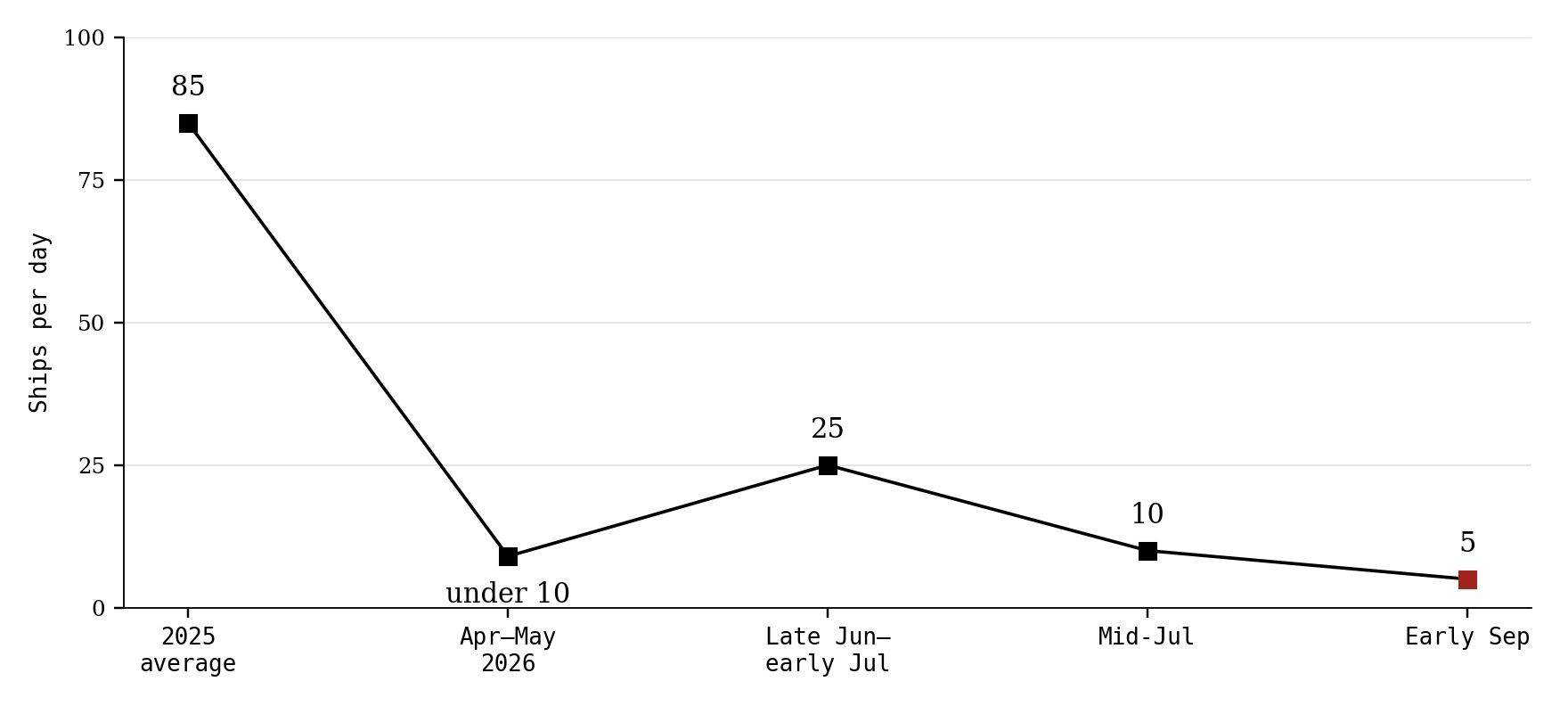
Figure 1 — Daily ship transits through the Strait of Hormuz. Source: UN DESA, as reported by APA, 19 Sep 2026. The April–May value is reported only as 'single digits'.
Saudi Arabia's bypass depended on the other gate. Since Iran closed Hormuz in March, the kingdom has pushed crude west through the East-West pipeline to Yanbu and routed it through Bab al-Mandab at roughly eight times the rate of a year earlier. [The Conversation] This month that bypass was hit at both ends. Iraqi militias knocked the pipeline out for more than a week, and the Houthi seizure of the coast from Mokha to the strait's islands put Bab al-Mandab under a group that has declared Saudi shipping barred. [The Economist; CNBC]
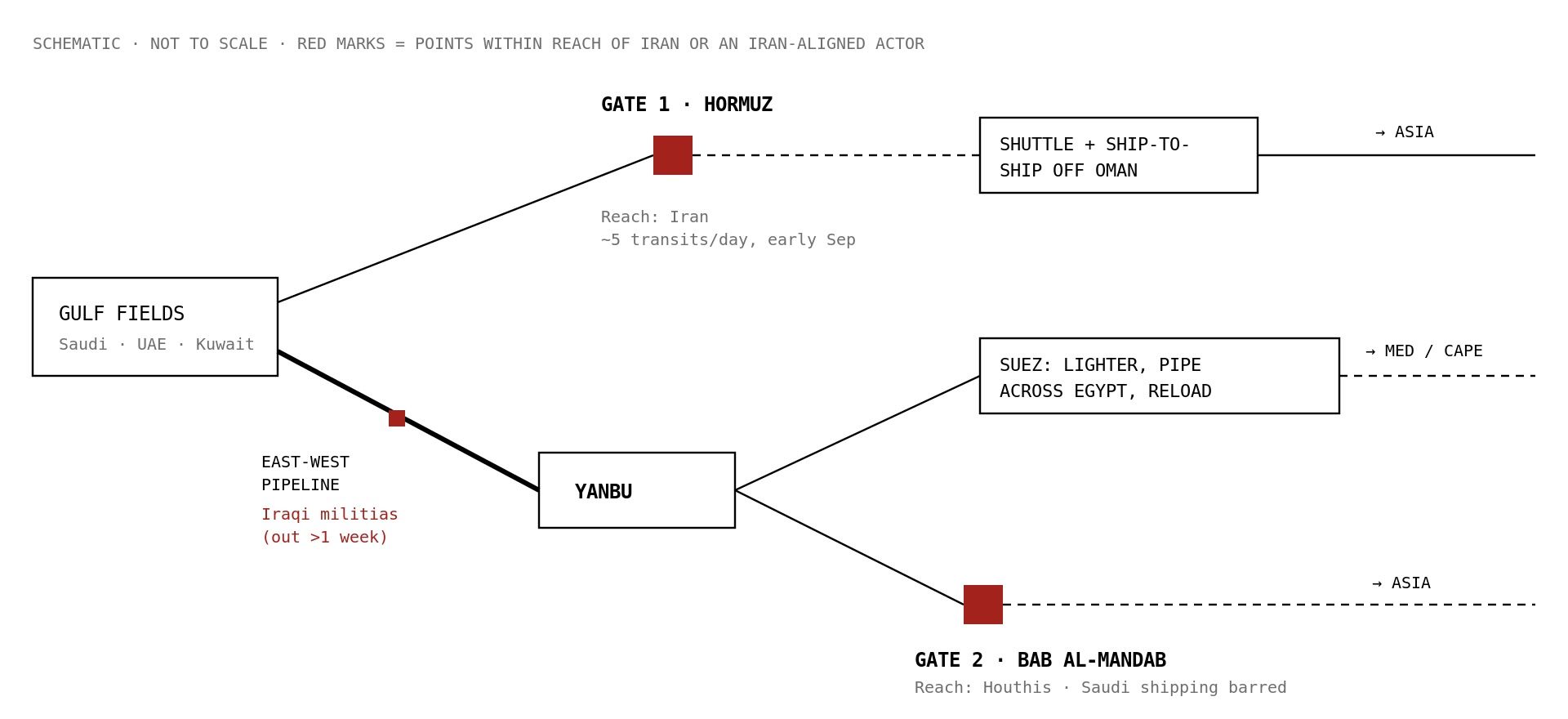
Figure 2 — Saudi and Gulf export paths and the actors that can reach them. Schematic.
The market has priced the loss of redundancy, not only the loss of volume. Cargoes loaded at Yanbu are now sailing north, being lightened to pass Suez, piped across Egypt and reloaded in the Mediterranean for the voyage round the Cape. Oil leaving through Hormuz moves in Gulf-owned tankers escorted by the US Navy to ship-to-ship transfer points off Oman, where roughly 15 per cent of the world's very large crude carriers now wait. Spot rates for those vessels are around $650,000 a day, and added transport costs may exceed $25 a barrel. [The Economist, 24 Sep] Brent has held near $100, but prompt physical crude has traded above $130 and diesel in the United States is at a record. [The Economist, 23 Sep]
Our test is not how many routes a state holds but how many of them one adversary can reach. Iran, the Houthis and the Iraqi militias are not one actor, and Iran denies directing the Houthis. We treat them as an aligned network rather than a chain of command: that is enough to answer the test. For Saudi Arabia in September 2026, the answer is all three routes.
4. The guarantor steps back
The evidence that Washington has stepped back from the guarantor role is now direct rather than inferential.
Refusal of the Saudi request for direct military help against the Houthis; a planned strike reportedly cancelled — The US will not fight Riyadh's second front. Grade: High.
US–Houthi contacts in Oman producing a promise to spare US ships; the President says the US is 'in constant contact' with the group — Protection is now for American assets, not for partners. Grade: High.
Withdrawal from Syrian bases completed in spring; Iraqi bases due to be emptied by end-September (both planned before the war) — The footprint was shrinking before the war; the war accelerates it. Grade: High.
Saudi Arabia barred US warplanes from its airspace in May during an effort to reopen Hormuz — Hosts are already imposing ad hoc conditions on base use. Grade: Moderate.
A majority of Americans called the war a mistake within two months; views of the Israeli government have deteriorated sharply — Future administrations will inherit a public averse to Gulf wars. Grade: Moderate.
Munitions and interceptor stocks strained; Pentagon budget pressure cited as a reason not to widen the war — Capacity, not only will, limits a new commitment. Grade: Moderate.
The counter-evidence is real and should not be dismissed. The US Navy still escorts the Hormuz shuttle; the blockade of Iranian ports continues; Treasury has escalated to the aviation sector; and Central Command has told Arab commanders it is not leaving. [The Economist; Axios via Amwaj.media] What these have in common is that they serve the war against Iran. What has gone is the commitment to absorb risks that belong to partners — the Saudi front in Yemen above all. That is why we describe the United States as a belligerent with conditions rather than a departing power.
Gulf governments will not say this publicly while their cities are within range of Iranian missiles; a debate about reducing American bases would look like abandonment at the worst moment. The adjustment will therefore show up first in behaviour — conditions on base use, new suppliers, new pacts — rather than in declarations.
5. The negotiation: positions and sequencing
Iran's position. Tehran has sent seven conditions through Qatar and Pakistan. Five have been named publicly: release of frozen assets, an end to the war on all fronts, non-interference in Iran's internal affairs, an end to attacks on Iranian territory, and the lifting of the naval blockade. The parliament speaker, who leads the negotiating team, says Hormuz will not reopen and the old negotiating framework will not return until they are met. [Al Jazeera; Amwaj.media; Anadolu]
The American position. Washington wants free passage through Hormuz and movement on the nuclear file, and would rather negotiate a new agreement than return to the interim memorandum signed in June, which broke down in July amid disputes over navigation and security arrangements. The President has said publicly that he expects a deal after the midterms. [Al Jazeera; Reuters; The Economist]
The gap is sequencing, not only substance. Iran wants the blockade, sanctions and frozen assets to move before it gives up its leverage over Hormuz; the United States wants Iranian movement on navigation first. Neither can compel the other: the US can hold the blockade and air superiority but cannot force capitulation, while Iran cannot break the blockade but keeps enough asymmetric leverage to impose costs on everyone. [analysts quoted by Al Jazeera] The phased path reported on 24 September is an attempt to solve the sequencing problem, and it is the right place to look for movement.
The Gulf is not united on the endgame. Saudi Arabia has reportedly urged Washington not to rush back to the memorandum and to keep the blockade while seeking a better deal; Qatar and Oman are the outliers and carry the mediation. Riyadh declined to attend an Omani meeting at Salalah intended to endorse an Oman–Iran arrangement for a new authorised shipping route, and Iran's security chief says a deal with Oman is ready but needs regional endorsement. [The Economist; The Guardian; Al Jazeera]
On the seven-day offer. Reuters and Kyodo cited a senior Iranian official as saying Hormuz could reopen within seven days if military pressure eased and the blockade was lifted; another senior official told a US outlet the reports were untrue. We grade the offer NOT ESTABLISHED and treat it as a negotiating signal rather than a commitment. [CNBC]
6. Bab al-Mandab has its own logic
It would be a mistake to read the Houthi offensive only as an Iranian lever. The group traces the latest round to a strike on Sanaa airport on 13 July, declared its truce with Saudi Arabia over that day, announced a naval blockade a week later, began missile attacks in August and launched the ground offensive on 3 September. It is the largest movement of Yemen's front lines since the UN-brokered truce of April 2022.
Three things made the moment attractive to the Houthis: Saudi Arabia's distraction, the fracture of anti-Houthi forces in the south after the Saudi–Emirati rift of late 2025, and the prize of a second choke point at a time when the first is closed. Their political aim is recognition on terms Riyadh refused in 2023, not only economic concessions. [The Conversation]
This is why a US–Iran deal would not by itself reopen the Red Sea. Iran has influence over the Houthis; it does not own their Yemeni agenda. Unless Saudi Arabia is party to a settlement, or the Houthis are pushed back from the coast, the southern gate will stay contested after the northern one reopens. Riyadh faces a real dilemma: air strikes to stop further Houthi advances invite strikes on its infrastructure, while restraint concedes the coast.
7. Who fills the gap
No outside power can replace the American role. Europe lacks the capacity: Britain's contribution to Saudi air defence is air-to-air refuelling for a period of weeks — described by one account as a single tanker. Russia has neither the means nor the interest, and together with China vetoed a US-backed Security Council sanctions resolution on Iran. China is Iran's main oil customer and wants Hormuz reopened, but has no recent experience of military operations far from its borders.
The regional responses are hedges. Since July Saudi Arabia has announced a mutual-defence understanding with Pakistan and Türkiye and a Red Sea maritime coalition of more than a dozen states; it has obtained ballistic missiles from China. The UAE has signed a ten-year drone deal with Ukraine that includes co-production. Türkiye is the region's leading drone exporter and has put its own proposal to Washington and Tehran. [The Economist; Al Jazeera]
We judge these moves significant for the direction of travel and insignificant for the balance at either strait in the next quarter. The likely near-term pattern is the one the region knows best: blocs built around non-Arab powers, ad hoc coalitions that outlive their purpose or dissolve within months, and Gulf states paying for options rather than guarantees.
8. Iraq: host, conduit and launch pad
Iraq sits on every side of the problem. Iraqi militias struck the Saudi pipeline; American bases in Iraq are being emptied this month; and US officials in New York praised Prime Minister Ali al-Zaidi's effort to bring the Iran-backed militias under state control, arguing that Iran's weakness creates an opening. Baghdad, cut off from the Gulf, has revived overland oil exports through Syria to the Baniyas terminal for the first time in fifteen years. [The Economist; Al-Monitor; Getty Images, 13 Sep]
The withdrawal of American forces and the militias' demonstrated reach into Saudi Arabia pull in opposite directions. If the state cannot discipline the militias as the Americans leave, Iraq becomes a third front against the Gulf rather than a buffer. We grade that risk MODERATE and will revise it on evidence of militia activity after the end-September withdrawal date.
9. What it means for the South Caucasus and the Caspian
The war's economic edge is now reaching the Caspian region directly. Azerbaijan stopped Iranian airlines' flights from 22 September, citing the new US aviation sanctions, as did Georgia and Oman; Turkmenistan has closed its airspace to Iranian carriers. Iranian travellers are being pushed onto land crossings into Türkiye and Armenia, while ordinary passenger travel overland into Azerbaijan remains restricted. [APA; Al Jazeera]
Freight is moving the other way. Azerbaijan Railways reports that its Astara terminal inside Iran handled more than 537,000 tonnes in January–August, about 30 per cent more than a year earlier, and 76,000 tonnes in August alone, up 50 per cent. [ADY via APA] We do not yet know how much of that growth is diverted Iranian trade and how much is North–South corridor traffic that would have grown anyway, so we grade the causal link LOW.
For Europe, the closure of both Gulf gates raises the value of supply routes that no Gulf actor can reach — the Southern Gas Corridor and the Middle Corridor among them. That is an opportunity for Baku and a responsibility: routes that become more valuable also become more attractive targets, and the lesson of the Gulf this month is that a bypass is only as independent as the actors who can reach it.
10. What would change our judgement
A second confirmed round of US–Iran talks with agreed sequencing language — Phased reopening of Hormuz becomes likely before year-end (bears on KJ3)
US strikes on Houthi positions at Saudi request — The guarantor role is not gone, only suspended (bears on KJ1)
Transits through Hormuz above 25 a day for two consecutive weeks — The June–July pattern is repeating; test whether Bab al-Mandab follows (bears on KJ2, KJ5)
Saudi–Houthi talks through Oman or Qatar — The southern gate is being negotiated separately, as we expect (bears on KJ5)
Militia attacks on Gulf targets from Iraq after end-September — Iraq becoming a third front (bears on §08)
Formal limits on US base use announced by a Gulf host — Retrenchment moving from behaviour to policy (bears on KJ1, KJ6)