INTRODUCTION
The two-week ceasefire agreed between the United States and Iran on 8 April 2026, mediated by Pakistan, has reduced the immediate temperature of the most dangerous crisis in the Middle East since the 2003 Iraq invasion. It has not, however, resolved the underlying dispute. After 49 days of air operations, a naval blockade of Iranian ports, the assassination of Supreme Leader Ali Khamenei, and an estimated $270 billion in damage to Iranian infrastructure, the conflict has entered a phase that is best understood as an armed pause rather than a durable political settlement.
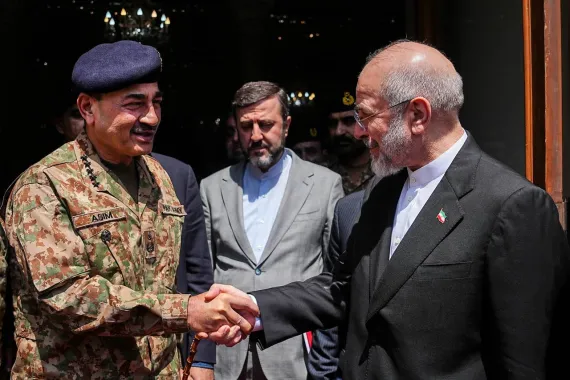
The first round of direct negotiations in Islamabad on 11–12 April — led by US Vice President JD Vance and Iranian parliamentary speaker Mohammad Bagher Ghalibaf — ended after 21 hours without agreement. Iran refused to accept Washington’s demands for a complete halt to uranium enrichment and the dismantling of major enrichment facilities. The United States, for its part, maintained its naval blockade of Iranian ports even as talks were under way, a step Tehran characterised as a violation of the ceasefire’s spirit. On 18 April, Iran closed the Strait of Hormuz for a second time, citing the continued blockade. The situation remains acutely unstable.
This analysis examines what the ceasefire reveals about the strategic dynamics of the conflict, assesses the internal political shifts within Iran that are reshaping its decision-making, and explores three plausible scenarios for the next phase. It draws on publicly available statements by senior officials on both sides, institutional assessments from the IEA, IMF, and CSIS, and recent reporting from multiple international outlets.
1. THE MEANING OF IRANIAN RESILIENCE
Much of the debate around the war has been distorted by a false binary: either Iran is on the verge of capitulation, or it is somehow emerging triumphant. Neither reading is persuasive. The more accurate picture is that Iran has absorbed severe punishment without collapsing — but at enormous cost and with no clear path to reversing the damage inflicted on its military, economic, and political infrastructure.
The scale of destruction is significant. US and Israeli air operations targeted oil and gas facilities, petrochemical plants, steel and aluminium factories, military complexes, bridges, ports, railway networks, power stations, and water desalination plants. The Iranian government has assessed total war-related damage at approximately $270 billion, a figure likely to rise as assessments continue. The National Petrochemical Company suspended all petrochemical exports on 16 April, citing the need to stabilise domestic supply. The Iranian rial has weakened sharply, inflation has accelerated, and internet shutdowns have compounded the economic disruption.
Yet the Iranian state has not fractured. Government institutions continue to function. The security apparatus has tightened control rather than lost it. And Tehran’s diplomatic posture — while constrained — has not shifted toward unconditional concession. Ghalibaf has been explicit: “We insist on some issues which are non-negotiable for us.” Iran’s Foreign Ministry spokesperson, Esmaeil Baghaei, confirmed that Tehran “based on its needs, must be able to continue enrichment.” Iranian officials have also communicated through Pakistan’s army chief that the missile programme lies outside the scope of any potential deal.
This resilience is not the same as strength. It reflects, rather, a system that has been built over four decades to absorb external shocks, suppress internal dissent, and maintain institutional coherence under conditions of extreme stress. The critical question is not whether Iran has been hurt — it plainly has — but whether the level of pain is sufficient to produce the kind of concessions Washington is seeking. On the evidence available, the answer appears to be: not yet, and perhaps not through military and economic pressure alone.
2. PRESSURE HURTS IRAN, BUT NOT FAST ENOUGH
The economic dimension of the crisis is central to understanding both sides’ calculations. The US naval blockade of the Strait of Hormuz, imposed on 13 April, has effectively severed Iran’s access to international maritime trade through the Persian Gulf. Over 10,000 US personnel, more than a dozen warships, and dozens of aircraft are enforcing the operation. Iran is losing an estimated $400 million per day in lost revenue. No commercial vessel has successfully breached the blockade.
Analysts cited by Reuters have estimated that Iran could withstand a complete halt in oil exports for up to two months before being forced to curb production, with one estimate suggesting that 40 days of sustained blockade could degrade wellhead pressure in several major fields to the point of permanent damage. If that assessment is correct, the blockade imposes a real but not immediate existential threat — one that creates urgency within Tehran but does not compel capitulation on a timeline convenient for Washington.
This is why the crisis increasingly resembles a pain-tolerance contest. Tehran appears to calculate that even if the Iranian economy suffers, the broader regional and global economy may suffer faster and more visibly. The International Energy Agency described the situation as “the greatest global energy security challenge in history.” The IMF has warned that a prolonged disruption could push the global economy toward recession. Oil prices have surged, shipping routes have been disrupted, and commodity prices — tungsten rising over 50 per cent, sulfuric acid up 30 per cent — have reflected the scale of the shock.
Iran’s leverage, in other words, lies not in its ability to win militarily but in its capacity to impose costs on the wider system. If forty days of sustained pressure did not produce Iranian concessions on enrichment, missiles, or regional posture, it is unclear what an additional forty would achieve — unless the United States is prepared to accept a much longer campaign with the global economic consequences that would entail.
3. HORMUZ: THE STRATEGIC AND NARRATIVE BATTLESPACE
The Strait of Hormuz sits at the centre of the crisis, functioning simultaneously as a military chokepoint, an economic lever, and a narrative battlespace. Approximately 20 million barrels of oil per day — roughly 20 per cent of global seaborne oil trade — transit its two unidirectional sea lanes under normal conditions. Iran initially restricted passage on 28 February 2026 in response to the US–Israeli air campaign. It briefly reopened the strait during the ceasefire before closing it again on 18 April, citing the continued US blockade.
There is a significant legal and definitional dispute at the heart of this standoff. Iranian officials and some legal analysts have argued that Tehran did not formally blockade the strait but rather exercised sovereign rights within its territorial waters and exclusive economic zone, including suspension of innocent passage under conditions of armed conflict. Whether one accepts that interpretation in full is less important than the strategic implication: the struggle over Hormuz is not only about ships. It is about who defines the situation, who appears to be the aggressor, and who claims the role of defender of international order.
Ghalibaf has spoken in maximalist terms: “The Strait is under the control of the Islamic Republic.” He has also warned that “if they do not abandon the blockade, traffic in the Strait will cease entirely.” Yet Tehran has simultaneously attempted to present itself as responsible: reopening the strait during the ceasefire and attributing its second closure to American provocation. This dual posture — claiming both restraint and escalatory capacity — is central to Iran’s strategy. Tehran wants the political value of appearing both responsible and dangerous, positioning itself as a state that is not destroying order but demonstrating that order cannot be sustained without its cooperation.
The global consequences of the Hormuz dispute extend well beyond Iran and the United States. Gulf Arab states, which depend on the strait for the overwhelming majority of their hydrocarbon exports, have a direct interest in its reopening but limited leverage over either party. European and Asian importers are absorbing price increases and supply disruptions that compound existing inflationary pressures. The longer the standoff persists, the greater the risk that energy markets undergo structural reconfiguration — with importers accelerating diversification away from Gulf supply, and producers investing in alternative export routes. Paradoxically, Iran’s demonstration of Hormuz’s vulnerability may accelerate the very trends that would diminish the strait’s future strategic value.
4. THE INTERNAL POWER STRUCTURE IS HARDENING
The war has accelerated what may prove to be the most consequential political transformation in Iran since the 1979 revolution. The assassination of Ali Khamenei on 28 February destroyed the system of competitive oligarchy that had given the Islamic Republic its peculiar resilience — balancing clerical authority, elected institutions, and the security apparatus in a deliberately ambiguous arrangement. What has replaced it is qualitatively different.
On 8 March, the Assembly of Experts selected Mojtaba Khamenei, the late supreme leader’s son, as his successor — a decision driven largely by IRGC insistence on expediency during wartime, despite Mojtaba’s limited religious credentials. US intelligence assessments, as reported by the Washington Post, have concluded that a weakened but more hardline government is consolidating power in Tehran, backed by the Revolutionary Guards. Informed sources indicate that a “military council” of senior IRGC officers now exercises effective control over core decision-making, enforcing a security cordon around the new supreme leader and filtering the information that reaches him.
The appointment of Mohammad Baqr Zolqadr as secretary-general of the Supreme National Security Council and the return of Mohsen Reza’i — the IRGC’s commander throughout the 1980–88 Iran–Iraq War — as military advisor to the supreme leader underscore the trend. The Foreign Policy analysis describes the emerging structure as a “post-clerical era” in which military-security logic, rather than religious doctrine, drives governance. IRGC Commander Ahmad Vahidi has reportedly insisted that all critical leadership positions be decided by the Guards.
This internal shift has direct implications for diplomacy. Iranian negotiators may still explore formulas for de-escalation, but their political room to manoeuvre is narrower than at any point since the 1990s. Every diplomatic gesture must be defended before a security establishment that views compromise as vulnerability. Ghalibaf’s framing reflects this constraint: “The enemy has not abandoned his enmity. The enemy is certainly in ambush, certainly seeking to inflict harm.” Diplomacy is being presented not as reconciliation but as another arena of struggle — resistance by other means.
The implications extend beyond the current crisis. If the IRGC’s consolidation of power proves durable, external actors will be dealing with a fundamentally different Iranian state — one in which the residual checks and balances of the Islamic Republic have been replaced by a military-security apparatus less susceptible to popular pressure, less constrained by clerical deliberation, and more inclined to view the international environment through the lens of permanent threat. That does not necessarily make Iran more aggressive in the near term — a weakened state may calculate that restraint serves its interests — but it does make the system less transparent, less predictable, and harder to engage through conventional diplomatic channels.
5. NEGOTIATION WITHOUT TRUST
The Islamabad talks exposed the depth of the gap between the two sides. The 300-member US delegation arrived with maximalist demands: zero enrichment, dismantlement of major nuclear facilities, removal of Iran’s stockpile of highly enriched uranium, and comprehensive restrictions on the missile programme. Iran’s 70-member team, for its part, proposed a 10-point framework that initially attracted American interest before Washington introduced what Tehran described as excessive additional conditions.
The fundamental disconnect is not technical but political. Washington appears to believe that the severity of the military campaign has created a coercive opportunity — that Iran, having been badly hurt, will eventually accept terms it would have rejected before the war. Tehran appears to believe the opposite: that it has survived the worst the United States and Israel could inflict, and that endurance itself constitutes a form of leverage. Ghalibaf has put it plainly: “We made progress in the Islamabad negotiations, but the gaps are wide and some fundamental points remain.”
This perception gap is not secondary. It is the core problem. Each side’s reading of the situation leads it to expect the other to move first. Washington believes pressure should produce Iranian flexibility. Tehran believes survival should earn American restraint. Neither has yet offered the other sufficient reason to revise its position.
Sequencing compounds the difficulty. Iran insists on step-by-step implementation with reciprocal compliance at each stage: “It should not be that we fulfil our commitments but they do not.” Given the history of the 2015 JCPOA — which the United States withdrew from unilaterally in 2018 — Tehran’s distrust of American commitment has a concrete empirical basis. Washington, for its part, distrusts Iran’s capacity to comply with any agreement in good faith, particularly given the IRGC’s expanded role in governance. The result is a negotiation in which both sides want a deal but neither is willing to absorb the political risk of being seen to make the first significant concession.
6. WHY ESCALATION MAY NOT PRODUCE THE EXPECTED RESULTS
A further complication is that Iran may not be drawing the lessons that Washington expects from the conflict. There is a strand of analysis within Tehran’s strategic community that reads the broader regional pattern — including Russia’s war in Ukraine — not as a cautionary tale about the futility of resistance but as evidence that time favours endurance over compromise. If states can absorb severe punishment and survive, the argument goes, then the coercive value of military superiority is inherently limited.
This perspective carries significant implications. If Iran concludes that sustained pressure can be weathered, then the psychological foundations of deterrence weaken. If it further concludes that the war has justified a stronger security state — one in which the IRGC’s domestic control is more entrenched than before — then the conflict may have the perverse effect of making the regime more authoritarian and less susceptible to external pressure in future crises.
Iran faces two opposite historical risks simultaneously: what might be called the “Herat Syndrome” — conceding gains prematurely out of exhaustion, as nineteenth-century Iranian rulers did under British pressure — and the “Faw Syndrome,” recalling 1986–88, when Iran captured Iraq’s Faw Peninsula but refused to trade territorial gains for a political settlement, ultimately accepting ceasefire terms far worse than those available earlier. The question for Tehran’s decision-makers is whether this moment demands the discipline to negotiate from a position of perceived strength or the realism to recognise that delay may erode whatever leverage remains.
7. THREE PLAUSIBLE SCENARIOS
Scenario One: A narrow framework deal. In this outcome, neither side achieves its ideal settlement, but both secure enough to justify de-escalation. Iran would preserve enrichment in principle but accept limits on levels, volumes, and verification. The United States would lift the naval blockade and relax some sanctions in stages. Israel would halt strikes. This scenario requires both sides to abandon maximalism: Washington accepting that zero enrichment is unrealistic, and Tehran accepting that unlimited enrichment is non-negotiable for the other side. Pakistani mediation, combined with pressure from Gulf states concerned about prolonged energy disruption, could facilitate movement. The probability is moderate but depends entirely on whether the IRGC-dominated system can sell such an agreement internally without it appearing as capitulation.
Scenario Two: Prolonged ceasefire erosion. This may be the most plausible near-term path. The ceasefire holds nominally. Talks continue through intermediaries. Public optimism rises and falls. Yet the underlying structure deteriorates. The US blockade remains in place. Iran maintains its capacity to disrupt Hormuz. The Houthis and Hezbollah continue low-level operations. Neither side crosses the threshold that would trigger formal resumption of hostilities, but neither moves far enough to create a durable framework. This is unstable precisely because it can appear manageable: a “new normal” in which apparent calm masks a deteriorating structure. The risk is not dramatic collapse in a single day, but gradual corrosion until a localized incident — a boarding, an interdiction, a drone strike — triggers a cycle that neither side fully controls.
Scenario Three: Renewed and widened confrontation. If negotiations fail and maritime pressure hardens, the next round may not remain confined to one arena. Hormuz could become more tightly contested. Gulf energy infrastructure could return to the target set. The Houthis could intensify attacks on Red Sea shipping. Iran’s regional proxy network, while diminished, retains the capacity for asymmetric escalation. This is the scenario most likely to demonstrate that military superiority does not equate to strategic control. It would also be the scenario in which Iran, even while materially weaker, could claim symbolic victory simply by surviving a prolonged confrontation with the world’s most powerful military. The global economic consequences — an extended disruption to 20 per cent of seaborne oil trade — would be severe and would test the political sustainability of the US approach across allied capitals.
CONCLUSION
The central lesson of this crisis is uncomfortable but unavoidable: Iran can be hurt badly without being compelled to surrender. The United States and Israel have demonstrated overwhelming military superiority, inflicted hundreds of billions of dollars in damage, eliminated Iran’s supreme leader, degraded its conventional military capacity, and imposed a naval blockade that costs Tehran $400 million per day. Yet the Iranian state has not collapsed, its negotiating position has not fundamentally shifted, and its internal power structure has consolidated around actors who view compromise as existential risk.
Iran, for its part, is not entering this phase as a winner in any conventional sense. Its economy is under unprecedented strain. Its military capabilities have been severely degraded. Its people are bearing costs that the leadership did not choose and cannot easily mitigate. But the system is not acting like a defeated state. It believes it retains leverage through Hormuz, endurance through institutional depth, and legitimacy through the narrative of resistance.
The most important question is no longer whether further escalation is possible. It is what escalation would actually achieve. The conflict has reached a point where the relationship between additional military pressure and additional political concessions has become deeply uncertain. More force may produce more destruction, but there is diminishing evidence that it would produce the strategic outcome Washington seeks.
That is why the decisive question for policymakers on both sides is whether they are willing to trade coercive ambition for a narrow, imperfect, but stabilising agreement — or whether the logic of escalation will prove more compelling than the logic of compromise. For now, Ghalibaf’s assessment remains the most accurate description of where the crisis stands: “We made progress, but the gaps are wide and some fundamental points remain.” The war has paused. The argument has not.