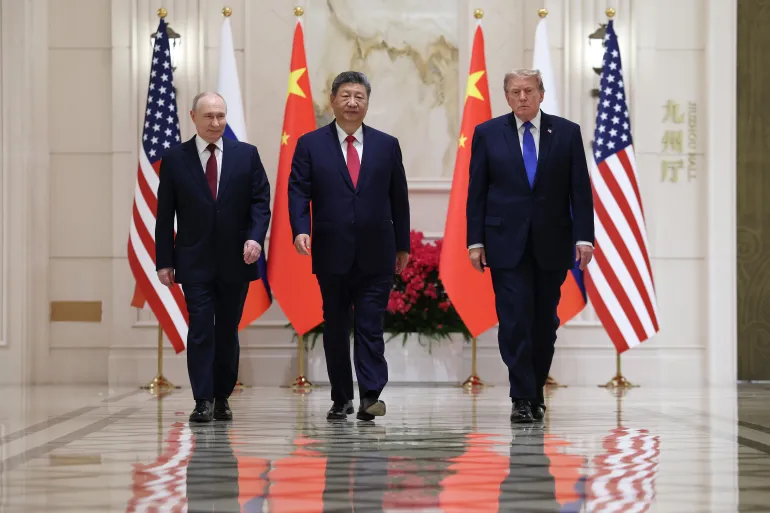
On 19 November 2026, Donald Trump, Xi Jinping and Vladimir Putin sat down together at Kylin Villa in Shenzhen, on the margins of the APEC summit China is hosting this year. The closed-door session lasted roughly fifty-five minutes and was preceded by a family photo and by two bilateral meetings, Trump with Putin earlier in the day and Trump with Xi for about an hour. It was the first time the leaders of the three largest nuclear powers had met in a trilateral format, and Xi opened by describing the occasion as having "groundbreaking significance." Whether that description survives scrutiny depends less on what the three leaders signed than on what their meeting reveals about the direction of the international order.
A short declaration with a long subtext
The document released afterwards by the White House, titled the "U.S.-Russia-China Heads of State Declaration toward Peace," is notably brief. It contains four commitments. The three permanent members of the UN Security Council pledged to reform the United Nations so that it can respond more effectively to global challenges. They announced a plan to increase the production and supply of refined petroleum products and reaffirmed the importance of stable energy flows. They stated that state consent and the immunity of state officials are of paramount importance and that the International Criminal Court and similar bodies must not abuse their jurisdiction. Finally, they reaffirmed that a nuclear war cannot be won and must never be fought, and agreed to conduct a dialogue on reducing nuclear risks and preventing proliferation.
Read on their own, none of these points is new. The formula on nuclear war repeats the language the five permanent members adopted in January 2022, and calls for UN reform have appeared in countless communiqués. What gives the text its significance is the combination of signatories and the choice of themes. The clause on international courts is the most revealing. Washington has long rejected ICC jurisdiction over its personnel, Moscow faces an ICC arrest warrant for its president, and Beijing has never joined the Court. That the three agreed to put this shared scepticism in writing suggests that, whatever their rivalries, they see common cause in limiting external legal constraints on great-power behaviour. For states that rely on international law precisely because they lack great-power leverage, this is not a reassuring signal.
The nuclear agenda: an opening, not an agreement
Trump arrived in Shenzhen intent on making nuclear arms control the centrepiece of the meeting, arguing that the three countries are "uniquely positioned" to address the issue. A senior US official had cautioned beforehand that Washington did not expect any agreement and saw the talks as an entry point. That modest framing proved accurate. The commitment to "conduct a dialogue" sets up no forum, no timetable and no numbers.
Even so, the outcome deserves more attention than its wording suggests. China has consistently refused to join trilateral arms control talks, arguing that its arsenal is a fraction of the American and Russian stockpiles and that the two larger powers must cut first. Xi's remark in Shenzhen that nuclear weapons "should be comprehensively banned and thoroughly destroyed" restates Beijing's long-standing disarmament rhetoric rather than accepting limits on its own build-up. Agreeing to a trilateral dialogue at all is therefore a small but real procedural concession. The test will be whether that dialogue acquires an agenda that addresses the growth of China's arsenal, the absence of a successor framework to the expired US–Russian strategic arms limits, and the destabilising effect of new delivery systems. Until then, the nuclear clause should be read as diplomatic positioning, not risk reduction.
What was left unsaid
The silences in the declaration are as instructive as its contents. There is no reference to Ukraine, even though Putin said in his opening remarks that the war would be the focus of discussion and the Kremlin aide Yury Ushakov confirmed it was raised in the Trump–Putin bilateral. There is nothing on Taiwan, nothing on Iran, and nothing on trade, despite Trump's claim in his meeting with Xi that the two sides had split their tariffs in a "fair way" and the creation of a joint "Board of Trade" at their Beijing summit in May. Al Jazeera's reporting before the summit noted that analysts expected no major breakthroughs given deep differences over Ukraine, Iran, nuclear weapons and trade, and the final text confirms that the three leaders chose to bank only the issues on which consensus cost nothing.
This pattern points to the real function of the Shenzhen meeting. It was less a negotiation than a demonstration that the three capitals can talk at the top level without intermediaries, and that each leader values the image of being one of only three people who matter. Xi's line that "the world is at peace when great powers live in harmony" captures the logic neatly. Peace, in this framing, is a product of understandings among the powerful, not of rules that bind them equally.
The risk of a concert without rules
Commentators have been quick to ask whether Shenzhen represents a new Yalta. The comparison is overdrawn. In 1945 the victorious powers drew lines on a map backed by armies in the field. In 2026 the three governments remain strategic competitors: the United States and China are locked in technological and military rivalry in the Indo-Pacific, and Washington and Moscow remain on opposite sides of the war in Ukraine. Nothing in the declaration resolves those conflicts.
A more useful analogy is the nineteenth-century Concert of Europe, in which great powers managed crises through periodic consultation while reserving the right to settle questions over the heads of smaller states. Al Jazeera observed that the summit had unnerved smaller countries that feared their interests might be disregarded. That concern is well founded. When the leading powers jointly downgrade international courts, coordinate on energy supply and propose reforming the UN among themselves, the space for middle and small states to shape outcomes narrows. Personal diplomacy also makes such arrangements fragile. As one observer pointed out, Putin has led Russia for twenty-six years and Xi has led China for fourteen, while Trump has twenty-six months left in office. Understandings built on personal chemistry rarely outlast the people who made them.
What it means for the wider world
The first consequence is for the multilateral system. The United Nations, the International Criminal Court and the network of arms control and non-proliferation regimes all rest on the premise that rules bind the powerful as well as the weak. A declaration in which the three most consequential members of the Security Council question the reach of international courts and propose to reform the UN among themselves weakens that premise. It also hands an argument to governments everywhere that prefer to treat international law as optional.
The second concerns global markets. A joint pledge by the world's largest economy, its largest manufacturer and one of its leading hydrocarbon exporters to raise refined product supply and stabilise energy flows will be read closely by traders, by OPEC producers and by import-dependent economies in Europe and Asia. It arrives at a time when energy markets remain sensitive to conflict in the Gulf and to sanctions on Russian exports. If it translates into concrete coordination, it could ease prices. If it remains a statement of intent, it adds to the uncertainty it was meant to reduce.
The third is for America's allies and partners. European governments, Japan, South Korea and Australia have built their security policies on the assumption that Washington treats Moscow and Beijing as rivals to be balanced, not partners in a directorate. A summit in which the American president calls Putin a friend and praises a "fair" tariff split with Xi, while Ukraine and Taiwan go unmentioned in the final text, will deepen doubts in allied capitals about how durable American commitments are. Some will hedge by investing more in their own defence. Others may seek their own accommodations with Beijing or Moscow.
The fourth concerns the Global South and the many states that have prospered by working with all three powers at once. Their leverage depends on great-power competition. A period of coordination, even a shallow and temporary one, narrows their room for manoeuvre. Yet these states also have reason to welcome anything that lowers the risk of a direct clash between nuclear powers and eases the sanctions spillover and pressure to choose sides that have imposed real costs since 2022. The prudent response for middle powers is to strengthen the coalitions and institutions in which they act collectively, and to defend the legal norms that the Shenzhen declaration treats with visible ambivalence, because those norms remain their most reliable protection.
Conclusion
The Shenzhen trilateral produced little that is binding and much that is symbolic. Its declaration restates familiar positions, postpones every hard question and leaves the conflicts that divide the three powers untouched. Its importance lies elsewhere: it normalises a format in which three leaders discuss the world's security, energy and legal order among themselves. Whether that becomes a stabilising channel for managing nuclear risk or a template for great-power arrangements that sideline everyone else will depend on what follows, above all on whether the promised nuclear dialogue acquires substance. For smaller states, the lesson is clear. They cannot count on being in the room, so they must make their voices heard in the forums where they are.