In November 2026 the Russia–Ukraine war entered a phase in which negotiation and escalation advanced side by side. Within a single month, Russian and Ukrainian delegations met under US mediation for the first time since February, American envoys carried proposals between Moscow, Kyiv and Berlin, and Washington floated security guarantees for Ukraine modelled on NATO's Article 5. Over the same weeks Ukraine recaptured ground in the north of Kharkiv region, struck Russian refineries, airbases and warships as far away as the Mediterranean, and Russia answered with some of the heaviest missile barrages of the year. The two tracks are not contradictory. Each side is fighting to improve its position before a settlement it expects, sooner or later, to be negotiated. This assessment examines what changed in November, what did not, and why the war is likely to grow more intense before it grows quieter.
Timeline · 10–28 November 2026
A month of talks and strikes
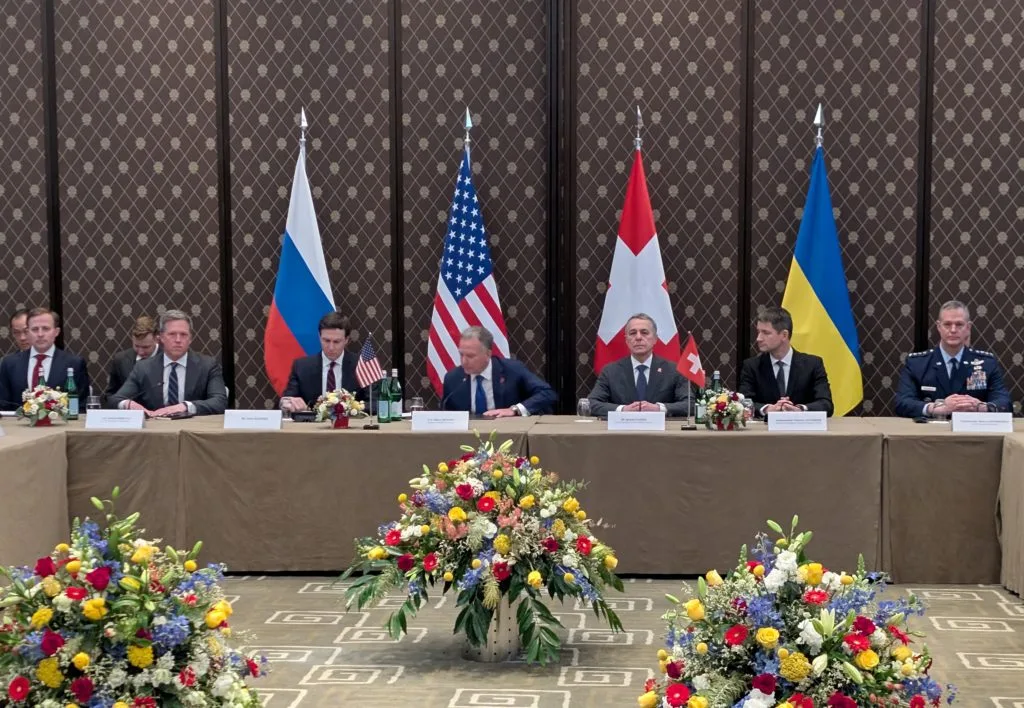
- 10–11 NOVTwo days of US-mediated Russia–Ukraine talks in Abu Dhabi, the first since February. Agreement in principle on a "large-scale" prisoner exchange; no breakthrough on territory.
- 12–13 NOVWitkoff and Kushner meet Putin in Moscow, then Zelenskyy in Dublin. Washington says Europeans will join the next round; the Kremlin is non-committal.
- 19 NOVTrump, Xi and Putin meet in Shenzhen. In Berlin, Kushner says Russia is "comfortable" with Article 5-style guarantees for Ukraine.
- 20 NOVUkraine announces "Operation Bear Trap" in northern Kharkiv region. Two Russian missiles and a drone crash in Poland. Six killed in a strike on Kyiv.
- 20–23 NOVRepeated Ukrainian strikes on the Kaleykino pumping station on the Druzhba pipeline.
- 21–22 NOVUkraine hits the Russian logistics ship Sparta II and, off Libya, sinks the corvette Merkury with naval drones.
- c. 22 NOVRussia fires 84 cruise missiles at Ukraine; widespread power outages follow.
- 24 NOVPutin calls retaliation for refinery strikes "inevitable". Kyiv replies that he can end the strikes by ending the war.
- 25 NOVVon der Leyen: "a strong European team" will join the next round of negotiations.
- 25 NOVUkraine says five Russian aircraft were damaged at Savasleyka airbase in Nizhny Novgorod region, east of Moscow.
- 27 NOVKyiv proposes a Black Sea ceasefire to protect food exports; Moscow has not yet replied.
Sources: Al Jazeera, Reuters, CNBC, Ukrinform, UNN, Censor.net. Compiled by RCSGS.
Abu Dhabi: the return of the table, without a map
The talks held in Abu Dhabi on 10 and 11 November ended a nine-month gap in direct contact. The previous trilateral round, in Geneva in February, had produced a 200-for-200 prisoner exchange and little else. This time Russia's delegation was led by Vladimir Medinsky and Ukraine's by David Arakhamia, with Steve Witkoff and Jared Kushner representing the United States. The outcome followed the familiar pattern of this war's diplomacy. The sides agreed, "in principle", on what Kushner called the biggest prisoner exchange of the war, to be carried out within weeks, and they made no progress on the question that matters most: where the line between Russian and Ukrainian control will run. Kushner described the meeting as "very tough but productive", and said territory would be "the hardest" issue to settle.
The more consequential argument in Abu Dhabi was about format. Arakhamia insisted that the next round should be multilateral, with Europe at the table, and Zelenskyy repeated that European security "cannot be considered without Europe". Medinsky said Moscow was "not opposed" to EU participation, while questioning what Russia and the EU would have to discuss. After meeting Putin in Moscow on 12 November, Kushner announced that both sides had agreed to bring "European partners" into the next round. Kremlin aide Yuri Ushakov played the claim down. On 25 November Ursula von der Leyen told the European Parliament that "a strong European team" would take part, and that the EU would "assess progress based on Russia's actions, not merely its words".
Europe's entry would change the character of the negotiation. A US–Russia–Ukraine format allows Washington to trade issues that are, in practice, European: sanctions relief, the frozen Russian central bank assets held mostly in the EU, and the deployment of forces on the continent. A European delegation brings vetoes on all three. It also brings a different reading of the war. Several European governments believe that Russia's economy and military are under greater strain than Moscow admits, and that a ceasefire on Russia's current terms would only give it time to rebuild. Moscow's hesitation is easy to understand: a wider table is harder to divide.
The Article 5 offer and the price attached
The most striking development of the month came on 19 November in Berlin, after a summit of the "Coalition of the Willing". Kushner said Washington had "gotten the Russians comfortable" with the idea that "any security guarantee for Ukraine would be based on Article 5", the collective-defence clause of the North Atlantic Treaty. He called it "a really, really big deal" and said President Trump was open to it, provided it was "in America's interest" and formed part of a broader package.
The offer needs to be read alongside what Washington is asking in return. According to reporting by the Wall Street Journal, cited by Al Jazeera, US negotiators have put two proposals to Kyiv. In the first, Ukraine would withdraw from the remaining "fortress belt" cities of Donetsk region, including Kramatorsk and Sloviansk, in exchange for full NATO membership. In the second, the front line would be frozen where it stands and Ukraine would receive NATO-style guarantees short of membership. Kushner's remarks suggest that Russia has accepted a diluted version of the second option.
The US proposals, as reported
Two routes to a settlement, and why neither is agreed
Option A: land for membership
Ukraine gives. The unoccupied part of Donetsk region, including the fortress-belt cities.
Ukraine gets. Full NATO membership.
Kyiv's view. Rejected. Zelenskyy refuses to withdraw from defended cities without a fight.
Moscow's view. Rejected. Putin calls NATO membership for Ukraine "unacceptable".
Option B: freeze with guarantees
Ukraine gives. Accepts the current line of contact as a de facto boundary.
Ukraine gets. Security guarantees "based on Article 5", form undefined.
Kyiv's view. Open, but says there is "no common understanding" of what the guarantee means.
Moscow's view. Reportedly accepts a diluted version; rejects European troops in Ukraine and any "quasi-membership".
Based on reporting by the Wall Street Journal via Al Jazeera, and public statements by Kushner, Zelenskyy, Putin and Ryabkov, 11–27 November 2026.
The weakness of the Article 5 formula is that it is a label without a mechanism. NATO's guarantee works because it is backed by integrated command structures, forward-based forces and a shared assumption that allies will fight. Russia has said it will not accept European troops on Ukrainian territory, and Deputy Foreign Minister Sergei Ryabkov called any form of "quasi-membership" for Kyiv "totally unacceptable". A guarantee that must be delivered from outside Ukraine, by states that have already declined to send combat forces, is a political promise rather than a military one. Zelenskyy has pointed out exactly this gap. French President Emmanuel Macron went further, arguing that "faced with the maximalist nature of the Russian position" the question of Ukraine's NATO accession should be reopened.
Kyiv's distrust is not only about the text. Zelenskyy has told Bloomberg that Washington is "moving in the same direction as what Putin wants: to force Ukraine into unfavourable compromises". Trump's Shenzhen meeting with Putin and Xi Jinping on 19 November, his description of Putin as "my friend", and earlier relaxation of some sanctions on Russian oil have reinforced the impression in Kyiv that the American mediator is impatient with Ukraine's refusal to cede land. That perception shapes Ukraine's military choices as much as its diplomatic ones.
The battlefield: Ukraine shifts the narrative
For much of 2026 the dominant military story was slow Russian advance in Donetsk region. November complicated that picture. On 20 November Ukraine's 475th Assault Regiment announced "Operation Bear Trap" in the north of Kharkiv region, near Velykyi Burluk. A month earlier, Russia had claimed to have encircled around 2,000 Ukrainian troops there. Ukrainian commanders say that, instead, they used deception and multiple axes of attack to break the encirclement, recapture 14 settlements and roughly 200 square kilometres, and disrupt a Russian plan to take close to 500. The scale is contested and some observers question whether it amounts to a significant counter-offensive. The tactics, however, are notable: drones first, infantry last, a pattern now visible in several Ukrainian operations this year. Ukraine has also reported gains on the Lyman front and in southern Zaporizhzhia, while Russia continues to push toward Kramatorsk and near Kupiansk.
The cost to Russia is high by any measure. Ukraine's General Staff put Russian losses in November at 55,629 killed and wounded with five days still remaining, which would make it the costliest month of the full-scale invasion. These figures cannot be independently verified and are likely to be inflated, but the trend they describe, rising losses for limited territorial gain, is consistent with independent assessments throughout the year.
The deep-strike campaign: making the war expensive
Ukraine's most effective lever in November was not on the front line but hundreds and sometimes thousands of kilometres behind it. After a brief pause following Trump's declaration of an "energy ceasefire" in mid-October, Ukrainian drone and missile attacks on Russian oil infrastructure resumed in late October and intensified through November. According to two industry sources cited by Reuters, the attacks have cut Russian refineries' combined crude processing by about 45 per cent since late October. Zelenskyy has put the share of disabled capacity at more than 55 per cent. Targets in the past fortnight alone included the Novoshakhtinsk, Kuibyshev, Syzran and Perm refineries, and the Kaleykino pumping station on the Druzhba export pipeline, struck twice.
Russian oil refining · estimated reduction since late October
How deep the strikes have cut
Sources: Reuters (combined crude processing, two industry sources); President of Ukraine (share of capacity disabled). The two figures measure slightly different things. Bars scaled to 100%.
The campaign has widened in reach and type. On 25 November Ukraine said it had damaged five aircraft at Savasleyka airbase in Nizhny Novgorod region, including MiG-31 interceptors used to launch Kinzhal hypersonic missiles. Ukrainian naval drones struck the Russian logistics ship Sparta II in the Baltic on 21 November, and on 22 November sank the corvette Merkury off Benghazi, Libya, reportedly launched from a "mother ship". A Russian supply vessel, the Angara, was hit in the Mediterranean the same day. These operations carry the war into regions where Russia projects power far from Ukraine, and they create new political risks: Italy has protested the Libyan attack, and Moscow has accused Baltic states of facilitating Ukrainian operations.
Moscow's answer has been to strike Ukraine's power grid and to threaten more. Around 22 November Russia fired 84 cruise missiles at Ukraine; a strike on Kyiv on 20 November killed six people, and nationwide outages have followed. On 24 November Putin told oil executives that retaliation for the refinery strikes was "inevitable". Foreign Minister Andrii Sybiha replied that if Putin did not like the strikes, he could end the war. On 20 November two Russian missiles and a drone fell in Poland, a reminder that the escalation carries risks for NATO territory as well.
The logic on both sides is the same. Ukraine is using energy strikes to raise the cost of continuing the war and to build leverage for an energy ceasefire it has offered on a reciprocal basis. Russia is using winter attacks on the grid to raise the cost to Ukrainian society of refusing territorial concessions. Kyiv's proposal on 27 November for a Black Sea ceasefire to protect food exports, and the EU's call for a "winter ceasefire concerning energy infrastructure", show where a first partial agreement could be found. Both depend on whether Moscow judges that its refining losses now outweigh the damage it can still inflict on Ukraine's grid.
Why compromise remains distant
Three structural problems explain why November's diplomacy produced process but not peace.
First, territory remains a zero-sum question. Russia continues to demand the whole of Donetsk region, including cities it has not captured. Ukraine will not hand over defended towns, and Operation Bear Trap has strengthened the argument in Kyiv that Russian advances are neither inevitable nor cheap. Any freeze of the front line requires Moscow to accept less than it claims, and nothing in its November statements suggests it is ready to do so.
Second, the security guarantee is undefined. The Article 5 formula is attractive because it is vague. Once it is defined, every detail, from who would fight, to where forces would be based, to what would trigger a response, becomes a point of conflict with Moscow. Russia's refusal to accept European troops in Ukraine removes the most credible way of making the guarantee real.
Third, the mediator's own interests are in play. Washington wants a deal that limits its long-term commitment, and Kushner's condition that any guarantee be "in America's interest" signals that the United States does not intend to become Ukraine's main protector. Europe, which would carry most of the burden, is only now entering the negotiations. Until the Europeans define what they are prepared to guarantee, neither Kyiv nor Moscow can calculate what a settlement would actually be worth.
Outlook: the next eight weeks
The coming weeks are likely to be defined by winter, by the prisoner exchange agreed in Abu Dhabi and by the first round of talks with a European delegation, if it takes place. The scenarios below reflect RCSGS's assessment of the likeliest paths to the end of January 2027.
Scenarios · to end of January 2027
Where the war could go this winter
Negotiations amid escalation
The prisoner exchange goes ahead and a wider round with Europe convenes, while strikes on energy infrastructure on both sides intensify through the winter.
Partial energy or Black Sea truce
Mounting refinery losses push Moscow to accept a reciprocal halt to energy strikes or a maritime truce, without any agreement on territory.
Major escalation spills over
Russia's promised retaliation, further incidents in Poland or clashes linked to Baltic operations draw NATO states more directly into the crisis.
Framework ceasefire agreed
A freeze of the front line combined with defined security guarantees. The gap on territory and on European forces remains too wide.
RCSGS assessment. Meters show relative likelihood, not precise probabilities.
November showed that diplomacy in this war has become a continuation of the fighting by other means. Both sides are negotiating, and both believe that the terms will be set by who can impose greater costs over the winter. Ukraine has demonstrated that it can hurt Russia's economy and military far from the front. Russia has shown that it can still damage Ukraine's grid and absorb heavy losses for incremental gains. The arrival of Europe at the table may make a settlement more durable when it comes, but it is unlikely to make it come faster. For now the most realistic gains are partial: prisoners exchanged, perhaps a truce over energy or the Black Sea. A comprehensive peace will require Moscow to accept less territory than it claims and the West to define a guarantee it is prepared to honour, and in November neither condition was met.