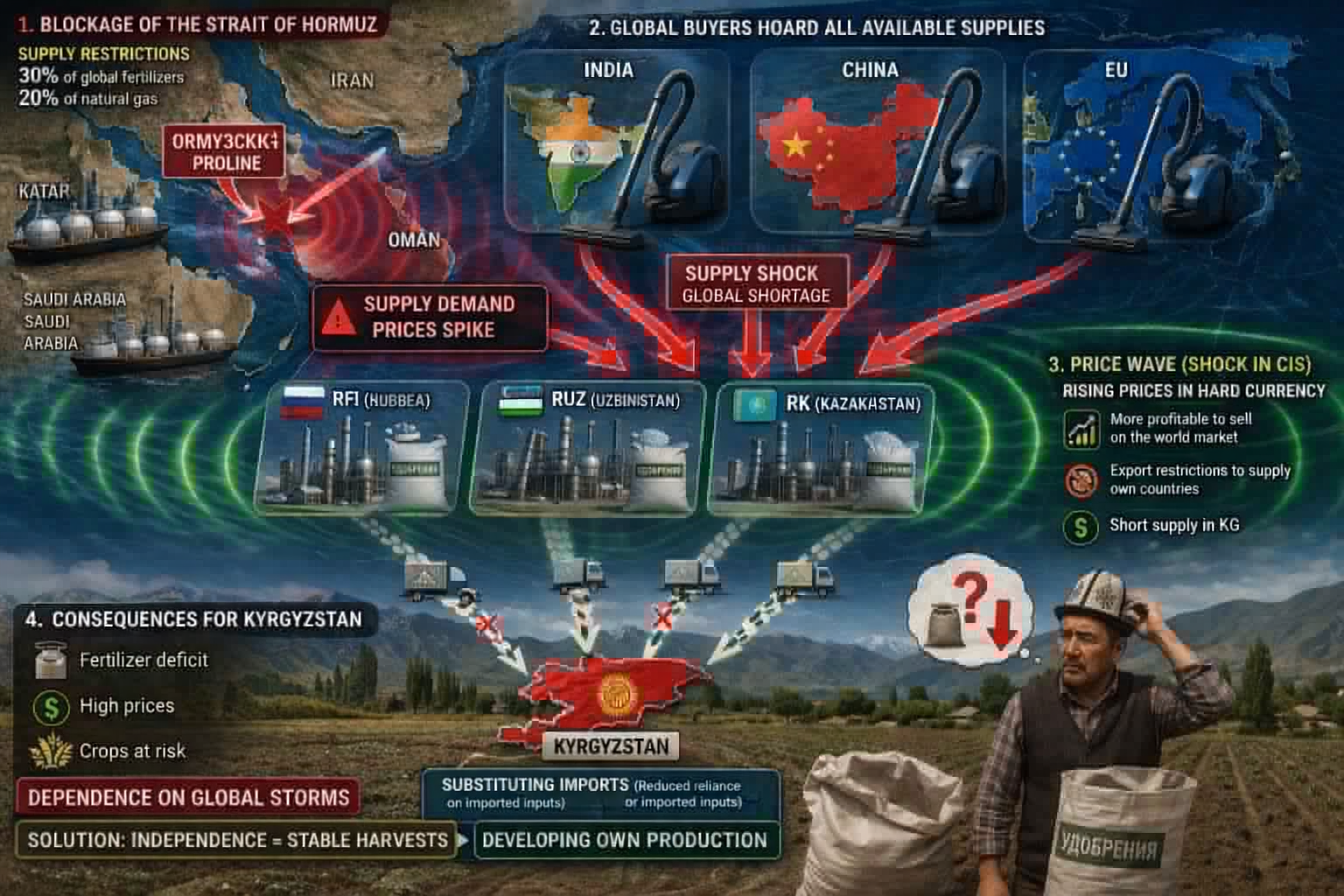
The escalation of conflict involving Iran and the disruption of the Strait of Hormuz represent a geographically distant crisis with disproportionately close consequences for Central Asia. While the region is not a direct participant in Middle Eastern geopolitics, its structural dependence on global energy markets, external trade routes, and imported agricultural inputs makes it acutely vulnerable to second-order effects. The unfolding situation highlights a broader reality: Central Asia’s economic and food security is increasingly shaped by global systemic shocks rather than purely regional dynamics.
Hormuz as a Global Chokepoint—and Central Asia’s Hidden Dependency
The Strait of Hormuz is one of the world’s most critical maritime arteries, handling roughly one-third of global seaborne oil, a significant share of natural gas, and up to 30% of internationally traded fertilizers. Any sustained disruption—whether through blockade, military escalation, or heightened insurance and transport costs—has cascading consequences across global supply chains. The UN Food and Agriculture Organization (FAO) has warned that a prolonged crisis could evolve into a “catastrophe” for global agriculture. The core issue is not immediate food scarcity but the rising cost and delayed delivery of key inputs—especially fertilizers and energy. These inputs are foundational to agricultural production cycles, meaning today’s disruptions translate into tomorrow’s food shortages. For Central Asia, this matters deeply. Despite being landlocked and geographically removed, the region is tightly embedded in global commodity flows.
Fertilizer Shock and Agricultural Vulnerability in Kyrgyzstan
Kyrgyzstan provides a particularly illustrative case. The country does not directly import fertilizers from Iran or Gulf states, yet it is experiencing tangible disruptions. This reflects the structure of the global fertilizer market, where production is geographically concentrated and logistics-dependent. Nitrogen fertilizers, for instance, rely on natural gas—linking their price directly to energy markets. With gas exports affected by Hormuz instability, production costs rise globally. Meanwhile, large consumers are shifting procurement strategies, redirecting supplies from traditional exporters such as Russia and Uzbekistan—Kyrgyzstan’s primary suppliers. The result is not outright scarcity but intensified competition. Kyrgyzstan has already recorded a 12,000-ton shortfall in fertilizer deliveries compared to the previous year. More significantly, imports of phosphorus and potassium fertilizers have dropped sharply, while prices have increased by 10–20% domestically and up to 30% globally.
This creates a structural dilemma for farmers. Faced with rising costs, they reduce input use—particularly secondary nutrients—while maintaining minimal nitrogen application. This adaptation strategy may preserve short-term viability but risks lowering yields and degrading soil quality over time.The FAO underscores this risk: reduced fertilizer use leads directly to lower agricultural productivity, which, in turn, drives food price inflation. The time lag inherent in agriculture means that the full impact of today’s disruptions will likely materialize in upcoming harvest cycles.
Food Security Risks: From Global Shock to Local Impact
Although global food prices have not yet surged dramatically—thanks to strong harvests and high stock levels—the FAO warns against complacency. Current stability masks underlying vulnerabilities, particularly regarding future production cycles. The key issue is forward-looking: the cost of producing the next harvest. As FAO economist Máximo Torero emphasizes, delays in accessing fertilizers and energy inputs force producers to scale back. This is especially dangerous for poorer countries, where agricultural cycles are tightly constrained by seasonal timing. In Kyrgyzstan, the timing of the crisis coincides with the spring sowing season—arguably the most critical period in the agricultural calendar. Even short disruptions in supply can have outsized effects on annual output. The government’s efforts to coordinate with importers and secure alternative supplies reflect an awareness of this vulnerability, but structural constraints remain.
Why Fertilizer Prices in Kyrgyzstan Depend related to crisis situation in the Strait of Hormuz
The recent statement by the Kyrgyz President linking the challenges faced by Kyrgyz farmers to instability in the Strait of Hormuz has generated considerable debate. At first glance, the connection appears tenuous. Kyrgyzstan does not import fertilizers directly from the Persian Gulf; instead, it relies on neighboring suppliers such as Russia, Uzbekistan, and Kazakhstan. However, this skepticism overlooks a fundamental reality of the contemporary global economy: even geographically distant disruptions can trigger cascading effects across interconnected markets.
This is where the “domino effect” becomes evident. Major agricultural economies such as India, Brazil, and members of the European Union depend heavily on stable fertilizer supplies to sustain their production cycles. When access to Gulf-based exports is constrained, these countries rapidly seek alternative sources. Producers in Russia, Uzbekistan, and Kazakhstan key suppliers within Eurasia region become immediate substitutes. As global demand converges on these producers, competition intensifies and prices rise sharply.
For these exporting countries, the incentives are straightforward. Selling fertilizers on global markets, often denominated in US currency in global prices, becomes significantly more profitable than maintaining regional supply arrangements at previously agreed prices. Consequently, fertilizers that are geographically close to Kyrgyzstan become economically distant. In periods of acute shortage, governments may even impose export restrictions to safeguard domestic agricultural sectors, further limiting availability for external buyers. Kyrgyzstan thus finds itself squeezed out of the market—not necessarily because supply has vanished, but because it has been repriced beyond reach.
Compounding this challenge is the central role of natural gas in fertilizer production. Gas is a primary input in the manufacturing of nitrogen-based fertilizers, and a large proportion of global gas shipments also passes through the Strait of Hormuz. Disruptions in the strait therefore exert upward pressure on gas prices, increasing production costs worldwide. Fertilizer plants, including those in the post-Soviet space, must either raise prices accordingly or reduce output. This second-order effect amplifies the initial supply shock, reinforcing the upward spiral in prices.
For Kyrgyzstan, the implications are direct and tangible. Rising fertilizer costs translate into higher production expenses for local farmers, reduced application rates, and ultimately lower crop yields. In Central Asian countries like Kyrgyzstan and its neighbors where agriculture remains a vital component of livelihoods and food security, such pressures can quickly escalate into broader socio-economic risks, including food price inflation and rural vulnerability. It is within this context that policy responses such as developing domestic fertilizer production or diversifying import partners gain strategic significance. Initiatives like establishing a production facility in the south part of Kyrgyzstan and expanding cooperation with China are not merely economic projects; they are risk-mitigation strategies aimed at reducing exposure to external shocks. By strengthening internal capacity and supply resilience, Kyrgyzstan can partially insulate itself from volatility originating far beyond its borders.
To sum up, the linkage between instability in the Strait of Hormuz and fertilizer prices in Kyrgyzstan is neither abstract nor exaggerated. Rather, it reflects the deeply interconnected nature of global supply chains. The modern world economy operates as a single organic body: when a critical artery is disrupted, the effects reverberate across the entire system. For Kyrgyz farmers, these global tremors are felt not as distant geopolitical events, but as immediate constraints on production and livelihoods.
The war in Iran and the Strait of Hormuz crisis Central Asia’s embeddedness in global economic networks and its limited capacity to absorb external shocks. For Kyrgyzstan and its neighbors, the immediate challenge lies in managing inflation and ensuring agricultural continuity. However, the longer-term lesson is more strategic: resilience requires diversification—of supply chains, energy sources, and agricultural inputs—as well as greater regional coordination. Ultimately, the crisis underscores a paradox of globalization for Central Asia: integration into global markets has enabled growth and connectivity, but it has also imported vulnerability. The extent to which regional states can mitigate these vulnerabilities will shape their economic and food security trajectories in an increasingly unstable geopolitical environment.