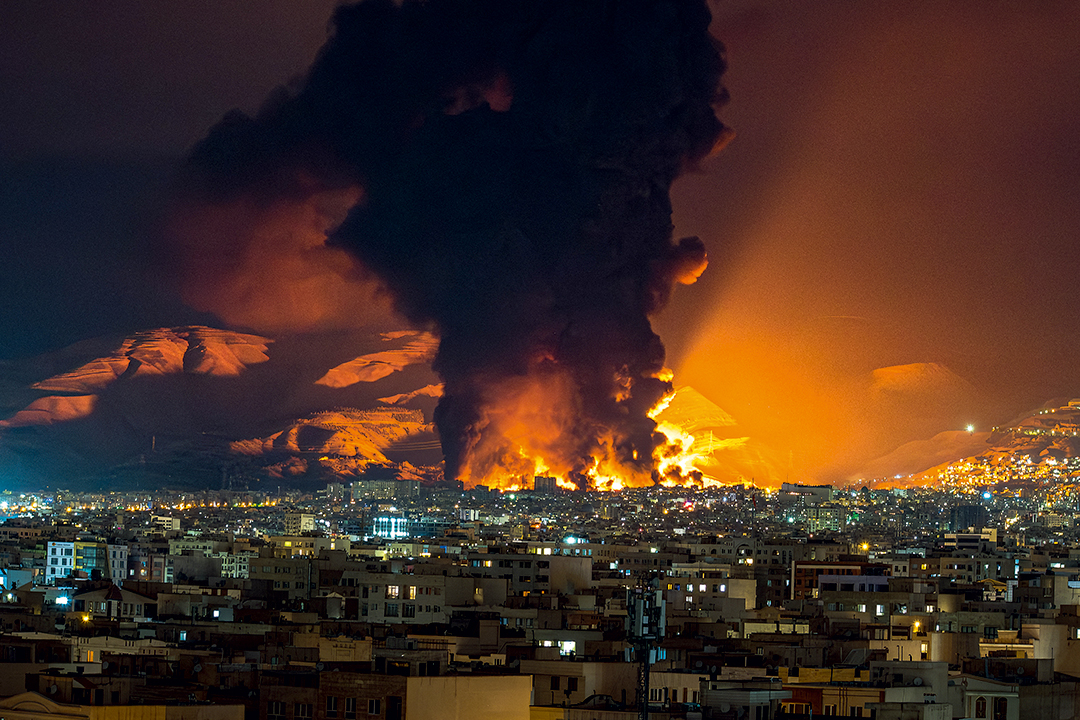
Executive Summary
Five weeks into the war, the central fact is no longer the scale of the opening strikes. It is the failure of those strikes to produce a decisive political outcome. The United States and Israel have inflicted severe damage on Iran’s military leadership, industrial base, and infrastructure. But the war has not translated into strategic control. Iran still retains significant missile-launching capacity, still threatens shipping and regional infrastructure, and still appears able to shape the tempo of escalation through Hormuz and a widening network of pressure points across the region.
This is why the war increasingly looks less like a coercive campaign designed to force quick concessions and more like a contest of endurance. Iran’s theory of victory is not based on matching American or Israeli firepower strike for strike. It is based on surviving, preserving enough launch capability to keep imposing costs, and convincing the other side that escalation will spread faster than it can be controlled. In that sense, the key battlefield is no longer only Iranian territory. It is the wider regional system: shipping lanes, Gulf infrastructure, investor confidence, insurance markets, industrial recovery, and coalition cohesion.
At the same time, Washington and Israel have also changed the character of the war. What began as a campaign against nuclear and missile threats has expanded into a broader effort to damage Iran’s capacity to recover after the war. Repeated strikes on steel facilities, technical infrastructure, and other industrial nodes show an increasingly explicit attempt to delay reconstitution, weaken reconstruction, and turn battlefield pressure into long-term economic degradation. That may lengthen Iran’s recovery timeline. But it also risks deepening the logic of retaliation, broadening the target set, and making any political exit harder to achieve.
The core strategic dilemma is therefore stark. The United States and Israel have achieved major operational successes, but not yet a clean strategic result. Iran has absorbed extraordinary damage, but has not yet been neutralized as a regional coercive actor. That gap between military damage and political outcome is now pushing the war toward its most dangerous phase: one in which both sides may escalate not because they are winning, but because neither has yet found a plausible off-ramp.
The War Has Shifted from Shock to Attrition
The first phase of the war was shaped by the expectation of rapid strategic collapse. That expectation has not held. Instead, the conflict is now being defined by cumulative pressure, infrastructure disruption, and the slow erosion of the opponent’s ability to operate normally. Iranian strategic narratives increasingly frame the war not simply as battlefield attrition, but as a struggle over regional connectivity, logistics, and the economic confidence of the wider U.S.-aligned system. In this view, the point is not only to survive bombardment, but to ensure that everyone else feels the war as well.
That shift is visible in multiple ways. Tehran increasingly presents Hormuz as more than a temporary wartime lever. It is being framed as a source of post-war political leverage, with discussion of long-term exclusion rules and a new regulatory order for the strait. At the same time, Iranian narratives stress that foreign vessels are increasingly seeking Iranian permission for transit, reinforcing the perception in Tehran that de facto control is consolidating rather than weakening.
This matters because it changes the logic of the war. If Iran can turn wartime sacrifice into durable leverage over maritime flows, then reopening Hormuz is no longer just a military problem. It becomes a political problem too. The longer the current pattern persists, the harder it becomes for Tehran to reopen the waterway without visible gains, because doing so would look like surrendering the most important bargaining chip the war has produced.
Iran Has Been Hurt Badly, but Not Disarmed
None of this means Iran is winning in a simple military sense. It is not. It has lost senior figures, suffered heavy damage to missile production and industry, and absorbed strikes on bridges, logistics, airports, and major steel facilities. But the more relevant question is whether those losses have stripped Iran of the ability to keep fighting in strategically meaningful ways. The answer, based on the material now available, is no.
One of the most important indicators is surviving launch capability. Recent U.S. intelligence assessments cited in your source material argue that roughly half of Iran’s missile launchers remain intact, or at least not definitively destroyed, while thousands of one-way attack drones also remain available. The same reporting says a large share of Iran’s coastal defense cruise missiles may still be intact, which is crucial because those systems underpin its continued threat to shipping in Hormuz.
The reason is structural. Iran spent decades preparing for this kind of war. Underground facilities, caves, tunnels, concealed logistics, and mobile launch practices have made it much harder to convert air dominance into total suppression. Even where launchers are buried or blocked rather than destroyed, that still creates a murky picture: assets may be temporarily inaccessible without being permanently eliminated. This is one reason the war has produced such a wide gap between official claims of near-complete degradation and more cautious intelligence estimates.
That distinction matters enormously. It is one thing to reduce daily fire rates. It is another to eliminate the capacity for future coercion. At this stage, the campaign appears to have damaged Iran’s ability to generate massed effects at previous levels, but not to have removed its capacity to keep the region under threat. That means Washington and Israel may have achieved operational disruption without achieving decisive disarmament.
Israel and the United States Are Now Targeting Recovery, Not Just Warfighting
If Iran’s surviving capability is the main reason the war continues, the changed targeting pattern is the clearest sign of how Washington and Israel are adapting. Repeated attacks on Mobarakeh Steel and other industrial nodes point to a campaign increasingly focused not only on what Iran can fire now, but on how quickly it can rebuild later. The objective is no longer merely to blunt immediate retaliation. It is to stretch the reconstitution timeline.
This is one of the most important strategic developments in the conflict. A strike on a steel plant is not just an industrial strike. In the logic now visible across the source material, it is a strike on missile supply chains, on construction, on reconstruction, and on the state’s ability to restore normality after the war. That same logic also explains reported strikes on technical universities, pharmaceutical production, and other civilian-military gray-zone infrastructure. The target is not only Iran’s war machine. It is the ecosystem that would allow the war machine, and the state behind it, to recover.
There is a real strategic rationale here. If Iran’s launchers and missiles cannot all be destroyed in the field, then delaying the next cycle of production and regeneration becomes more important. Some of the material you provided makes this point explicitly: launchers may survive, but damage to places such as Khojir, Shahroud, Parchin, Bidkaneh, and major industrial inputs could still significantly lengthen the time required to restore full capability. That is a serious achievement. But it is not the same as ending the war. It may even prolong it by convincing Tehran that only broader escalation can impose restraint.
Hormuz Remains the Center of Gravity
The war’s decisive strategic fact is that Hormuz still has not been reopened on terms dictated by Washington. Multiple sources in the material point in the same direction: whatever the scale of destruction inside Iran, the United States has not yet translated that into control over the strait. That single fact explains why talk of victory remains unconvincing.
Iran’s leverage here is not merely geographic. It is political, military, and economic at once. As long as Tehran can credibly threaten maritime traffic through a mix of surviving coastal missiles, IRGC naval assets, dispersed retaliation, and pressure on Gulf infrastructure, it can keep externalizing the costs of war. That pressure is already visible in energy prices, shipping disruption, and the broader argument running through several of your sources that this conflict is increasingly a war on regional confidence itself.
This is also why the war has become so dangerous for Gulf states. The more the conflict shifts from direct military exchange to infrastructure-centric coercion, the more exposed the Gulf becomes as the war’s economic battlefield. Iranian strategic messaging increasingly signals that the response to attacks on Iranian bridges, industry, and civilian infrastructure will not be confined to Israel or U.S. assets alone, but may extend to logistics corridors, ports, bridges, aviation, energy nodes, and broader commercial confidence across the Gulf system.
The Ground Option Is Real, but It Solves Little
Recent force movements, airfield activity, deployment of close-support assets, and reporting around Kharg and other islands have fueled persistent speculation about a U.S. ground option. The source material makes clear that such an option is not fantasy. It is operationally plausible. But the same material also shows why it is strategically unattractive.
Kharg is the clearest example. It is attractive because it handles the bulk of Iran’s oil exports. U.S. forces could likely seize it, especially through helicopter assault backed by marines, airborne units, and special operations forces. But seizing is the easy part. Holding and resupplying the island under Iranian missile, drone, and saturation pressure is the real challenge. A force on Kharg would sit within reach of the mainland, dependent on vulnerable logistics, exposed to repeat attack, and potentially tied down indefinitely.
The deeper problem is strategic utility. Even if Kharg were taken, Iran could still attack the occupiers, divert exports, strike Gulf infrastructure harder, and widen the war. The result might be a spectacular tactical operation that fails to resolve the central strategic problem. In fact, it could worsen it by turning the war into a prolonged occupation contest at the edge of Iran’s home battlespace.
For the same reason, limited raids may be more plausible than sustained territorial seizure. But raids come with their own problem: they can inflict damage without producing a stable political end state. That is the pattern already visible in the air war. More force may deepen the contradiction rather than solve it.
Diplomacy Is Harder Because Power in Tehran Is Fragmented
The diplomatic track is weak not only because the war is intense, but because the Iranian system is harder to read and harder to negotiate with under fire. Several of your materials converge on the same point: President Pezeshkian is weak, decision-making is dispersed, and real war and ceasefire authority lies with the Supreme Leader’s circle and the IRGC rather than the presidency. That makes simple readings of presidential statements misleading.
More importantly, the system may be entering a period of internal rearrangement. The relationship between Mojtaba Khamenei, the IRGC, the president, and other elite actors is now central. The most plausible medium-term outcome may not be regime change, but change within the regime: a harder, more security-driven order in which military influence expands further. If that happens, the war could produce precisely the opposite of what many in Washington and Jerusalem want: not a more pliable Iran, but a more radical and less constrained one.
That also helps explain why Iran insists on a comprehensive ceasefire across all fronts, especially Lebanon. From Tehran’s perspective, a fragmented deal that halts direct U.S.-Iran exchange while leaving Hezbollah under pressure or leaving Israel free to continue in Lebanon would not end the war. It would merely rearrange it. That is why even a U.S. decision to pause or stop would not automatically produce regional de-escalation.
The Most Likely Outcome Is a Longer, Wider, Less Decisive War
The war is nearing a crossroads, but not necessarily a resolution. The most likely trajectory now is neither total Iranian collapse nor a clean U.S.-Israeli breakthrough. It is a longer conflict in which operational gains continue to accumulate, but strategic closure remains elusive.
That would mean continued pressure on energy markets, shipping, industrial production, and Gulf confidence. It would also mean mounting strain on U.S. resources and coalition politics. Some of the material you provided places this in a broader great-power frame: the longer the war drags on, the more it consumes U.S. attention, munitions, and strategic bandwidth, with consequences that reach far beyond the Middle East.
The central lesson is simple. This war is no longer about whether the United States and Israel can hit Iran hard. They can, and they have. It is about whether they can convert destruction into a political settlement before the logic of attrition hardens into the new normal. Right now, the evidence points in the other direction. Iran has been badly hurt, but not strategically silenced. And the longer that remains true, the more the war will be shaped not by shock, but by endurance, disruption, and the spreading costs of a conflict that neither side has yet learned how to end.