Introduction
Climate-induced migration is emerging as a critical, yet often under-theorized, dimension of security in Central Asia. Rather than constituting a direct or autonomous driver of conflict, climate-related mobility functions as a threat multiplier, amplifying existing structural vulnerabilities tied to resource governance, socio-economic inequality, and fragile interstate relations. This framing, increasingly adopted by the United Nations and international policy institutions, is particularly applicable to the Central Asian context, where environmental stress intersects with historically contingent political and geographic constraints.
Climate Stress and Transboundary Water Tensions
At the core of this dynamic lies the region’s acute dependence on transboundary water systems originating in the Tien Shan and Pamir Mountains. Climate change is accelerating glacial retreat, altering hydrological cycles, and increasing seasonal variability in river flows. These changes exacerbate longstanding tensions between upstream states such as Kyrgyzstan and Tajikistan, and downstream countries including Uzbekistan and Kazakhstan, particularly over the allocation of water for hydropower versus irrigation. While these tensions have not escalated into sustained interstate conflict, they have contributed to periodic localized confrontations and diplomatic friction. In this context, climate-induced migration—driven by declining agricultural productivity and water insecurity—intensifies pressure on both sending and receiving areas, reinforcing a cycle of environmental stress and political tension.
Domestic Implications: Rural-to-Urban Migration and Urban Pressure
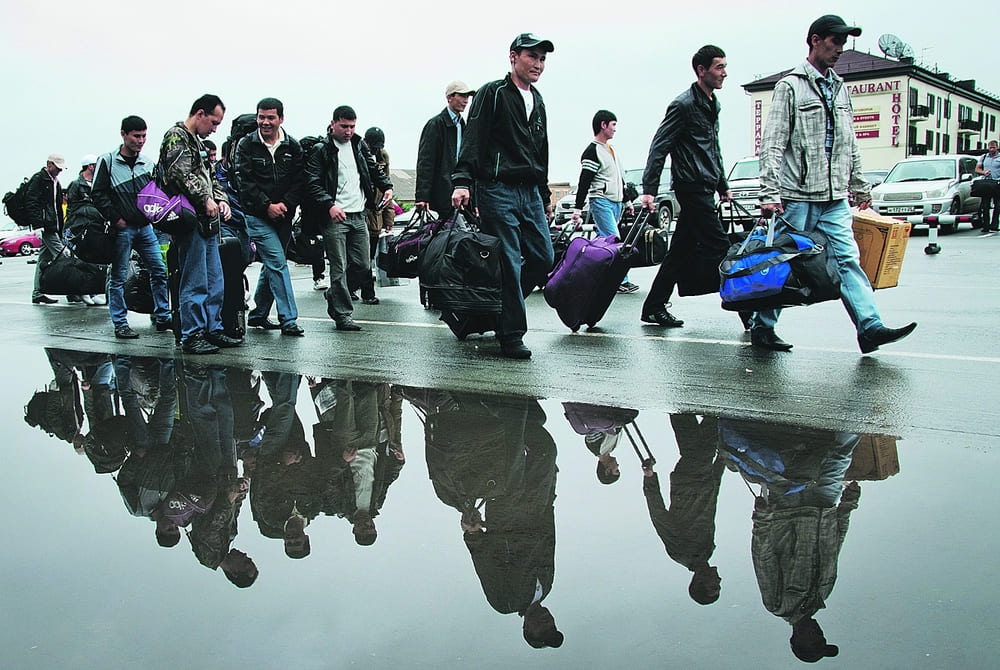
At the domestic level, climate stress is reshaping patterns of internal migration. Rural livelihoods in climate-sensitive sectors, especially agriculture and pastoralism, are becoming increasingly unsustainable due to drought, land degradation, and water scarcity. As a result, affected populations are moving toward urban centers such as Bishkek and Osh, seeking alternative economic opportunities. This rural-to-urban migration generates a distinct set of security challenges, including rising unemployment, expansion of informal settlements, and increased demand for already strained public services. As highlighted in projections by the World Bank, such internal displacement is likely to accelerate in the coming decades, potentially undermining urban stability if not managed through effective policy interventions.
Border Regions and Localized Insecurity
The security implications are particularly pronounced in border regions, most notably in the Fergana Valley, where demographic pressures, resource scarcity, and poorly demarcated boundaries converge. Climate-induced resource competition—especially over water and arable land—can exacerbate existing intercommunal tensions, increasing the likelihood of localized violence. In such contexts, migration is not merely a consequence of insecurity but also a factor that can reshape the demographic and political balance in contested areas, further complicating conflict dynamics.
Climate Migration and Indirect Security Risks
Importantly, while climate-induced migration may contribute to conditions associated with instability, its relationship with more acute security threats, such as radicalization or organized violence, remains indirect and contingent. Environmental stress and displacement can deepen socio-economic marginalization and weaken state presence in peripheral regions, thereby creating permissive conditions for non-state actors. However, empirical evidence suggests that such outcomes depend heavily on governance quality, state capacity, and the availability of economic alternatives, rather than on climate factors alone.
Governance, Legitimacy, and State Response
From a governance perspective, the management of climate-induced migration represents a critical test of state legitimacy in Central Asia. Governments’ ability—or failure—to respond effectively to environmental degradation, ensure equitable resource distribution, and accommodate displaced populations will significantly shape public trust and political stability. Weak or uneven responses risk exacerbating grievances, particularly in contexts where perceptions of corruption or regional inequality are already pronounced.
Regional Cooperation and Institutional Limits
At the regional level, climate-induced migration underscores the need for enhanced cooperation mechanisms. Existing frameworks, such as the International Fund for Saving the Aral Sea, provide a foundation for collective action but remain limited in scope and effectiveness. Strengthening such institutions, alongside developing coordinated approaches to water management and climate adaptation, will be essential to mitigating the long-term security risks associated with environmental change.
Conclusion
In sum, climate-induced migration in Central Asia should be understood not as a discrete security threat, but as a systemic stressor that interacts with water geopolitics, socio-economic fragility, and governance deficits. Its impact is most visible at the local and subnational levels, where it contributes to incremental instability rather than large-scale conflict. Recognizing this nuanced role is essential for developing policy responses that move beyond reactive security measures toward integrated strategies of adaptation, resilience, and regional cooperation.