On May 9, surrounded by the pageantry of Russia's 81st Victory Day, Vladimir Putin stepped before reporters in Moscow and announced that the war in Ukraine was "coming to an end." He said he was ready to meet Volodymyr Zelensky — in Moscow, or in a neutral country, any time. It sounded, on the surface, like an opening. Read the fine print and it was something else entirely: Putin would meet Zelensky only once the final terms of a settlement had already been agreed. The meeting he was offering was not a negotiation. It was a signing ceremony for a deal Ukraine had not made and would not make.
That empty offer is the image that defines May 2026. The choreography of diplomacy performed with full conviction; the architecture of peace absent. Three tracks — military, diplomatic, and geopolitical — moved at once in this period, and in opposing directions. Reading them together is the clearest guide to what comes next.
On the Ground: Ukraine Regains the Initiative
May opened with Russia's spring offensive visibly stalling. Ukrainian counterattack operations that began in late April continued through the month — pushing Russian forces out of several settlements in western Zaporizhzhia and consolidating gains in southern Ukraine that now total more than 400 square kilometres across winter and spring. Earlier recaptures around the Kupyansk axis represent Ukraine's most significant territorial recovery since the Kursk incursion of August 2024.
Russia still holds roughly a fifth of Ukraine's territory — somewhere between 18 and 20 percent, depending on how one counts the contested grey zones — and the Kremlin's stated goal remains the capture of all of Donetsk Oblast. Putin publicly claimed this month that Ukraine's share of Donetsk has shrunk from roughly a quarter of the region to between 15 and 17 percent. The number cannot be independently verified, but the sustained pressure on the Fortress Belt cities of Kostyantynivka, Pokrovsk, and Kramatorsk is real enough. By May 20, Russian forces in the Slovyansk direction had attempted advances and produced none. The Russian command had begun pulling units off the Kupyansk axis to reinforce Lyman — a redeployment a commander makes when he is short of men, not when he is winning.
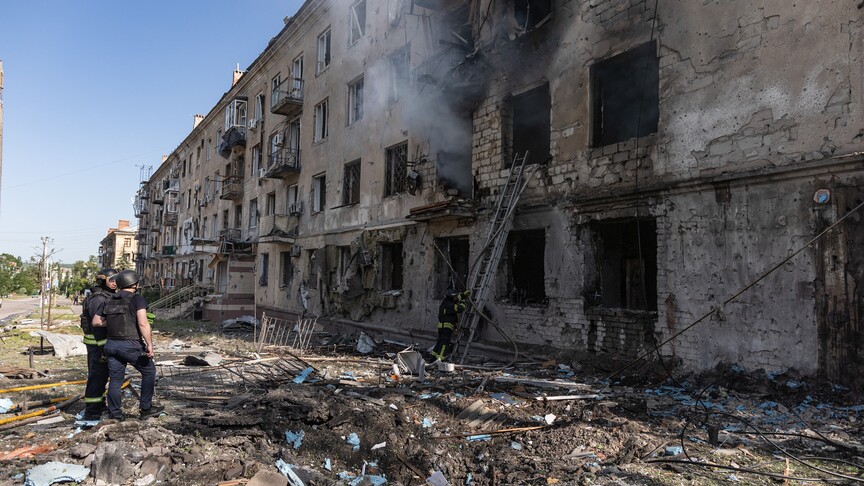
The defining tactical story of the month was not on the front line at all. It was hundreds of kilometres behind it. Ukrainian drones — produced at industrial scale and operated with growing precision — struck Russian command posts, supply depots, radar installations, and rear logistics throughout May. They hit gas platforms in the Black Sea. They reached a Russian repair unit in occupied Severodonetsk, nearly forty kilometres from the nearest front. The strikes on Russia's oil and energy infrastructure that began in April continued into May — systematic, repeated, hitting the same facilities over consecutive days until the damage compounded beyond repair.
The cumulative effect is a slow strangulation. Russia cannot move troops or supplies forward without exposure. It cannot stockpile for an offensive without watching the stockpiles burn. Ukraine has not broken through. It has imposed a different kind of war on the side that started it.
The Diplomatic Track: Rubble in Geneva, Theatre in Moscow
To understand May 2026's diplomatic landscape, one must start in February — because by May, the landscape had already been scorched.
Three rounds of US-mediated trilateral talks between Ukraine, Russia, and Washington took place in Abu Dhabi and Geneva between January and February 2026. All three failed, each in a manner that revealed something about Russia's actual intentions. The most instructive was the third round in Geneva on February 17–18. Hours before delegates arrived at the conference table, Russia launched one of its largest combined strikes of the year — 29 ballistic missiles and 396 drones across 12 Ukrainian regions, killing at least three people and targeting energy infrastructure. It was not an accident of timing. Zelensky said it plainly: "Russia greets with a strike even the very day new formats begin in Geneva." The second day of talks ended abruptly after just two hours. Both sides described them as "difficult." Russia had not moved a centimetre from its maximalist demands on territory. The US mediation team — led by Steve Witkoff and Jared Kushner — left without a breakthrough on anything that mattered.
By May, that channel had effectively seized up. Secretary of State Rubio, arriving in Rome, said the US mediation efforts had not led to a "fruitful outcome" and had "stagnated." The most powerful country on earth, with the most leverage over both parties, had run out of diplomatic runway — at least for the moment.
Into this vacuum came Victory Day. Russia and Ukraine declared competing ceasefires in the days leading up to May 9 — parallel, uncoordinated, and immediately undermined by both sides. Russia announced a unilateral truce from May 8–9 for the parade, threatening — in the same breath — a "massive missile strike on the centre of Kyiv" if Ukraine attempted to disrupt the celebrations. Ukraine declared its own separate ceasefire from midnight on May 5–6. Trump then announced a US-backed three-day truce for May 9–11 on Truth Social, which both Zelensky and Putin's adviser Ushakov nominally confirmed. None of it held. Ukrainian forces logged over 100 front-line clashes on the first day alone, with close to 150 combat engagements recorded in the 24 hours that followed. What had been framed to the world as a humanitarian pause was, on the ground, indistinguishable from any other week of the war.
It was against this backdrop that Putin stepped out on May 9 and delivered his offer. He said the conflict was moving toward conclusion. He said he was willing to meet Zelensky anywhere. He nominated Gerhard Schröder — the former German chancellor and longstanding Putin confidant — as his preferred interlocutor for any future security dialogue with Europe. And he clarified, with precision, the one condition attached to all of it: a meeting would happen only after final agreements had already been reached. Not to reach them. After. The offer had a shape but no substance. It was an invitation to a destination that required arriving first.
Zelensky's response was unambiguous. Ukraine would not negotiate under fire, would not legitimise territorial conquests as a precondition, and would not mistake the performance of peace for peace itself. The demand remained unchanged: a full and unconditional ceasefire, then talks, then a settlement built on Ukraine's territorial integrity.
What each side actually wants has not moved. Russia's minimum survivable outcome — de facto recognition of its territorial gains, Ukrainian neutrality, and a permanent ceiling on Kyiv's armed forces — is precisely what Ukraine cannot grant without ceasing to be Ukraine in any meaningful sense. Ukraine's baseline — stop the killing first, negotiate second — is what Russia treats as a trap. The gap between these positions is not a negotiating gap. It is a wall, and nothing in May 2026 brought either side a step closer to it.
The Western Architecture: Cracks in the Foundation
The third track running through May is the fracturing of the security architecture that has underwritten Ukraine's resistance since 2022.
Early in the month, the Trump administration cancelled the deployment of the "Black Jack" armoured brigade combat team — four thousand troops bound for Poland — despite the unit's departure ceremony having already been held at Fort Hood. It was the second European troop reduction announced in May alone, and on May 22, Washington formally reduced the forces it pledges to send to Europe in the event of war. The signal to Moscow could not have been clearer, and the signal to Kyiv was clearer still.
For Ukraine, the practical effect is a thinning weapons pipeline at exactly the moment it can least afford one. US deliveries are being delayed as Washington restocks munitions consumed in its Iran campaign, and European allies face the same bottleneck with American-manufactured systems for which no near-term alternative exists. Ukraine's electrical grid — operating at perhaps 30 to 40 percent of pre-war capacity, with no realistic prospect of full restoration before the next heating season — faces another winter in a degraded state.
For Europe more broadly, May has accelerated a reckoning already underway. Several NATO members — led by the Nordic-Baltic bloc and Poland — are developing alternative command and deterrence structures that could function without American leadership, or in spite of American obstruction. The Joint Expeditionary Force, a British-led ten-nation coalition, has emerged as the most operationally ready candidate. The Western security order that held for seventy-five years is not collapsing. But it is being redesigned under pressure, in real time, and without a clear blueprint.
What Comes Next
On the battlefield, Russia is expected to attempt a renewed summer push concentrated on the Donetsk axis — the drive toward Kramatorsk and Kostyantynivka. The challenge for Moscow is one of distribution. Ukrainian operations in southern Ukraine have already forced its command to choose between defending what it holds and pressing what it wants — a strategic dilemma Russia has not faced at this scale since 2023. Whether Ukrainian pressure can sustain that dilemma through the summer, or whether Russia absorbs the cost and grinds through, is the military question of the season.
Diplomatically, the US-mediated channel has stalled and the Victory Day theatre has passed. What remains is the question of whether Trump's frustration with Russian intransigence — visible and growing — eventually converts into concrete pressure on Moscow: tighter sanctions, resumed arms flows, a harder line. That conversion, or its absence, will define the war's trajectory through the second half of 2026 more than any battlefield development.
Structurally, the war is entering a phase in which neither side can win decisively in the field but neither faces sufficient pressure to accept the concessions peace would require. The most likely near-term path is more of what May produced: ceasefires that collapse on contact, diplomatic gestures that generate headlines but not results, and a slow drift toward a frozen conflict that locks in today's lines without resolving any of the underlying contest.
The question is no longer whether this war ends in 2026. It will not. The real question is whether the diplomatic infrastructure being built around it — imperfect, performative, increasingly strained — holds long enough to matter when exhaustion finally creates the conditions for a genuine settlement.
On the evidence of May, that moment has not arrived. Putin's offer is on the table. It is, as offered, empty. And the war continues.