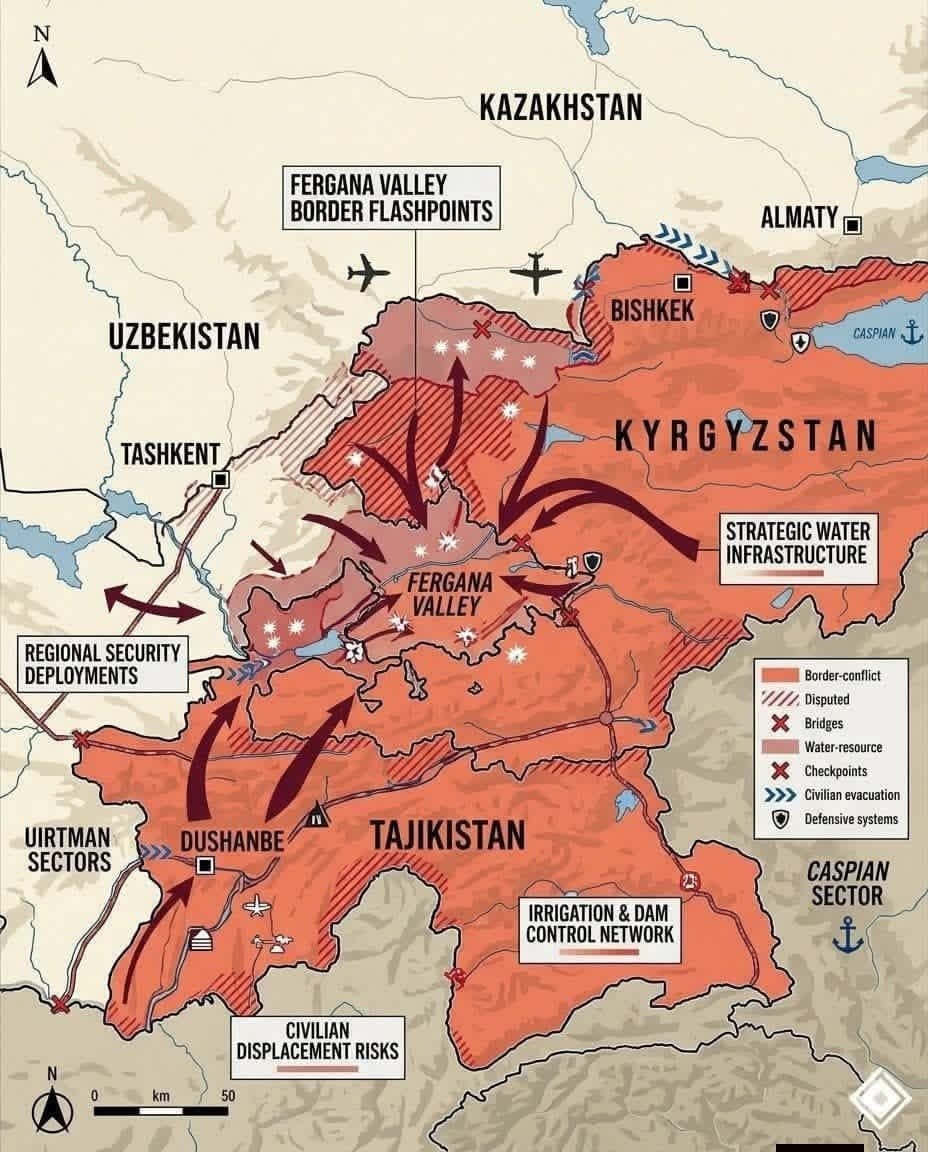
On 20th of May, The United Nations General Assembly adopted by consensus Kyrgyzstan's resolution "Peaceful Resolution of Border Disputes," prepared jointly with Tajikistan and Uzbekistan and with the support of more than 40 countries. The document reflects the experience of Central Asian countries in peacefully resolving border issues through dialogue, negotiations, and international law. The resolution emphasizes that border disputes should be resolved exclusively peacefully and by mutual consent. Bishkek believes that Central Asia's experience can serve as an example of good-neighborliness and a contribution to international security.
The text also recalls Kyrgyzstan's progress in resolving border issues with its neighbors. In 2023, Kyrgyzstan and Uzbekistan completed the delimitation of their shared border, resolving issues around the Kempir-Abad reservoir and territorial exchange. Particular attention is paid to the Kyrgyz-Tajik border, which has previously seen armed clashes, including the September 2022 conflict that resulted in numerous casualties and mass displacement. Following this, the parties intensified negotiations, fully agreed on the disputed areas by the end of 2024, and in March 2025, Presidents Sadyr Japarov and Emomali Rahmon signed a border agreement and reopened the closed checkpoints.
It is time for ordinary people to be proactive in promoting peace between their countries
While official negotiations and interstate agreements remain essential for resolving border disputes in Central Asia, long-term peace and regional stability ultimately depend on the success of people-to-people diplomacy. In regions affected by historical grievances, ethnic divisions, and recurring border tensions, sustainable reconciliation cannot be achieved solely through political agreements signed by governments. Trust must also be rebuilt among ordinary citizens living along contested frontiers.
People-to-people diplomacy refers to direct interaction, communication, and cooperation between societies, communities, educational institutions, cultural groups, civil society organizations, and local populations across borders. In the Central Asian context, such diplomacy has become increasingly important because many border conflicts — especially between Kyrgyzstan and Tajikistan — are rooted not only in territorial disagreements but also in deteriorating social relations among neighboring communities.
For decades, residents of border regions in the Ferghana Valley shared common markets, water systems, schools, cultural traditions, and family ties. However, repeated clashes, militarization, nationalist rhetoric, and border closures gradually deepened mistrust. Violent confrontations in 2021 and 2022 between Kyrgyzstan and Tajikistan severely damaged social cohesion, displaced thousands of civilians, and created psychological trauma on both sides.
In this environment, people-to-people diplomacy plays several critical roles.
First, it helps reduce mutual mistrust and humanize the “other side.” Political conflicts often create narratives that portray neighboring populations as enemies. Direct engagement through cultural exchanges, youth forums, academic cooperation, and local dialogue initiatives can challenge stereotypes and reduce hostility. When communities interact regularly, they become less vulnerable to nationalist propaganda and disinformation. Second, local-level cooperation contributes to conflict prevention. Many border disputes in Central Asia emerge from practical everyday issues such as access to water, roads, pastureland, or markets. Community-based dialogue mechanisms involving local elders, civil society representatives, women’s groups, and municipal leaders can help address disputes before they escalate into violence. Informal communication channels often prove faster and more flexible than official diplomatic structures.Third, people-to-people diplomacy strengthens economic interdependence. Cross-border trade, joint markets, tourism, and small business cooperation create shared economic interests that encourage stability. Communities benefiting economically from peaceful relations are less likely to support escalation or confrontation. In Central Asia, reopening border crossings and restoring local commerce can significantly improve livelihoods in underdeveloped frontier regions.
Educational and academic exchanges also carry long-term importance. Universities, think tanks, and research institutions across Central Asia can promote regional understanding through joint projects, conferences, and student exchanges. Shared research on water management, climate change, migration, and regional history may help create a more cooperative regional identity beyond narrow nationalism.
Youth engagement is particularly important. Younger generations in Central Asia increasingly communicate through digital platforms and social media. While these technologies can spread misinformation and nationalist sentiment, they also offer opportunities for dialogue and regional networking. Programs connecting young leaders from Kyrgyzstan, Tajikistan, Uzbekistan, and other Central Asian countries can help cultivate a future generation more committed to cooperation than conflict.
Religious and cultural diplomacy may also serve as unifying factors. Central Asian societies share deep historical, linguistic, and cultural connections shaped by centuries of coexistence along the Silk Road. Reviving awareness of common heritage can strengthen regional solidarity and reduce perceptions of division.
At the same time, people-to-people diplomacy faces important challenges.
Political systems operating within each countries of the region various from one another. Additionally, nationalist narratives, political sensitivities, restricted border regimes, and lack of institutional support can limit grassroots engagement. In some cases, governments remain cautious toward independent civil society initiatives in border regions due to security concerns. Therefore, successful people-to-people diplomacy requires not only local enthusiasm but also political support from state institutions.
Ultimately, durable peace in Central Asia cannot rely exclusively on military deterrence or elite-level agreements. Border treaties may define territories, but reconciliation between societies defines whether peace will endure. The experience of Kyrgyzstan and Tajikistan demonstrates that without rebuilding trust among ordinary citizens, even formally resolved borders may remain vulnerable to renewed tensions.
Therefore, alongside diplomatic negotiations and security arrangements, Central Asian states should invest more actively in cultural exchanges, educational cooperation, local dialogue initiatives, joint economic projects, and youth engagement programs. People-to-people diplomacy remains one of the most effective tools for transforming inter-state agreements into lasting regional peace.
Erkinbek Kamalov