Executive summary. On June 14–18, 2026, after a roughly four-month war touched off by U.S.–Israeli strikes on Iran in February, Washington and Tehran signed a 14-point memorandum of understanding (MoU) to halt hostilities. It is a framework, not a final peace: it suspends the Strait of Hormuz blockade, opens a 60-day window to negotiate Iran's enriched-uranium stockpile, and dangles sanctions relief, asset releases, and a reconstruction fund of at least $300bn. Direct talks in Switzerland produced a “roadmap” toward a final deal but left the hardest questions — enrichment, inspections, and who controls Hormuz — unresolved.
Bottom line: The MoU is, in the words of one assessment, “all carrot and no stick.” It trades cash and legitimacy for nuclear restraint that is promised but not yet verified. Iran's clerical-military leadership emerges intact and cash-hungry; the United States gets lower oil prices and an exit from an unpopular war; Israel and Iran hawks see strategic objectives abandoned. The agreement could endure if economic incentives hold — or unravel on inspections, a Lebanon flare-up, or domestic politics in either capital.
1. What the MoU Means in Practice
A memorandum of understanding is a political commitment, not a binding treaty. It records intentions and a sequence of steps, but it carries no automatic enforcement and can be reversed by either government. That distinction matters here: the document ends the shooting phase of the war and sets a 60-day clock, but it converts almost none of its promises into legally guaranteed outcomes. In practice, the MoU does four things.
- Stops the fighting and reopens the strait. Both sides commit to an “immediate and permanent termination of military operations on all fronts, including in Lebanon.” The U.S. agrees to lift its naval blockade within 30 days and withdraw forces within 30 days of a final deal; Iran agrees to clear mines and allow commercial vessels safe passage, toll-free, for 60 days.
- Defers the nuclear question. Iran “reaffirms that it shall not procure or develop nuclear weapons” and agrees to resolve its stockpile of roughly 440kg of 60%-enriched uranium through a mutually agreed mechanism — “at minimum” on-site down-blending under IAEA supervision. Crucially, the technical details are left to later talks.
- Opens the door to money. The U.S. “undertakes to terminate all types of sanctions” on an agreed schedule, to unfreeze assets, and — “with regional partners” — to assemble at least $300bn for reconstruction. Gulf states are the implied funders; Washington insists U.S. taxpayers will not pay.
- Preserves sovereignty and drops regime change. Each side pledges to “refrain from interfering in each other's internal affairs,” effectively shelving the regime-change aims voiced early in the war.
The catch. The MoU is deliberately ambiguous on its two most consequential issues. On Hormuz, international law bars tolls for transit through natural straits, yet Iran's lead negotiator has said the strait “will not return to pre-war conditions” and that Iran will “receive a fee for services.” On the nuclear file, down-blending is irreversible and verifiable in principle, but the timing, the fate of the remaining programme, and the scope of inspections are all unsettled. The agreement, in short, buys time and lowers temperature without settling the underlying contest.
2. Recent Talks: A Roadmap, Then a Snag
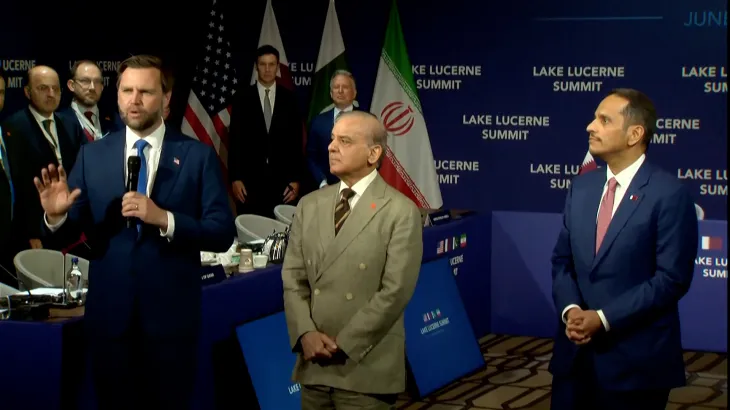
Direct U.S.–Iran negotiations — the first sustained channel since 1979 — opened in Switzerland on June 21, 2026, mediated by Qatar and Pakistan. Within two days the mediators announced agreement on a “roadmap toward reaching a final deal within 60 days,” and Vice-President J.D. Vance said the talks set a “good foundation.” Negotiators split into working groups on sanctions relief, the nuclear file, reconstruction, and monitoring. Tehran reported tangible early wins: the U.S. Treasury issued a 60-day waiver letting Iran sell oil and petrochemicals, and Iranian officials said roughly $12bn in frozen assets would be released.
The process is fragile. A presidential threat to “take over” the Strait of Hormuz and resume strikes if Iran did not rein in Hizbullah briefly prompted Iranian negotiators to walk out. And as of June 23–24, a public dispute erupted over inspections: Vance said Iran had agreed to readmit IAEA inspectors, while Tehran denied any such commitment to inspect its war-damaged sites. IAEA Director-General Rafael Grossi insisted oversight “is going to happen.” The gap between what each side says it agreed to is itself a warning about how much remains unresolved.
The politics are equally turbulent. The agreement has drawn bipartisan criticism in Washington — from Republicans calling it a surrender to Democrats branding it a “horrific” capitulation — and on June 23 the U.S. Senate passed a war-powers resolution (50–48) directing the removal of forces, a symbolic rebuke that does not carry the force of law. In Tehran, pragmatists led by parliamentary speaker Mohammad Bagher Ghalibaf are selling the deal as “a great stride to final victory,” while a hardline base mocks it as another Trumpian trick.
3. What Each Side Gets
The asymmetry is structural: Iran's gains are concrete and near-term — money, relief, survival — while Washington's are partly conditional (a nuclear pledge yet to be verified) and partly defensive (avoiding worse outcomes).
What Iran Gets
Sanctions relief and cash
A 60-day oil and petrochemical waiver, the release of frozen assets (around $12bn agreed so far), and the promise to terminate sanctions on an agreed schedule.
Reconstruction windfall
A pledged fund of at least $300bn for rebuilding — potentially Iran's largest external inflow in decades.
Regime survival and legitimacy
Regime change is off the table and sovereignty is affirmed. The clerical-military elite emerges intact and validated.
Strait leverage retained
Iran keeps its hand on Hormuz and signals it will charge “service fees,” preserving its single greatest source of leverage.
Missiles and proxies untouched
There are no limits on ballistic missiles or support for proxies; Iran preserves its regional network and deterrent.
What the United States Gets
Lower oil prices and an exit
Crude fell toward $72 from war-time peaks, and a politically toxic war is wound down ahead of the November midterms.
Hormuz reopened
Restored commercial traffic through the world's most important oil chokepoint, easing a global supply shock.
A nuclear pledge (on paper)
Iran's reaffirmed commitment not to build a bomb, plus agreement to down-blend its 60% stockpile under IAEA supervision.
A strategic off-ramp
A face-saving end to a war that failed its stated aims, and the option to claim a diplomatic “win” without further escalation.
Reduced escalation risk
A pause that lowers the odds of a wider regional war and relieves pressure on depleted U.S. munitions and reserves.
4. Winners and Losers
Iran's ruling elite — Winner
The war rallied a wobbling regime, and the deal offers its biggest cash windfall in decades with no concession on missiles, proxies, or political survival.
Trump administration — Mixed
Gains an off-ramp, lower fuel prices, and a claimed diplomatic win — but at the cost of prestige, abandoned war aims, and bipartisan backlash.
U.S. consumers and the global economy — Winner
Falling crude and a reopened Hormuz ease prices and supply risk, though buffers (a near-empty Strategic Petroleum Reserve) are thin.
Israel — Loser
Fought alongside the U.S. yet was cut out of the talks; the deal leaves Iran's programme, missiles, and Hizbullah largely intact — a strategic disappointment.
Iran hawks and regional skeptics — Loser
Critics in both U.S. parties and in Gulf capitals see economic pressure abandoned and a hostile regime rewarded and emboldened.
Iran's people and reformists — Uncertain
Relief may ease economic pain (84% inflation, mass layoffs), but the hardliners' ascendancy dims hopes of political opening; protests were crushed.
Gulf states — Mixed
Welcome de-escalation and reopened shipping, but face an emboldened Iran, an implied $300bn bill, and doubts about U.S. reliability.
California pistachio growers (a curiosity) — Fading
War-time supply gaps drove record prices; peace is expected to restore Iranian exports and erase a short-lived windfall.
5. Iran at the World Cup: The Deal's Mirror
The contradictions of the U.S.–Iran relationship are on vivid display at the 2026 FIFA World Cup, co-hosted by the United States, Mexico, and Canada — held in the same weeks the MoU was signed. Iran qualified in Group G (with Belgium, Egypt, and New Zealand) and, despite the war, FIFA confirmed it would play all three group matches on U.S. soil: against New Zealand and Belgium at SoFi Stadium near Los Angeles, then Egypt in Seattle. The optics are striking — Iran's national team competing in the territory of the state that, months earlier, was bombing it.
Visas, vetting, and a relocated training camp
Participation was heavily constrained. At FIFA's suggestion, Iran moved its training base from Tucson, Arizona, to Tijuana, Mexico, and the squad flew in via Turkey. The U.S. State Department said visas for players and “necessary support staff” were issued, but it openly framed the vetting in security terms — vowing not to let Iran “sneak terrorists” into the country, with Secretary of State Marco Rubio warning that anyone tied to the Islamic Revolutionary Guard Corps would be excluded. Roughly 14 staff members were denied visas, including a federation vice-president, and Iran was reportedly told the team had to enter and exit U.S. soil around match days (a claim its federation disputed). Forward Mehdi Taremi said the restrictions had created “a lot of tension” and hurt the host's image; teammate Alireza Jahanbakhsh described the difficulty of focusing while “checking on your family” back home.
Fans frozen out by sanctions
The treatment of supporters is the sharpest example. Iran's fans are subject to a U.S. travel ban affecting several qualified nations (alongside Côte d'Ivoire, Haiti, and Senegal), barring most from attending unless they hold pre-existing visas or narrow exceptions. FIFA then revoked Iran's standard supporter ticket allocation (about 8% of stadium capacity) because U.S. sanctions — via the Office of Foreign Assets Control — prevent U.S.-based organizers from processing transactions involving Iranian residents. FIFA said it was seeking “compliant solutions” for Iranian fans living outside the country; the Los Angeles area's roughly 140,000-strong Iranian diaspora may furnish much of Team Melli's live support.
Analytical read. The World Cup is a microcosm of the MoU's central tension. At the diplomatic table, Washington is extending Iran economic relief; at the stadium gate, the same sanctions architecture and security suspicion still wall Iranians out. A possible U.S.–Iran knockout match in the round of 32 would crystallize the paradox: adversaries at war in February, trade partners-in-waiting in June, opponents on the pitch in July. Sport here is not an escape from politics — it is a live test of whether engagement or estrangement defines the next phase.
6. Scenarios (12–24 Months)
A. Transactional Stabilization — “Cash for Calm” (Most likely)
Economic incentives prove decisive. Iran down-blends its stockpile under limited IAEA oversight, oil keeps flowing, assets unfreeze, and reconstruction money begins to arrive. A final deal — narrower than the JCPOA — formalizes the truce. Neither side fully trusts the other, and missiles and proxies remain off-limits to negotiation, but a fragile, interests-based peace holds. Israel grudgingly adapts, as it did to the JCPOA, shifting from confrontation to a quieter shadow war.
B. Slow-Motion Collapse — “Talks to Nowhere” (Plausible)
The 60-day window expires without a final agreement. The inspections dispute hardens, Iran “strings things along” on its programme, and sanctions relief stalls amid U.S. domestic opposition. The ceasefire endures in a degraded form — no new war, but no settlement either — leaving a frozen, militarized standoff vulnerable to any spark. A new U.S. administration after 2028 could tear up the framework, as happened to the 2015 accord.
C. Rupture — “Back to the Brink” (Lower, but real)
A trigger — an Israeli strike on a nuclear site, a Hizbullah-Israel escalation in Lebanon, a Hormuz incident, or a unilateral U.S. move — shatters the MoU. Hardliners in Tehran, already calling the deal a trap, are vindicated; Iran reconstitutes or dashes toward a weapon. With U.S. munitions depleted and the Strategic Petroleum Reserve near empty, a renewed conflict would be costlier and harder to contain than the first.
D. Iranian Domestic Realignment — “The Opening” (Wildcard)
Sanctions relief and the succession struggle after Ayatollah Khamenei's death empower pragmatists; Iran edges toward a Gulf-style social and economic liberalization while keeping its security posture. Less likely near-term given the hardline ascendancy and an unresolved, hidden succession (Mojtaba Khamenei has yet to appear publicly), but a structural possibility if the windfall is large enough to buy off the revolutionary base.
7. Risks and Opportunities
Risks
For the United States
Rewarding a hostile regime without verified nuclear limits; ceding leverage; bipartisan and allied backlash; a thin Strategic Petroleum Reserve buffer against the next shock.
For Iran
Dependence on a deal a future U.S. president could revoke; a hardliner revolt against “selling out”; surrendering nuclear leverage for money that may not fully arrive.
For the region
Israeli spoiler attacks; a Lebanon flare-up dragging signatories back in; an emboldened Iran and its proxies; a nuclear-latent Iran spurring Gulf hedging.
Opportunities
For the United States
Locking in lower oil prices, an exit from an unpopular war, and a template for managing — rather than fighting — Iran; political credit if calm holds.
For Iran
A historic economic lifeline; relief from 84% inflation and mass unemployment; reintegration into global oil and finance; regime consolidation.
For the region
De-escalation and reopened shipping lanes; space for Gulf-Iran détente and diversified security; a possible off-ramp from years of proxy conflict.
Assessment
The MoU is best understood as a wager that Iran wants money more than the bomb — and that incentives can do what airstrikes could not. It is a plausible bet, but a fragile one. Its survival depends less on the text than on three variables outside the document's control: whether verification can be made credible, whether Israel and Lebanon stay quiet, and whether politics in Washington and Tehran reward dealmakers over spoilers. The most likely path is a transactional, interests-based stabilization that falls well short of resolution — neither the breakthrough its architects claim nor the surrender its critics decry, but a managed, reversible truce that buys time while the deeper contest endures.